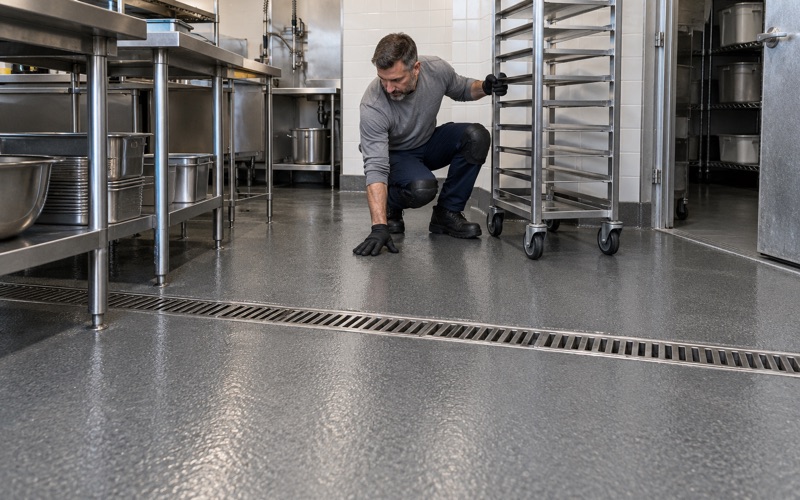
Schaumburg Epoxy Flooring brings more than 20 years of epoxy flooring work to Western Springs, and in this village the floors worth a closer look are not in industrial parks, because there are almost none. They sit behind civic buildings instead: a scene shop where flats get built and painted, a backstage corridor that carries rolling scenery, a school locker room that stays damp through most of the academic year.
Those jobs follow different rules than a garage. The schedule answers to a rehearsal calendar or a bell schedule, the sign-off comes from a facilities manager or a board rather than one homeowner, and the floor has to take paint, water, cleaning chemicals and foot traffic in combinations a house never sees.
Whatever the building, our method stays put. We open the concrete mechanically, list moisture testing as its own line in the scope, and hand over a proposal naming the product, the system and the finished thickness, so the floor that goes down can be checked against the one that was quoted.
A Community Theater Since 1929 and a High School Campus
Two institutions anchor the civic side of the village. The Theatre of Western Springs has been part of the community since 1929, and Lyons Township High School District 204 operates its South Campus here. Both are large public buildings with rooms visitors rarely see, and those back rooms are where a floor coating has to earn its place.
Neither is a client of ours, and we have not surveyed their floors. We name them because they show what kind of non-residential floor a village like this actually holds: production space, athletic support space and the service rooms that keep a public building running. A church fellowship hall or a club’s meeting rooms raise many of the same questions on a smaller scale.
What sets these floors apart from a house
A garage floor sees one or two cars and a winter of salt. A production or school floor sees rolling loads, spilled paint and solvent, daily mop water and, in a school, the steady grit of hundreds of shoes. That shifts the system toward thicker 100% solids epoxy body coats, a quartz aggregate broadcast where traction matters, and a topcoat picked for chemical and abrasion resistance rather than shine.
The village around them
Western Springs is a village in Lyons Township, Cook County, incorporated in 1886. Its fire department, established in 1894, is municipal, and the village’s building authority works out of village hall on Hillgrove Avenue. On a civic coating project, those offices can matter alongside the owner’s own facilities staff, particularly where exits, corridors or occupancy are involved.
Looking for epoxy-flooring closer to Pingree Grove? See Epoxy-Flooring in Pingree Grove.
Behind the Curtain: Scene Shop, Backstage and Wing Floors
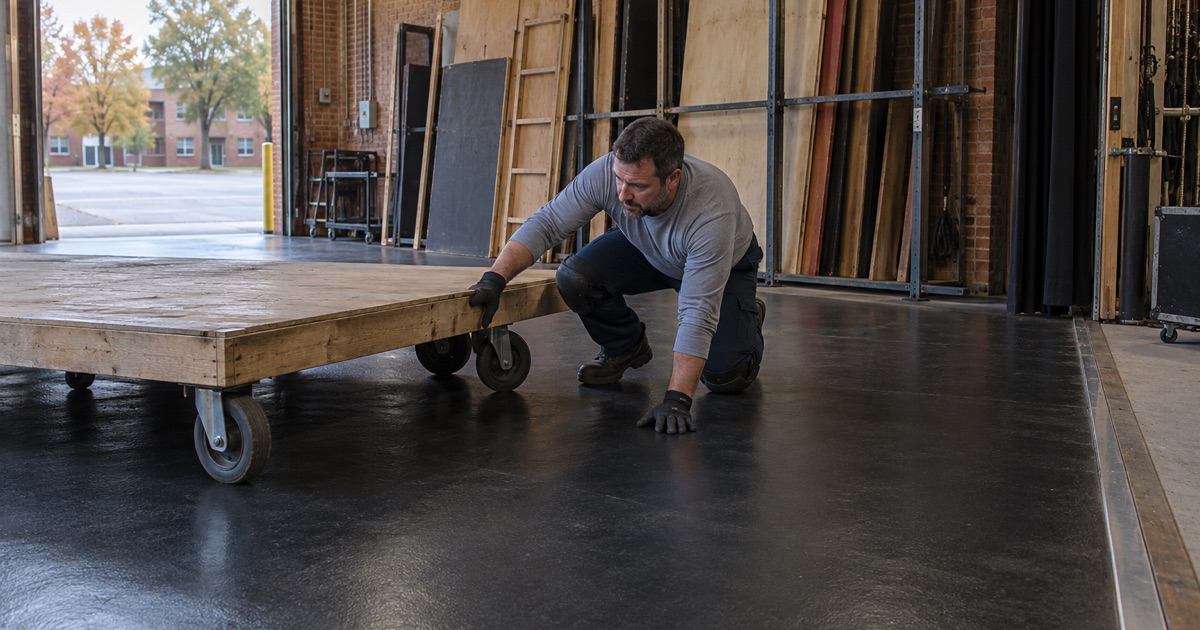
Backstage space at a community theater tends to pack several uses into a tight footprint. A scene shop builds and paints, the wings store and move scenery, and the corridors behind the stage carry actors, crew and costume racks between them, often under low light.
Scene shop floors
A shop floor takes sawdust, dropped hardware, glue, and paint that gets spattered on purpose and spilled by accident. A broadcast floor built on 100% solids epoxy with a polyaspartic or urethane topcoat cleans up far more easily than bare concrete, and the topcoat choice decides how well it stands up to solvents and scraping. We check any existing paint or sealer before quoting, since a new coating laid over an old film holds only as well as that film does.
Rolling platforms and loaded carts press on a floor at a single point. Where a slab is cracked, spalled or out of level, the proposal says so and prices the repair as its own item. A coating is a thin film that follows the concrete beneath it, and we tell an owner plainly that it will not hold a moving crack closed.
Wings and crossover corridors
Wings and crossovers need grip more than gloss, because crew move quickly in the dark between scenes. A fine quartz broadcast in the body coat gives traction without making the floor hard to sweep, and a satin or matte topcoat cuts glare under work lights. Painted guide lines and how the finish takes tape are worth settling with the stage manager before the job, not after.
A stage deck itself is often timber, and our work is concrete. If a performance surface turns out to be wood, we say it falls outside our scope rather than stretching a concrete system across it.
Preparation inside an occupied building
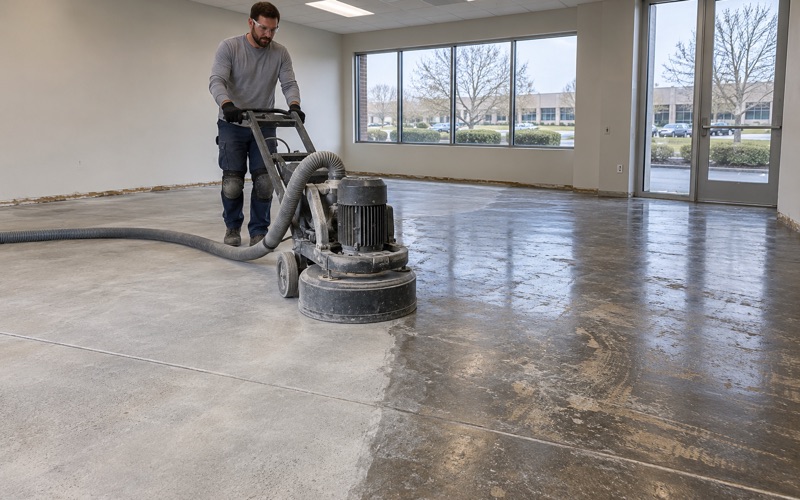
Opening concrete inside a public building is loud, dusty work, so we plan it carefully. We use diamond grinding with vacuum capture or shot blasting and never acid etch, which leaves a measurable surface profile in the ICRI CSP range the product calls for, without rinse water running across a shop. Testing comes before any material is ordered, with ASTM F2170 in-situ humidity probes or ASTM F1869 calcium chloride kits, because a lower-level room or a slab without a vapor retarder can push moisture up through a fresh coating.
We do not treat the plastic sheet test, ASTM D4263, as the deciding reading, since it shows that moisture is moving without saying how much. When the numbers come back high, the scope changes to include a moisture-mitigation primer under the system, and the warranty language changes with it, which we walk through before anyone signs.
Locker Room and Corridor Floor Coatings at a School
A high school campus such as Lyons Township High School’s South Campus shows what a school floor has to survive. We have not worked there, and nothing on this page describes its existing finishes. What follows is how we approach the categories of floor a school building of that size typically contains.
Locker rooms and team areas
Locker rooms are wet much of the day, cleaned with strong chemicals and crossed in wet shoes or bare feet. That calls for a textured broadcast finish, attention to slope toward floor drains, and careful detailing around the drain bodies, where coatings most often let go first. Urethane cement is worth weighing where hot water and heavy sanitizing are routine, since it tolerates thermal shock better than a standard epoxy.
Gym corridors and service rooms
The corridors outside a gym take street grit, salt-crusted boots in winter and equipment carts. Calcium chloride and rock salt deicers are hard on bare concrete, and a sealed, coated surface keeps that brine from soaking into the slab. Custodial closets, mechanical rooms and loading areas usually want a tough, easily mopped surface more than a decorative one, and either a vinyl flake broadcast or a solid color serves.
Concession and kitchen floors
Where a building serves food, the floor answers to the Cook County Department of Public Health, which covers suburban Cook outside a handful of municipalities that run their own departments. Illinois has adopted the 2022 FDA Food Code, and its floor provisions, including coved floor and wall junctures, shape what we propose for a concession stand or a teaching kitchen. We raise those details with the facility before a system is chosen.
Products for occupied buildings
Schools and theaters fill with people again soon after the work, so every product we select falls within the Illinois limits on VOC content for architectural coatings. Those limits bind the applicator as well as the manufacturer. High-solids, low-odor systems also shorten the wait before a room can be used again.
Fitting the Work Between Productions, Terms and Everything Else
A coating needs time for preparation, application and a cure before it carries traffic. At a theater that means a window between productions, when the shop is not mid-build and the wings are not full of scenery. At a school it usually means summer break or a long holiday, when corridors and locker rooms sit empty.
Planning with a facilities team
We start by asking for the calendar, not the square footage. A scene shop might be free between closing one show and starting the next build, and a school may want work phased so one locker room stays open while another is coated. The written proposal then lays out the sequence, the cure times, and when each area can take foot traffic and when it can take carts.
Cure is also an air-handling question in a building with its doors shut. Cool, humid air over fresh epoxy can leave amine blush, a waxy film that has to be cleaned off before the next coat, so we coordinate with whoever runs the mechanical systems while the work is underway.
Illinois issues no state license for coatings work, so local rules carry the weight. Before anything is scheduled, we confirm the Village of Western Springs’ requirements for contractor registration, bond and insurance, and we ask the permit desk whether the job counts as decorating or needs a permit.
A village of houses, and little else
Outside its civic buildings, Western Springs is overwhelmingly residential. The 2024 American Community Survey five-year estimates count 4,275 owner-occupied units out of 4,471 occupied units, or 95.6 percent, and single-family detached houses make up the great majority of the housing. There is very little warehouse or factory floor here to speak of.
For a homeowner, the job runs under the Illinois Home Repair and Remodeling Act, so a written contract and the state’s consumer-rights pamphlet come before any grinding starts. We go through warranty exclusions out loud before the sale, moisture first, and any crack or spall repair a slab needs is named in the quote rather than found halfway through.
Basement floors get the same honesty. A coating is not a radon fix, and in Illinois that work belongs to a contractor holding an IEMA radon mitigation license, so we never sell it as one. What we can do is test the slab, pick a system matched to what the test shows, and put the result in writing.
- 20+ Years Coating Floors
- Moisture Tested Before Coating
- Written Contract on Every Home Job