Schaumburg Epoxy Flooring has spent more than 20 years on concrete, and our epoxy-flooring in Westchester work is almost entirely the second life of a floor rather than its first. The slab is already there, usually with decades of use behind it, and often with a coating, a sealer or a paint job someone put down years ago. That changes how a floor gets quoted, prepared and built.
A renovation floor rewards patience at the start. We look at what is on the concrete, test what is in it, and decide whether it can carry a coating at all before anyone talks about flake colors or topcoat gloss. When a slab needs repair first, we say so in the proposal instead of hiding it under a broadcast.
The proposal itself is written to be checked. It names the product, the system build and the finished thickness, so the floor that goes down can be compared line by line with the floor that was sold. Moisture testing sits in that scope as its own line, not as an upsell after a blister appears.
A Village With Almost Nowhere Left to Build
The Cook County hazard mitigation plan’s annex for Westchester describes the village as primarily residential and built-out, with few developable parcels left. Its edges are already spoken for: Forest Preserve District land, cemeteries and a golf course ring the village, so there is little room for a new subdivision to appear. For a flooring contractor, that settles what kind of work exists here.
A built-out village does not stop needing floors; it just stops producing new ones. Garages get cleared out after a move, basements get finished for a growing family, and a tired floor gets fixed before a house is listed. Each of those jobs begins with a slab that someone else poured, cured and used long before we arrived.
208 homes since 2000
Census figures count 7,181 housing units in Westchester, and only 208 of them were built in 2000 or later. Of those, 182 date from 2000 to 2009 and 26 from 2010 to 2019, with none counted from 2020 on. New construction is a rounding error in this market; renovation is the market.
That means the garages, basements and utility rooms we see here were poured long before today’s products existed. Many have been painted, patched or sealed more than once, and the record of what went on them is usually gone. Every one of those layers matters to the next coating.
Owners who stay with the floor
Of 6,908 occupied units, 6,275 are owner-occupied, which works out to 90.8 percent. The person asking for a quote is usually the person who will park on the floor, store bikes on it and clean it for years afterward. We write scopes for that reader, with the trade-offs spelled out rather than smoothed over.
Looking for epoxy-flooring closer to River Forest? See Epoxy-Flooring Services in River Forest.
The 2012 International Codes, and Why the Edition Matters to a Spec
Westchester reports that it has adopted the 2012 International Codes, enforced through the village’s Community Development and Building Department. Codes are revised on a cycle, and the edition a village actually enforces is the one a specification has to answer to. We confirm the edition in force with the Building Department before we write a spec, rather than assuming the newest book applies.
What the code does and does not say
The building code does not prescribe a floor coating. No edition tells a homeowner to install epoxy, and we never sell a coating as something the village requires. What the code does shape is the concrete under the coating, and that is where the edition becomes useful to us.
The residential code has long exempted garage slabs from the under-slab vapor retarder required elsewhere. A garage poured to code may have nothing between the concrete and the soil, which is why we test a garage slab for moisture just as carefully as a basement. A code-compliant slab is not automatically a dry one.
Permits and registration, asked rather than assumed
We have not been told that a floor coating needs a permit in Westchester, and we have not been told it does not. Before a job is scheduled, we ask the village permit desk whether the work counts as decorating or needs a permit. We also confirm the village’s own contractor registration, bond and insurance rules, because Illinois issues no state license for flooring or coatings work.
The same honesty applies to radon. A floor coating is not radon reduction, and in Illinois that work takes a radon mitigation license from IEMA. We keep coatings and mitigation separate in every conversation.
Existing Slabs, Existing Coatings, Existing Drains
Renovation work starts with reading the floor in front of us. Old paint, peeling sealer, oil stains, saw cuts, patched cracks and a floor drain someone set decades ago all tell us what the next system has to deal with. We read the cracks and the old coating before quoting, not after the grinder is running.
Opening the slab, never etching it
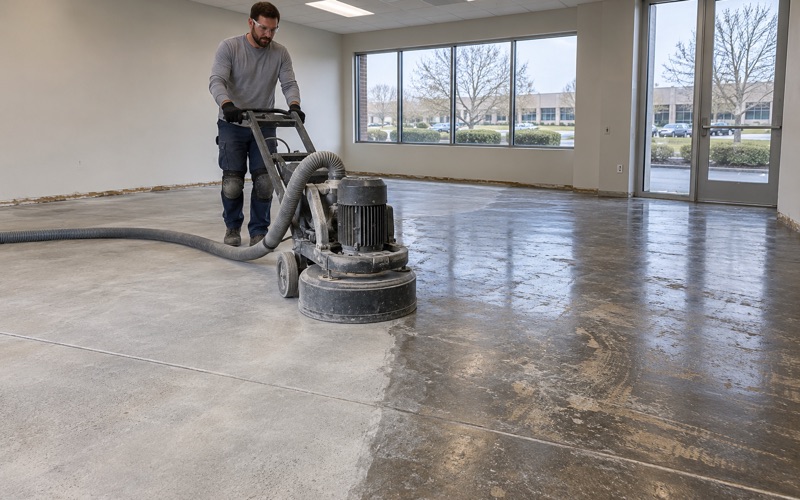
Every floor we coat is opened mechanically, with diamond grinding or shot blasting, to a profile the system calls for on the ICRI CSP scale. We do not acid etch. On an older slab, grinding also removes the failing coatings and contamination that an etch would simply wet and leave behind.
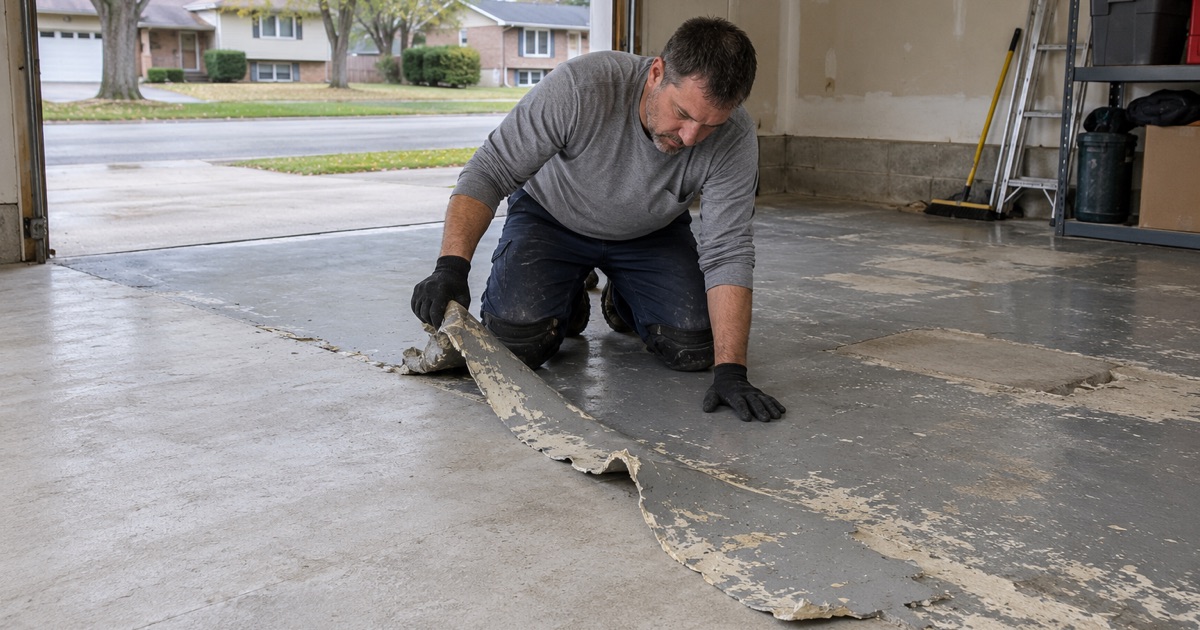
Where a previous coating is still bonded and sound, we tell you whether it can be ground back and overcoated or whether it has to come off entirely. Where it is lifting, it comes off. Building a new 100% solids epoxy over a layer that is already letting go only moves the failure up one level.
Moisture, measured on every slab
A basement slab and a garage slab both get a moisture test before we commit to a system. Depending on the floor, that can be ASTM F1869 calcium chloride testing, ASTM F2170 in-situ relative humidity probes, or a quick ASTM D4263 plastic sheet check to decide whether more testing is needed. Efflorescence on an old slab is a visible warning that water is moving through it.
When readings run high, the answer is a moisture-mitigation primer under the build, written into the proposal. Warranty exclusions are read out before the job is sold, and moisture is named first, because it is the condition no topcoat can overrule.
Drains, sumps and cracks
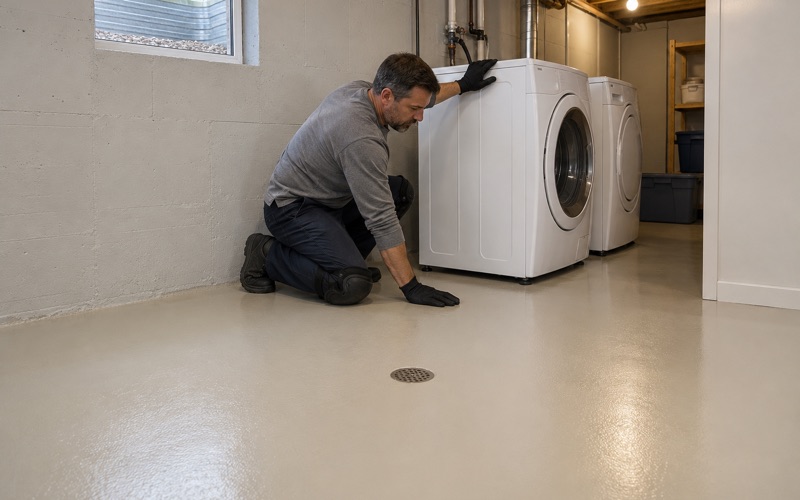
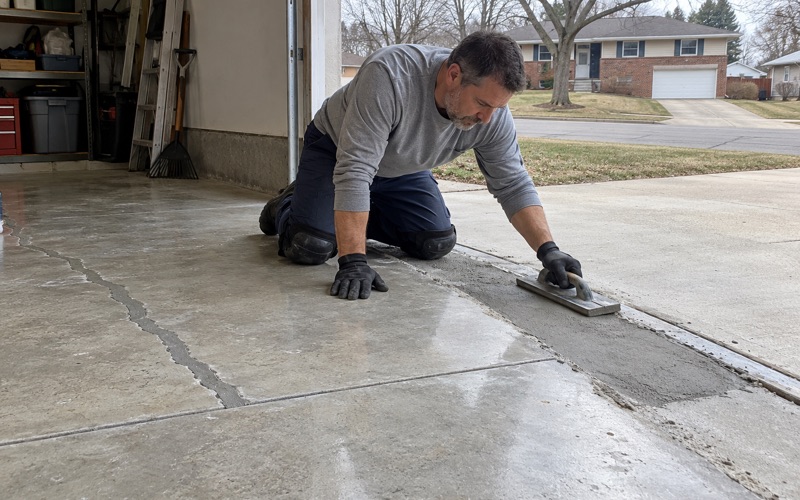
Older basements often carry a floor drain, a sump pit or both, and the coating has to terminate cleanly around each one. We detail those edges so water heads toward the drain instead of under the film. Cracks get filled and ground flush where they are stable, and we flag any that look active.
A coating is a film that follows the slab under it. It will not stop a crack from moving, and we say that before the job rather than promising otherwise.
Choosing a build for a floor with a past
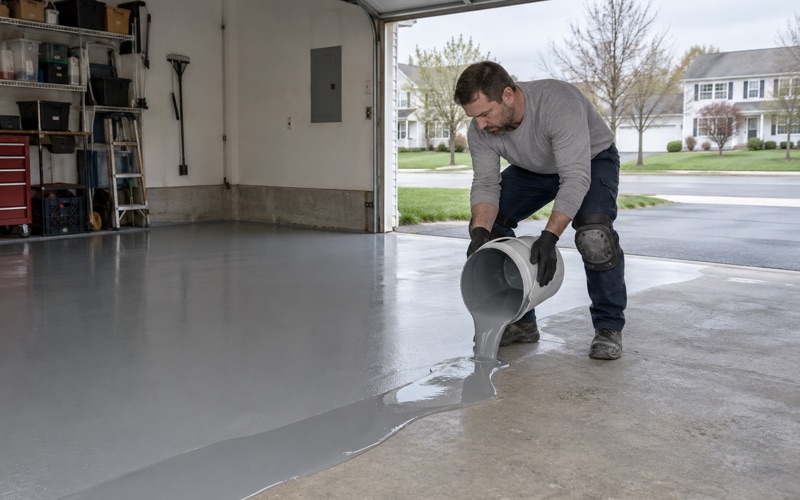
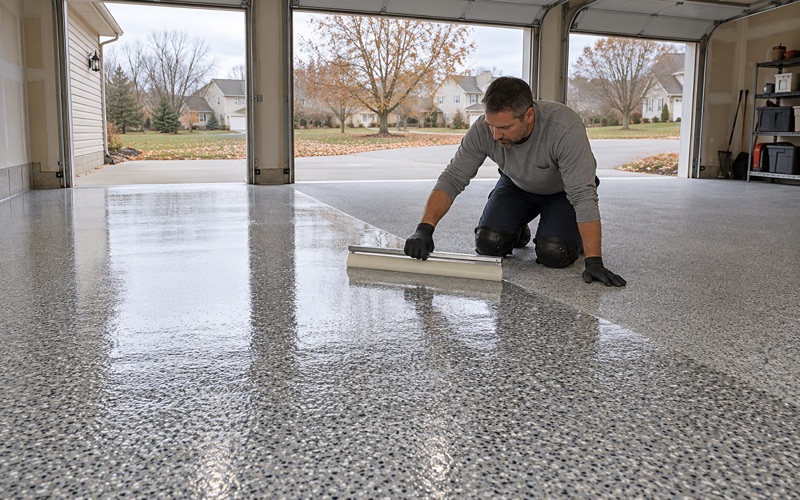
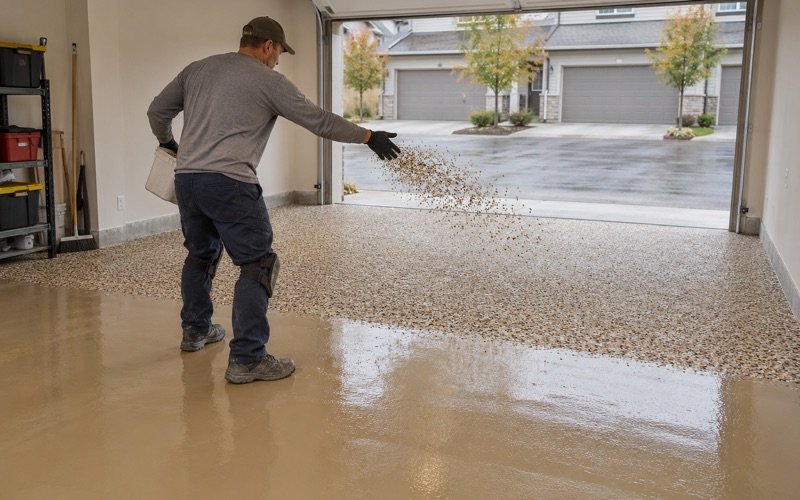
Once the slab is open and tested, the system follows from what we found. A dry, sound garage slab often takes a 100% solids epoxy base with a vinyl flake broadcast, which hides the patching an old floor tends to carry. A basement or utility room that sees standing water or heavy wear may suit a quartz aggregate broadcast for texture and grip, and a slab that only needs dust control may be better served by a lithium silicate densifier than by any film at all.
In a garage, the topcoat is chosen for the calcium chloride brine and rock salt that ride in on the tires all winter, with polyaspartic or polyurea finishes where hot tire pickup and abrasion are the main threats. Thickness is stated in the proposal for each coat, so a thin floor cannot pass for a thick one.
1,278 Multifamily Units by the Village’s Own Count
Westchester’s own count of its housing stock is 5,724 detached single-family homes and 1,278 multifamily dwelling units. Census figures for units in structure show 339 in two-unit buildings and 280 in three- and four-unit buildings. Shared buildings are a real part of this floor market, and they bring their own scheduling.
Associations, neighbors and access
Townhome and condominium jobs are planned around the association’s rules and around neighbors who still need to reach their own garages. That can mean working one bay at a time, staging equipment so a shared drive stays open, and posting the cure window before we start. The association usually wants the product, the build and the schedule in writing first.
Census data also counts 413 owner-occupied single-family attached units in the village. A shared wall between two garages means shared dust and noise, so we use dust collection on the grinders and keep neighbors informed about when the loud work runs.
Paperwork before the first pass
Every home job gets a written contract and the state’s Home Repair: Know Your Consumer Rights pamphlet before work starts, as the Illinois Home Repair and Remodeling Act requires. Products are chosen within the Illinois limits on VOC content for architectural coatings, which bind the installer as well as the manufacturer. In an attached unit, a low-odor system is also simply good manners.
Curing on the slab’s terms
Cure time is scheduled against slab temperature and the dew point spread at the slab surface, not against the calendar. Amine blush and a soft film are what happen when a coating cures on a cold, damp slab. When an unheated garage cannot hold the temperature a system needs, we say plainly that the job should wait for spring.
Westchester sits in Proviso Township in Cook County, and we treat its floors as the renovation work they are. Whether the floor belongs to a detached house, a two-flat or an association building, the work starts the same way: read the slab, test it, and quote only what it can carry.
- 20+ Years Coating Floors
- Moisture Tested Before Coating
- Written Contract on Every Home Job