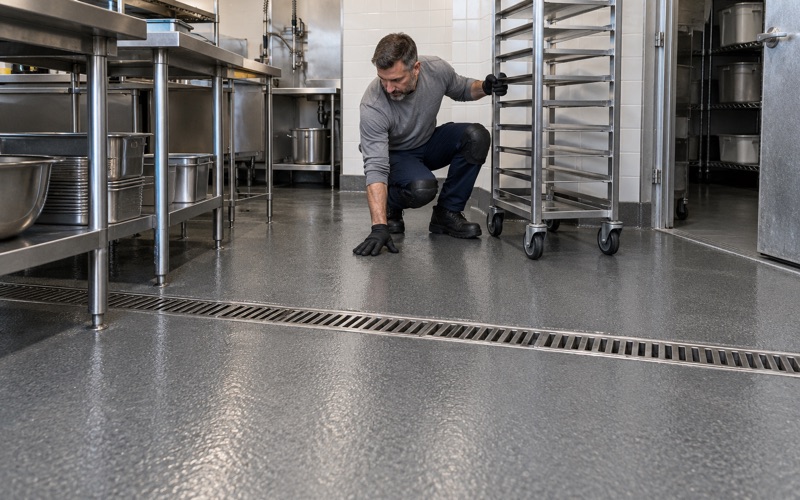
Schaumburg Epoxy Flooring has spent more than 20 years on epoxy flooring in River Grove and across the western suburbs, and the floors we think hardest about here are the ones that carry real weight. A coated slab under forklifts, service trucks and heavy equipment is a different job from a showroom finish. It has to bond through years of oil, point loads and traffic that does not stop for a long cure.
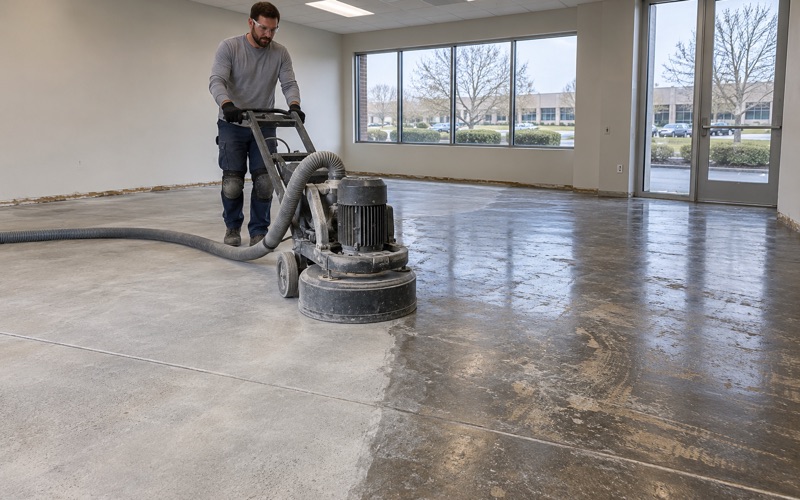
Every floor we coat starts the same way. We open the slab mechanically with a diamond grinder or a shot blaster, never with acid, and we read the cracks and any old coating before we put a number on paper. If the concrete needs repair before it can hold a coating, the quote says so in plain words.
The proposal then names the product, the system build and the finished thickness. That lets an owner or a facility manager check what went down against what was sold, which matters most on a floor that will be judged by how it holds up under load.
A Main Line, a Hump and Repair Shops in the Village Profile
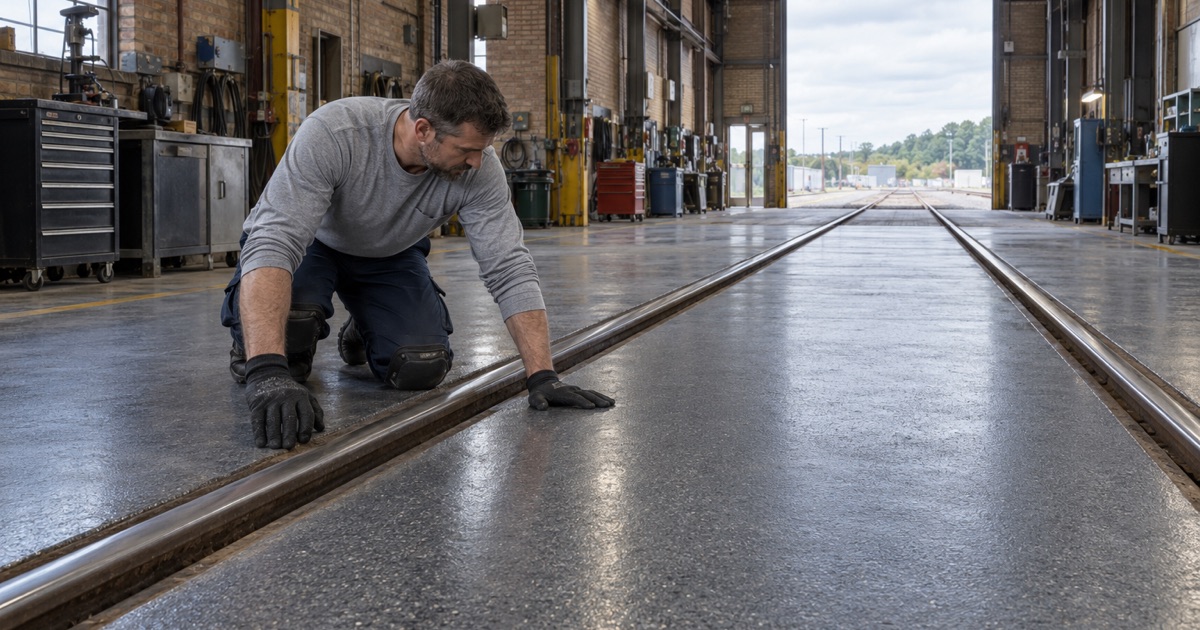
River Grove is a village in Leyden Township, Cook County, incorporated in 1888. Its own annex to the Cook County hazard mitigation plan, dated July 2019, describes a Canadian Pacific main line running within the village and leading into one of the area’s largest humps, with rail yards and the railroad’s major repair shops. That is an unusual line to find in a village profile, and it says a lot about what kind of floors stand near the tracks.
What a hump means for the floors around it
A hump is the part of a classification yard where freight cars are pushed over a rise and roll by gravity onto the track that sorts them into new trains. A yard built around one handles a steady volume of rolling stock, and rolling stock needs maintenance. Repair shops follow the cars, and the floors inside those shops take the heaviest, dirtiest work a slab ever sees.
Where the yard sits, and what we do not claim
We have not mapped where the yard and its shop buildings sit relative to the village line, and neighboring communities claim the same rail operation as part of their own economy. We do not describe any particular shop’s floor. What we can say is that the village’s own profile names heavy rail repair as part of its picture, and that a contractor quoting floors here should know what that kind of work does to concrete.
A small footprint around a big operation
The village covers about 2 square miles, and roughly half of that is open space: forest preserve, golf courses and cemeteries. That leaves a compact built area where homes, commercial buildings and light industry sit close together. A floor coating decision here is often made a few blocks from the rail line, by an owner whose own building takes some of the same punishment on a smaller scale.
Looking for epoxy-flooring closer to Bellwood? See Bellwood Epoxy-Flooring.
What a Railroad Shop Floor Carries
A shop floor under rolling stock deals with three things at once: concentrated weight, petroleum products and steel. Each one changes how a coating system should be built. We would rather explain those limits during the walkthrough than sell a decorative film that fails at the first jack stand.
Steel wheels and point loads
Steel wheels, jack stands, axle dollies and heavy carts put enormous pressure on a very small contact area. A thin coating over sound concrete can still crush, chip or shear at those points. For that kind of service we look at thicker builds, such as 100% solids epoxy broadcast with quartz aggregate or a urethane cement system, and we say plainly when a bare densified slab with a lithium silicate densifier is the better answer for part of the floor.
Diesel, grease and lubricating oil
Diesel and lubricating oil do not sit on top of concrete. They wick into it, and years of drips can carry contamination well below the surface a grinder reaches on the first pass. A coating applied over oil-soaked concrete can look fine at handover and then lift in sheets once the oil migrates back up into the bond line.
On a contaminated slab we grind, degrease and grind again, and we test the result before committing to a full system. When a section will not come clean, we tell the owner that before the job is sold, not after a patch has peeled. Some areas are better cut out and repaired than coated.
Fresh spills during service are a separate problem from old oil that has soaked in. A cured chemical-resistant topcoat handles diesel or hydraulic fluid that is wiped up within a shift, but a floor that sits under standing fuel needs a system chosen for that exposure. We ask which fluids are actually used on the floor before we pick one.
Why surface profile decides adhesion
Our prep is measured against the ICRI CSP scale, which describes how rough a prepared surface is. Heavy-duty systems need a deeper profile than a thin garage coat, and a shot blaster or an aggressive diamond grind is how we get there. Acid etching cannot reach that profile and does nothing to remove oil, which is why we do not use it on any floor.
Shop Floors That Work Around the Clock
Rail operations do not keep office hours, and neither do many of the businesses that grow up beside a working line. A floor that has to stay in service through nights and weekends needs a schedule built around the building, not around the contractor’s calendar. We plan commercial work for the windows a building can actually give us, including overnight and weekend shutdowns.
Phasing a floor that cannot close
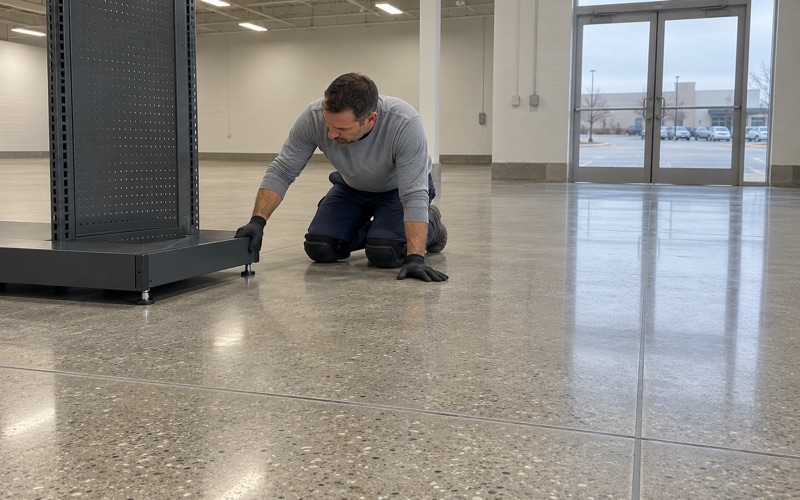
Large floors can be coated in sections, with one bay or aisle taken out of service while the rest keeps running. We mark the order of work, the cure time for each section and the point at which traffic can return. Where downtime is the tightest constraint, polyaspartic and polyurea topcoats can shorten the return-to-service window compared with a standard epoxy topcoat.
Before a section closes, we agree on how equipment and people will move around it and where the work zone ends. Our shot blasters and diamond grinders run with dust extraction attached, so the bay next door can keep working while its neighbor is prepared.
Curing to the slab, not the clock
A cure schedule written against the calendar is a guess. We schedule against slab temperature and the dew point spread at the slab surface, because a cold or damp slab can leave amine blush on epoxy and weaken the bond of the next coat. In a large building with big overhead doors, that reading can change from one end of the floor to the other.
Moisture testing as part of the scope
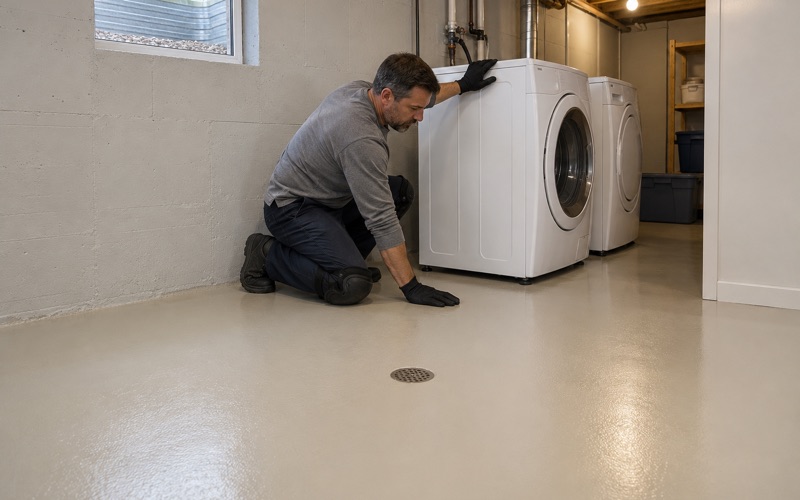
Moisture testing is a line item in our scope rather than something sold after a floor blisters. Depending on the slab, that means an ASTM F2170 in-situ relative humidity probe, an ASTM F1869 calcium chloride test or a simple ASTM D4263 plastic sheet test as a first read. Where moisture is high, a moisture-mitigation primer goes into the system build, and the warranty exclusions are read out before the job is sold, with moisture named first.
Fire code questions on a commercial job
River Grove has its own fire department, a village department with one station on Thatcher Avenue, staffed by part-time firefighters who are full-time members of other departments, with six on duty at all times. Fire code questions on a commercial coating job go to that department. We raise them early, along with any permit question for the Village of River Grove Building Department, rather than assuming a coating does or does not need sign-off.
Light Industry Beside the Tracks
Not every heavy-use floor near a rail line belongs to the railroad. Light industrial and commercial businesses share the village’s small built footprint, and their floors see a scaled-down version of the same wear: lift trucks, parts carts, solvents and spilled fluids. The village issued 1,066 building permits in 2023, a sign of steady work on its existing building stock.
Warehouses, workshops and service bays
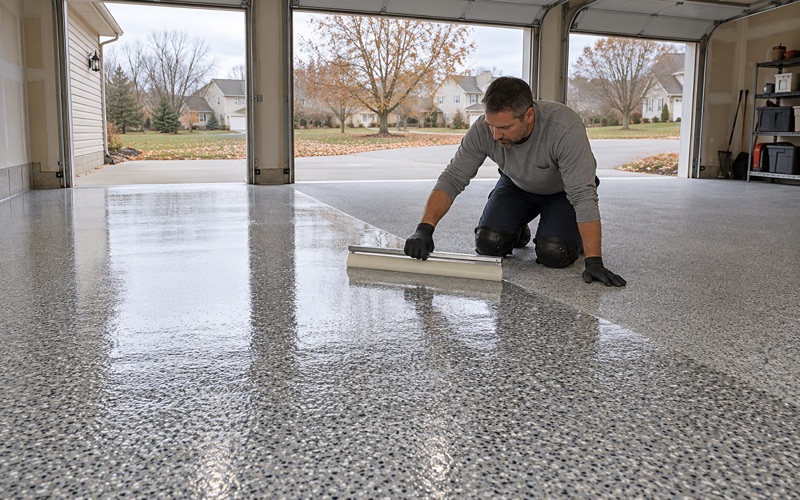
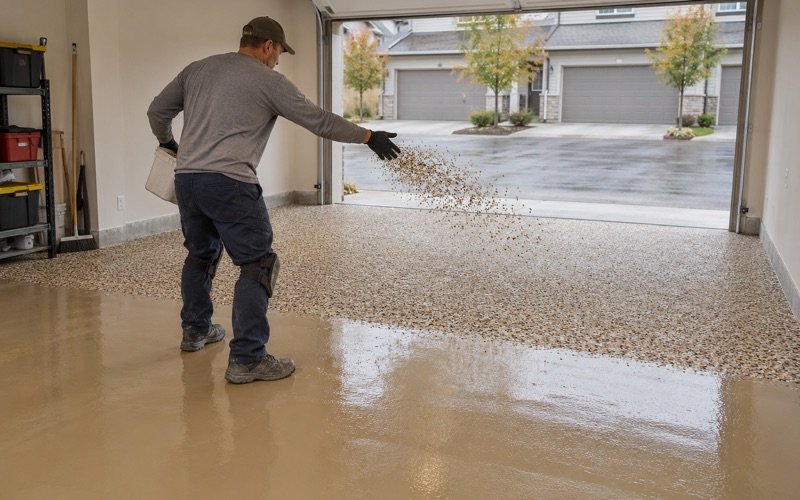
For a warehouse aisle or a service bay we usually look at a 100% solids epoxy base with a broadcast aggregate for traction, finished with a chemical-resistant topcoat. Hot tire pickup is a real failure on floors where vehicles park after a run, so the topcoat is chosen for that heat as well as for oil and fuel. A vinyl flake broadcast suits customer-facing areas where appearance counts as much as wear.
Cracks, joints and movement
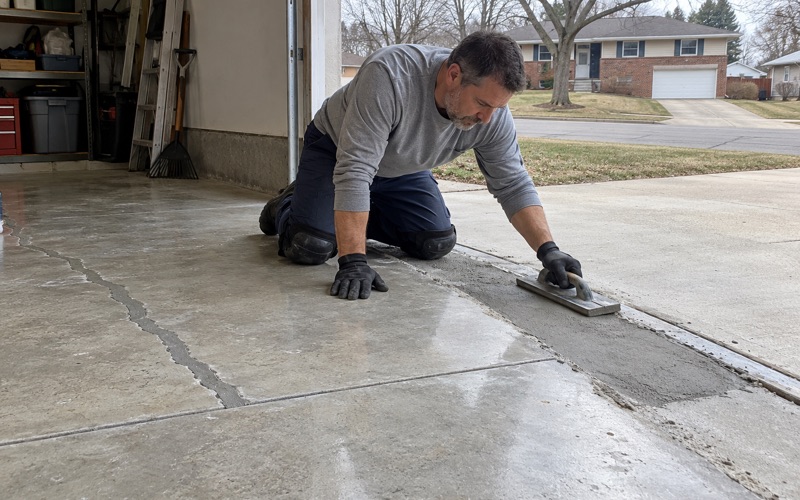
A coating is a film that follows the slab under it. It does not stop a crack from moving, and we say so before the job rather than after. We read each crack and control joint, repair what needs repair, and detail joints so the coating does not simply mirror every movement in the concrete as a new break.
Garages and homes near the line
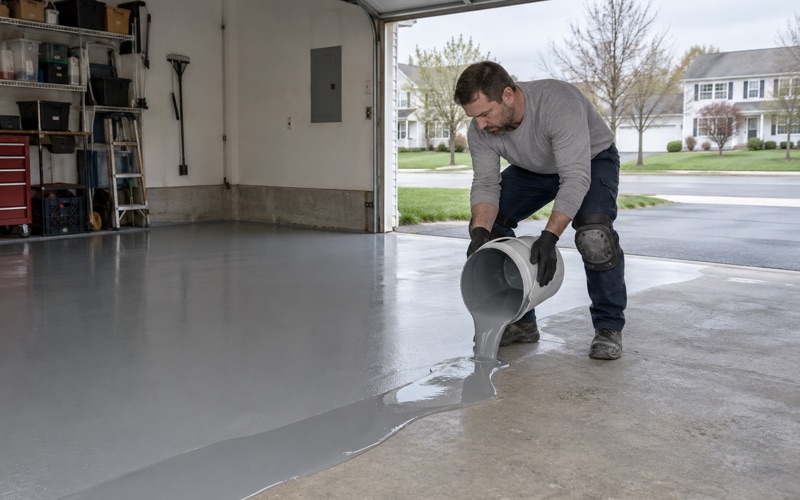
The same village holds owner-occupied houses with garages, and those slabs carry their own load: the calcium chloride brine and rock salt that a northern Illinois winter brings in on the tires. We build residential garage floors for that brine, and every home job comes with a written contract and the state’s Home Repair: Know Your Consumer Rights pamphlet before work starts, as the Illinois Home Repair and Remodeling Act requires.
Much of the village’s housing predates 1960, and an older garage slab that has seen decades of salt can carry scaling and pitting that must be repaired before any coating goes down. A garage slab may also have no vapor retarder under it, because the model code exempts garages, so we test before we coat rather than assume.
Coatings chosen within the rules
Floor coatings here are selected within the Illinois limits on VOC content, which bind the installer as well as the manufacturer. Illinois issues no state license for flooring or coatings work, so we confirm the village’s own contractor registration, bond and insurance requirements before a job is scheduled. That way the paperwork is settled before the grinder comes off the trailer.
- 20+ Years Coating Floors
- Moisture Tested Before Coating
- Written Contract on Every Home Job