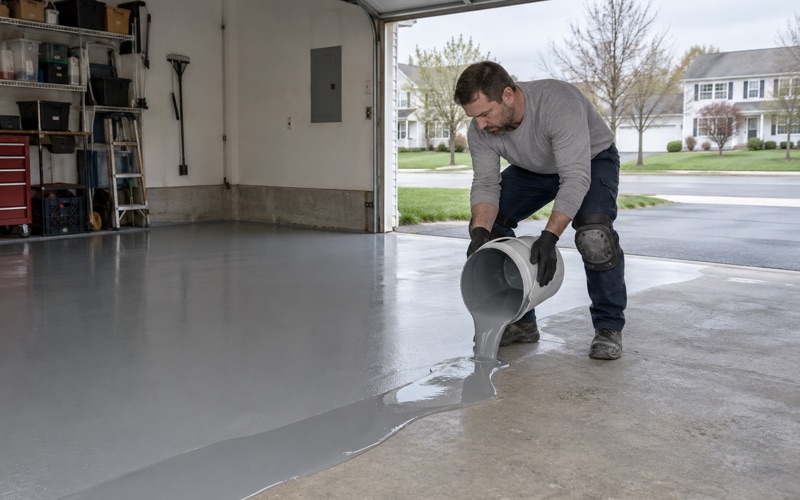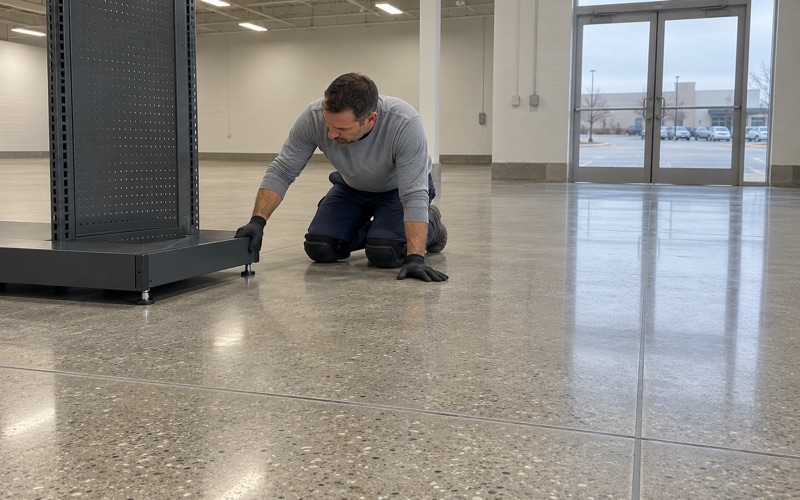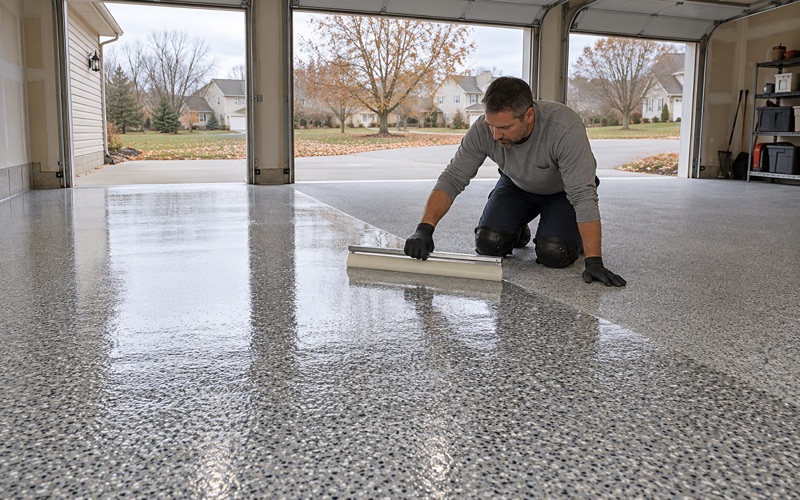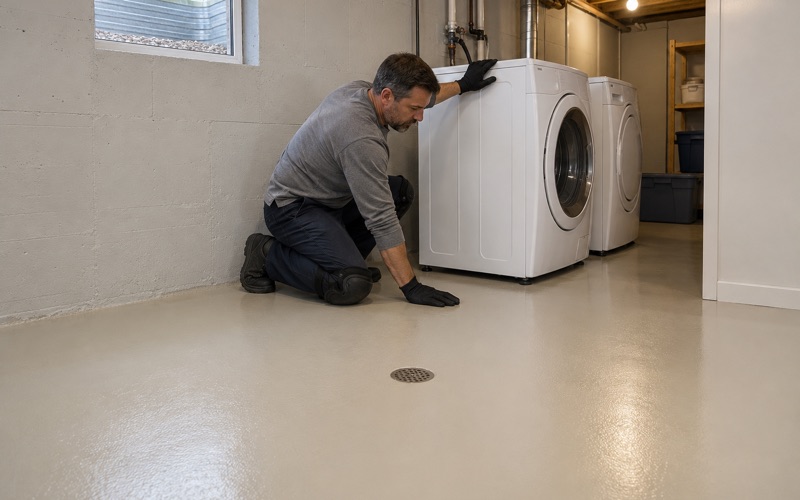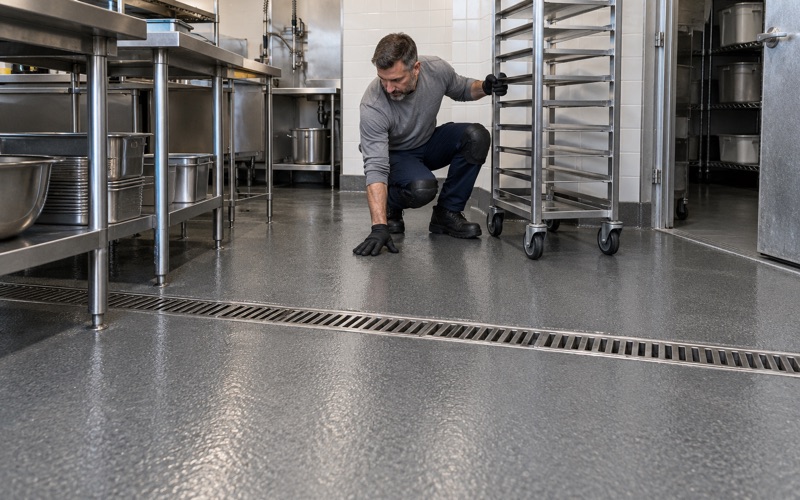
Schaumburg Epoxy Flooring brings more than 20 years of concrete coating work to epoxy-flooring in River Forest, and most of the calls we take from the village start with a floor that has been in service a long time already. A coating on an existing slab is a different job from a coating on fresh concrete. The concrete has a history by then, and the first hour on site goes to reading it.
That reading is what decides the scope. We look at the cracks, test the slab for moisture, check whether anything was ever applied to the surface, and only then write a proposal. When a slab needs repair before it can take a coating, we say so in that first visit rather than after the floor is down.
What follows is how we approach a floor in River Forest that has reached its first refinishing decision: the slab that has seen two decades of cars, storage and foot traffic, and now needs either a new system or an honest answer about why it should wait.
Twenty quiet years, then 360 homes in one decade
The housing record for River Forest has an unusual shape. The ACS 2024 five-year estimates count 103 units built in the 1980s and only 31 in the 1990s, so the two decades together added just 134 homes. Then the 2000s added 360 units in a single decade, more than the previous twenty years combined by a wide margin.
The decade after that slowed again, with 55 units built from 2010 to 2019 and none counted since 2020. That leaves a distinct cohort of concrete in the village, separate from both the older stock and anything recent. Those slabs are now roughly 15 to 25 years old.
Why the age band matters for a coating
A slab in that range is past the point where anyone treats it as new. Shrinkage has finished, the joints have opened as far as they are going to, and any settlement cracking has had time to show itself. It is also young enough that most of these floors have never been through a full grind-and-coat cycle.
That combination is what puts an owner at a first refinishing decision. The floor may look tired but sound, or it may be carrying a coating that has started to lift at the tire paths. Either way, nobody has opened this concrete since it was placed, and the work starts with finding out what is on it.
What we do not assume about these floors
We have no record of how these slabs were originally finished, and we do not pretend to. Some may be bare concrete, some may carry a clear sealer, and some may have had a coating rolled on at some point since. We find out on site rather than guessing from the age of the building.
We also do not assume the building type. The census counts units, not garages or basements, so a 2000s unit in River Forest could be a house, a townhome or a condominium. When the job sits inside a townhome or condominium building, we schedule around the association’s rules and around the neighbors who still need to reach their own garages.
Looking for epoxy-flooring closer to Wauconda? See Wauconda Epoxy-Flooring.
A first refinishing, starting with what is already on the slab
The single most common reason a coating fails on a 20-year-old slab is that it was laid over something it could not bond to. A clear acrylic sealer, a curing compound sprayed on the day of the pour, or an old water-based paint can all leave a film that looks like bare concrete. Epoxy applied over that film bonds to the film, not the slab.
The checks before anything bonds
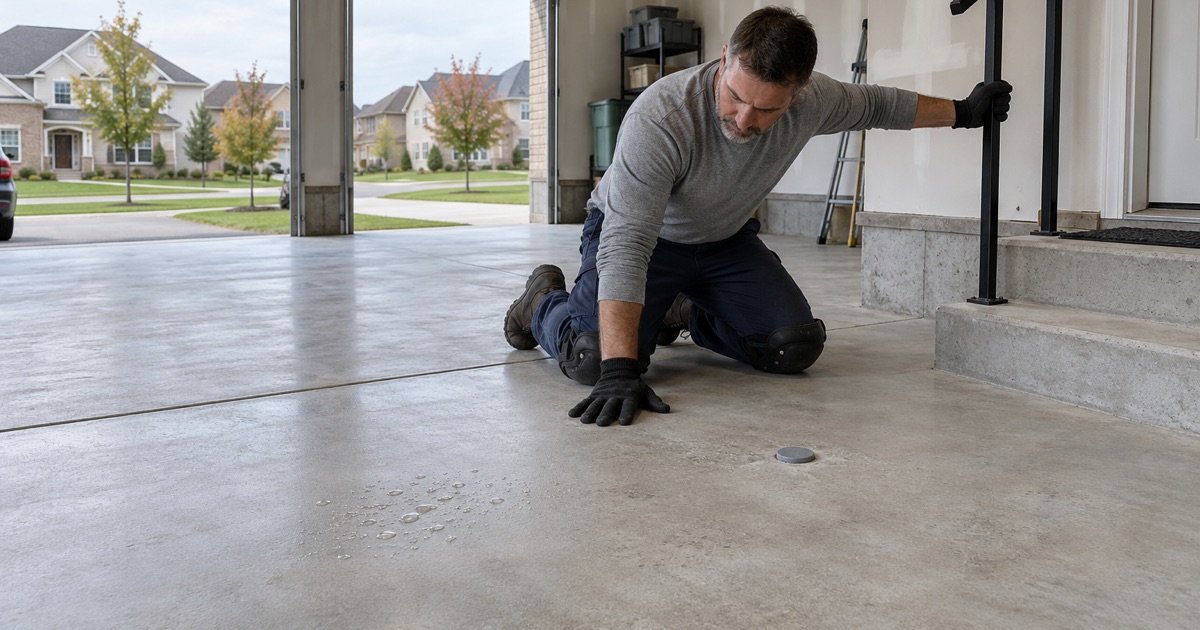
We start with a water drop test across the floor. Water that beads or sits on the surface points to a sealer or curing compound still in place, while water that darkens the concrete and soaks in points to an open surface. We repeat the test in several spots, because a floor can be sealed in one bay and bare in the next.
Where a film shows up, we confirm it by grinding a test patch and watching how the dust and the surface behave. That tells us how much material has to come off and which tooling will remove it. The finding goes into the written proposal, so the extra grinding is a line item and not a surprise.
Opening the slab mechanically
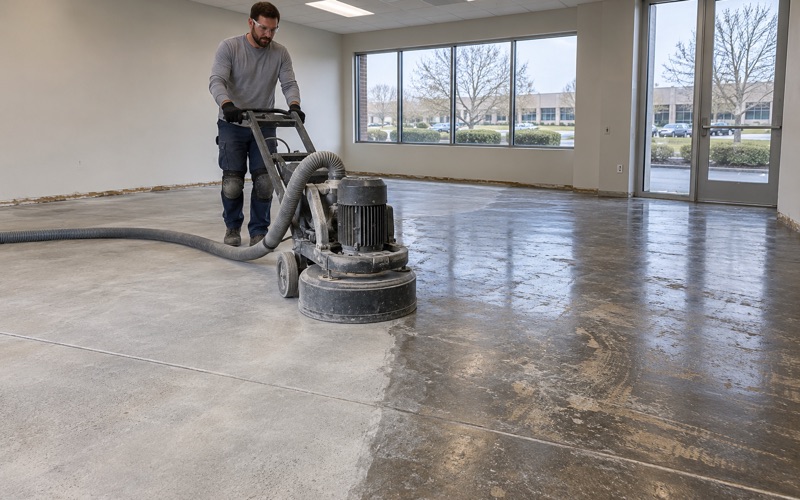
Every slab we coat is opened with a diamond grinder or a shot blaster. We do not acid etch, because acid cannot cut through a sealer and leaves residue in the pores that a primer then has to fight. Mechanical prep removes the film and the weak top layer together.
The target is a surface profile on the ICRI CSP scale suited to the system going down, usually rougher for a thick 100% solids epoxy build than for a thin sealer coat. On a slab that has been in service for two decades, grinding also takes off the oil, tire residue and worn cream that accumulated in that time.
Moisture testing as a line item
A garage slab built to code may have no vapor retarder under it, because IRC R506.2.3 exempts garages from that requirement. A newer slab is not automatically a dry one, so we test rather than assume. That holds for basement slabs and garage slabs alike.
Depending on the floor, we use the ASTM D4263 plastic sheet test as a first screen, ASTM F1869 calcium chloride kits for vapor emission rate, or ASTM F2170 in-situ relative humidity probes drilled into the slab. When the readings come back high, a moisture-mitigation primer goes into the scope before the base coat. When they come back far too high for any primer, we tell you the floor should not be coated yet.
Wear patterns on a floor parked on for twenty years
A slab that has held cars for 15 to 25 years tells you where the stress has gone. The tire paths are polished or stained, the area under the engine is soaked with oil, and the threshold at the garage door has taken the most salt. Each of those zones needs different handling before the coating goes down.
Tire paths and hot tire pickup
The tire lanes are where a weak coating fails first. Hot tires soften a thin film, then pull it off the floor as the car backs out, which is the defect known as hot tire pickup. Its root cause is usually a coating too thin for the job or a surface that was never opened properly.
We address both. The slab is ground to profile across the full floor, and the system is built to a stated thickness. Our proposal names the product, the full system build and the finished thickness, so what you were quoted can be checked against what was installed.
Salt, brine and the threshold
Twenty winters of calcium chloride brine and rock salt leave their mark at the front of a garage. Salt residue can sit in the pores of the slab and work against a new bond, and the concrete at the door edge often shows scaling or efflorescence. We clean that zone, grind it back to sound concrete and repair scaled areas before priming.
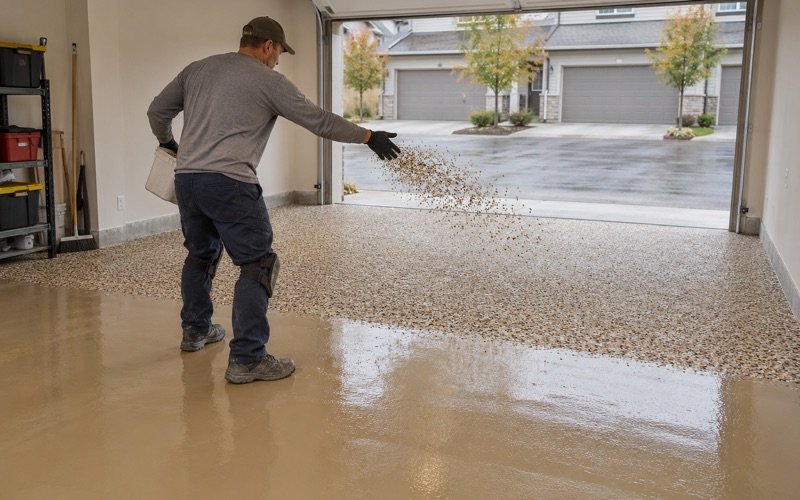
The finished system is chosen for that exposure. A polyaspartic or polyurea topcoat over a 100% solids epoxy base, with a vinyl flake or quartz aggregate broadcast for texture, stands up to brine and gives tires and shoes some grip when the floor is wet.
Cracks and what a coating can promise
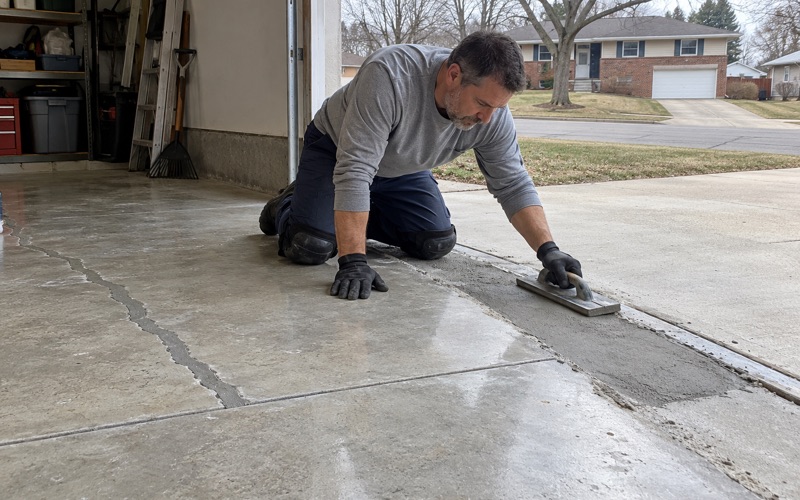
Two decades is long enough for a slab to show whatever cracking it is going to show. We read each crack before quoting, separating hairline shrinkage cracks from cracks that have moved or opened. The moving ones get routed and filled with a repair material suited to them.
A coating is a film that follows the slab under it. If a crack keeps moving after the floor is coated, the coating will show it, and we say that before the job rather than promising otherwise. The same honesty applies to the warranty: we read out the exclusions before you sign, with moisture named first.
Infill in a landlocked village
River Forest has no room to grow outward. The county hazard plan’s annex for the village describes it as landlocked in about 2.5 square miles, bounded by the Des Plaines River, North Avenue, Harlem Avenue and Madison Street. Whatever was built here in the 2000s went into a village with no open land at its edges.
That context helps explain the housing record. Of the 4,680 units counted, 1,977 were built in 1939 or earlier, and the stock in every decade since reflects a place filling in rather than spreading out. The 2000s cohort is one layer inside an established village, not a separate development at the fringe.
Working inside an occupied, owner-held village
Of 4,460 occupied units in River Forest, 3,911 are owner-occupied, or 87.7 percent. Most of the floors we are asked about here belong to the people who live above them. That shapes how we schedule: a garage floor takes the space out of use for a set number of days, and we plan the cure around getting the car back in safely.
Every home job gets a written contract and the Home Repair: Know Your Consumer Rights pamphlet before work starts, as the Illinois Home Repair and Remodeling Act requires. Illinois issues no state license for flooring or coatings work, so we confirm the Village of River Forest’s own contractor registration, bond and insurance requirements before scheduling.
Asking the village before the job
River Forest keeps its building codes in Title 4, Chapter 1 of the Village Code, and Village Hall sits at 400 Park Avenue. We ask the village permit desk before the job whether a floor coating counts as decorating or needs a permit, rather than assuming either answer. The village is its own township, River Forest Township, within Cook County.
Coatings are chosen within the Illinois limits on VOC content for architectural coatings, which bind the installer as well as the manufacturer. We also do not sell a floor coating as radon reduction; in Illinois that work requires an IEMA radon mitigation license, and a coated floor is not a mitigation system.
When the answer is to wait
Some 20-year-old slabs are ready for a full system the week we test them. Others need crack repair first, a moisture-mitigation primer, or a season of drying after a water problem is fixed. A first refinishing decision is worth getting right, because the floor you put down now is the one the slab will carry for its next stretch of service.
We would rather tell you a floor needs more preparation than coat it and watch it fail. That starts with a visit, a moisture test and a written scope that says exactly what will go down.
- 20+ Years Coating Floors
- Moisture Tested Before Coating
- Written Contract on Every Home Job