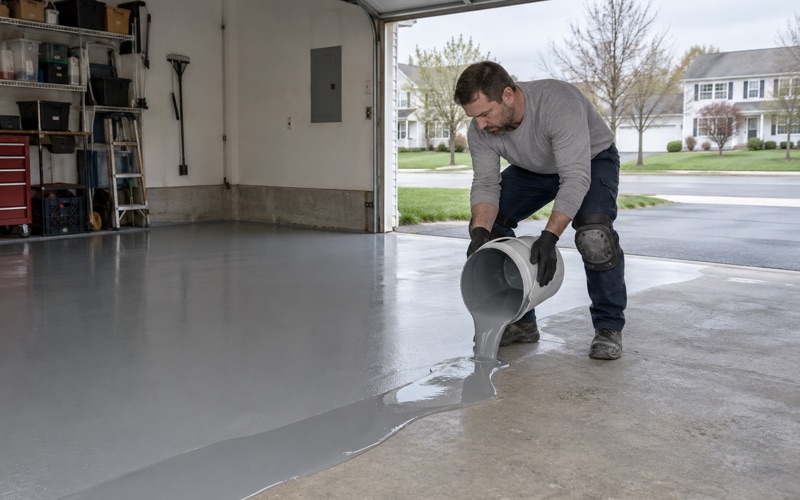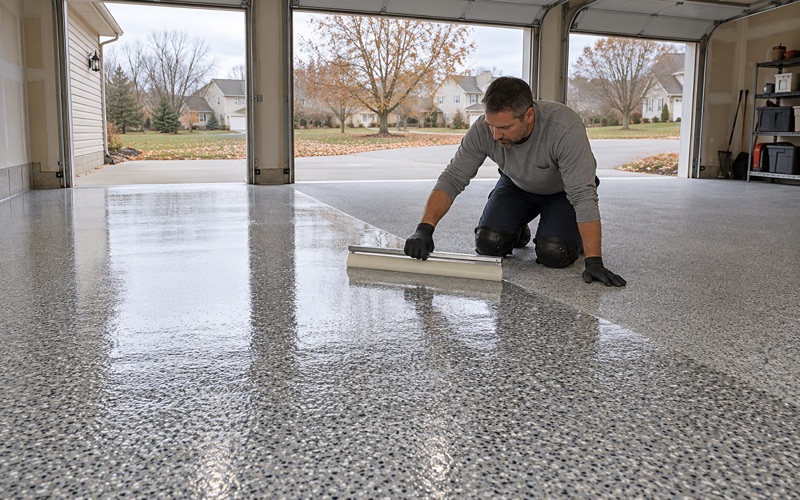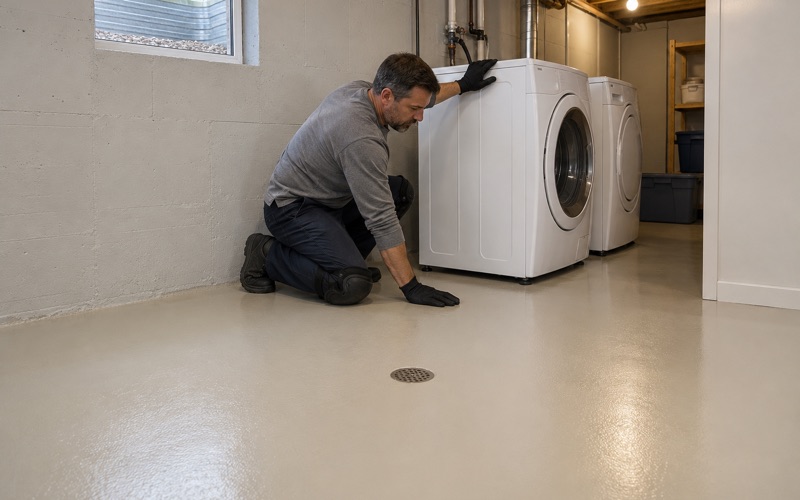
Schaumburg Epoxy Flooring has spent more than 20 years installing epoxy flooring in Prospect Heights and the surrounding northwest suburbs, and the floors we are asked to coat here are seldom bare concrete. A slab that has been lived on for decades carries a history nobody wrote down, and that history shapes the job long before anyone chooses a flake color.
So our work starts with the surface that is already there. We look at what sits on the concrete, read the cracks, and tell you plainly whether the slab is ready for a coating or needs repair first. Every floor is then opened mechanically with a diamond grinder or a shot blaster. We do not acid etch, because acid cannot reach concrete that is still covered by an older film.
The proposal you receive names the product, the system build and the finished thickness, and moisture testing appears in it as its own line item. That way the quote can be checked against what actually goes down, whether the room is a two-car garage, a basement or a workshop.
Two Decades That Built Most of Prospect Heights
Prospect Heights is a city rather than a village, sitting in Wheeling Township, Cook County, on 4.25 square miles of land. The Census Bureau’s American Community Survey (2024 five-year estimates, table B25034) counts 6,915 housing units here. Of those, 1,630 were built in the 1970s and 1,568 in the 1980s, for 3,198 homes from the city’s two largest building decades, or 46.2 percent of everything standing today.
What that age means for a quote
A house from those two decades now sits on a slab that is roughly 35 to 55 years old. That is long enough for several owners to have swept it, scrubbed it, sealed it, painted it, patched it or done none of those things. We have no record of which happened on a particular floor, and we do not guess. The age of the house tells us what questions to ask; the floor itself answers them.
The detached houses behind most residential calls
The same survey counts 2,320 owner-occupied detached houses in the city, along with 190 detached houses that are rented. Across all occupied units, 66.8 percent are owner-occupied. A detached house is where a garage or basement floor is one household’s decision, made on that household’s schedule, and it is where most of our residential conversations in Prospect Heights begin.
Why the record comes before the color chart
Because so much of the housing here dates from the same twenty years, the useful first question on a call is not which flake blend you like. It is when the house was built and what you know about the floor since you have owned it. A remembered paint job or an old receipt for a garage kit tells us more about the right preparation than any photo of the finished floor you are hoping for.
Looking for epoxy-flooring closer to Winfield? See Epoxy-Flooring Services in Winfield.
What Decades Can Leave on a Slab
We walk onto an older floor expecting to find something and expecting to identify it before we price the job. Four kinds of history matter most.
Sealers, paint and kit coatings
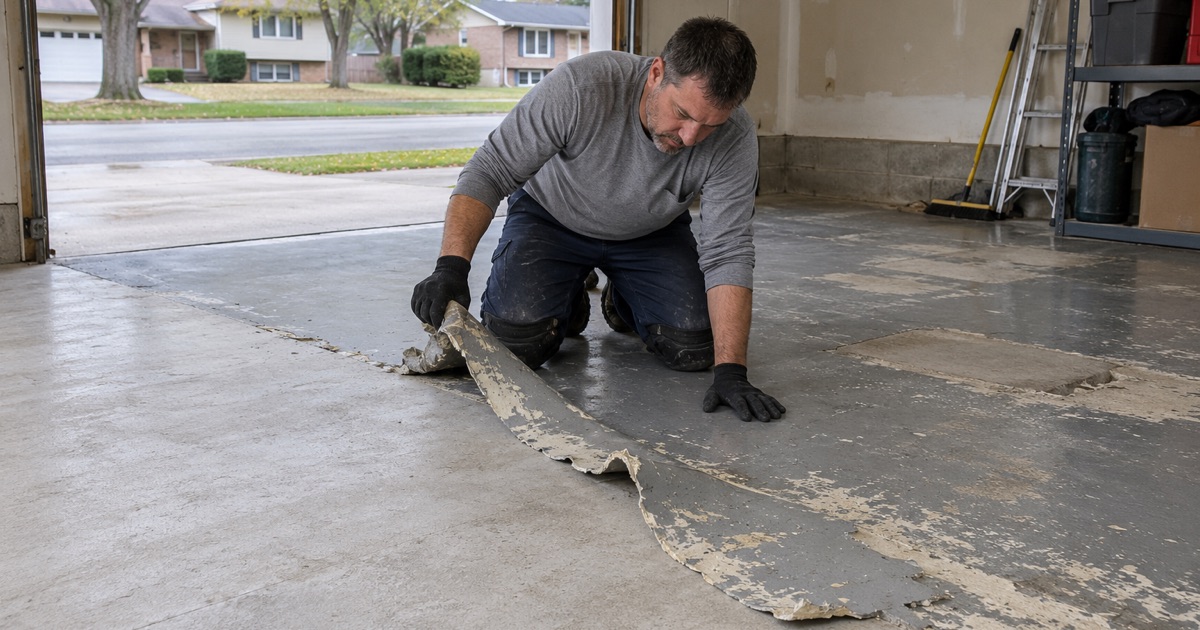
Clear acrylic sealers, garage-floor paints and one-part coating kits are all common products in the trade, and any of them may be on a slab of this age. Each forms a layer between the concrete and whatever comes next, and a new coating is only as well bonded as the layer under it. We check by scraping, by watching how water behaves on the surface, and by grinding a test patch, so the quote reflects what the floor is actually wearing.
Patches and old repairs
Decades of use often mean patching compound in a spalled corner, a strip of newer concrete where a line was trenched, or grout around an old fitting. Patches can differ from the original slab in hardness and porosity, and a weak one has to come out rather than be coated over. We tell you before the job which patches stay, which get replaced and what that adds.
Cracks and stains
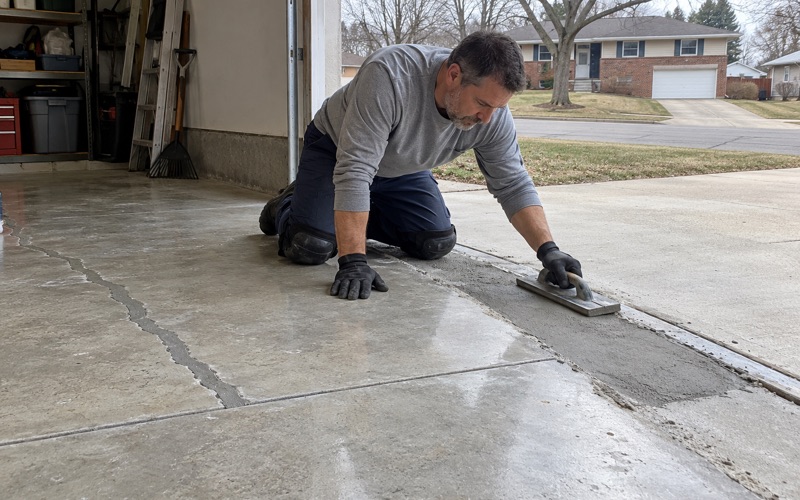
We read every crack for width and for whether it is still moving. A coating is a film that follows the slab under it, so we fill and detail cracks, but we say before the job that no coating will stop a slab from moving. Deep oil stains in garage concrete get the same scrutiny, and efflorescence on a basement floor is a signal that moisture testing needs to come first.
Basement slabs from the same era
A basement poured in the 1970s or 1980s has spent its whole life below grade, and the history on it often looks different from a garage’s. Paint around a sump pit, a ring of patching at a floor drain, or a sealer rolled on to keep dust down are all things we look for. Where water pushes up from beneath, hydrostatic pressure under a basement slab can lift a coating, so the drain and sump details get planned into the system rather than coated around and forgotten.
Stripping an Old Finish or Coating Over It
Owners often ask whether a new system can simply go on top of what is already there. Occasionally part of it can, but the answer comes from testing, not from hope.
When an existing coating can stay
A thick, well-bonded earlier coating can sometimes be ground to a fresh profile and used as a base. We only do that after adhesion checks across the floor, because a film that holds in one bay and lifts in another will take the new system with it. Paint, sealers and thin kit coatings almost always come off entirely.
Getting back to sound concrete
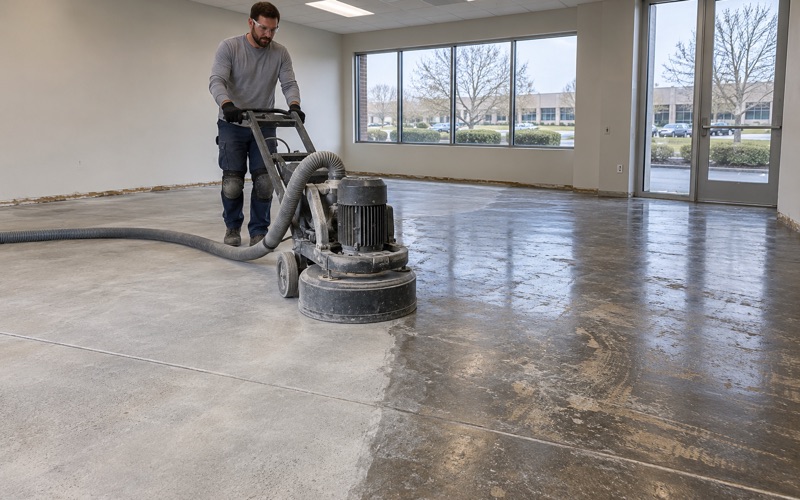
Diamond grinding handles edges, thin films and stubborn spots; shot blasting opens larger open areas quickly and evenly. Either way, the goal is a measured surface profile on the ICRI CSP scale suited to the system going down, with thicker builds such as urethane cement calling for a coarser profile than a thin epoxy coat. Grinding also tells us how far an old film penetrated, which a visual check cannot.
Moisture testing as part of the scope
Before anything is applied we test, using the ASTM D4263 plastic sheet test as a screen and ASTM F1869 calcium chloride or ASTM F2170 relative humidity probes where the floor calls for numbers. When readings come back high, a moisture-mitigation primer goes into the system build rather than being added after a floor blisters. Warranty exclusions are read to you before the job is sold, and moisture is the first one named.
The system that goes down
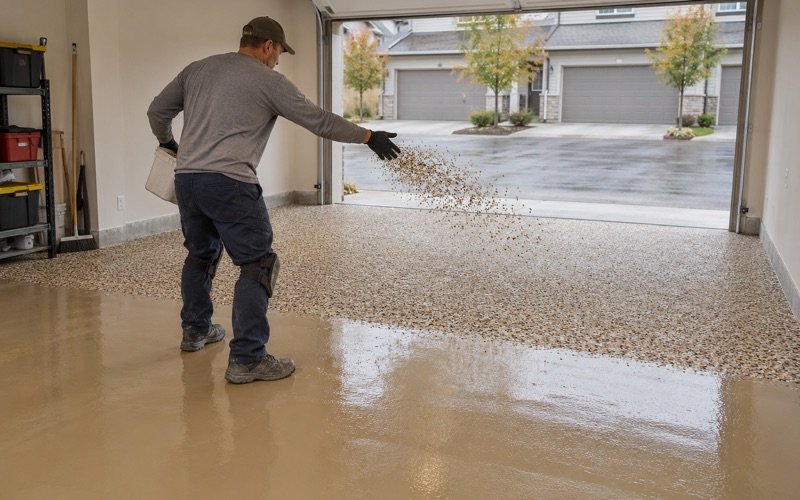
A typical garage build pairs a 100% solids epoxy base with a vinyl flake or quartz aggregate broadcast and a polyaspartic or polyurea topcoat. That build is chosen in part to resist hot tire pickup, the lifting that thin films suffer under warm tires. Basements and workshops may get a different build, and the written proposal spells out which one you are buying and how thick it finishes.
Curing on the slab’s terms
Each coat is scheduled against the slab’s own temperature and the dew point spread at its surface, not against a date on the calendar. A cold slab with too little spread can draw condensation, and an epoxy curing in those conditions can develop amine blush, a waxy film that weakens the bond of the next coat. When readings say wait, we wait, and we tell you that before the work starts rather than on the morning of the job.
Building Slowed After 1990: The Newer Minority
After the 1980s, construction in Prospect Heights fell off sharply. The Census estimates show 480 units from the 1990s, 318 from 2000 to 2009, 291 from 2010 to 2019 and 74 from 2020 or later. That is 683 units in all the years since 2000, a small share of the city next to the 3,198 from its two biggest decades.
The houses from the 1990s sit in between. Their slabs are around three decades old, young enough that some may still be bare and old enough that an owner has had time to put something down. We treat them the way we treat the older stock: inspect, test a patch, then quote.
Newer is not the same as dry
A newer slab skips most of the layered history described above, but it brings its own question. The model residential code, at IRC R506.2.3, exempts garages from the under-slab vapor retarder required elsewhere, so a garage poured to code may have nothing beneath it to slow moisture. We test a recent slab exactly as we test an old one rather than assuming its age makes it safe.
Builder treatments on recent pours
Newer concrete sometimes carries a cure-and-seal product or a lithium silicate densifier applied at construction. Both can reduce how well a coating grips, and neither is always visible. Mechanical preparation removes that uncertainty, which is one reason we grind or shot blast every floor regardless of its age.
Paperwork that does not change with the slab
Every home job, old house or new, gets a written contract and the state’s Home Repair: Know Your Consumer Rights pamphlet before work begins, as the Illinois Home Repair and Remodeling Act requires. Illinois issues no state license for flooring or coatings work, so we confirm the City of Prospect Heights’ own contractor registration, bond and insurance requirements before scheduling. We also ask the city’s permit desk whether a given coating job needs a permit, instead of assuming either answer.
Our coatings are selected within the Illinois limits on architectural coating VOC content, which bind the installer as well as the manufacturer. And while a sealed floor is a better floor, we never sell a coating as radon reduction, since that work in Illinois requires a state radon mitigation license.
- 20+ Years Coating Floors
- Moisture Tested Before Coating
- Written Contract on Every Home Job