
Schaumburg Epoxy Flooring installs polyaspartic floor coating systems in Schaumburg, IL, serving surrounding cities including Wood Dale, Bensenville, Barrington, Prospect Heights and Winfield. In more than 20 years of coating slabs, we have watched polyaspartic move from a specialty product to the topcoat on most of the garage floors we build, and we use it where its speed and color stability earn their price.
Polyaspartic is a form of aliphatic polyurea. It cures in a fraction of the time epoxy needs, tolerates a wider temperature window, and does not yellow in sunlight. Those strengths come with a short pot life and a higher material cost, which is why it rewards a crew that preps thoroughly and works quickly, and punishes one that does neither.
We apply it on its own as a single-system floor, as a clear topcoat over an epoxy and flake build, and as a fast-return finish for businesses that cannot close for long. Every job still starts with diamond grinding and a moisture test, because the fastest coating in the world fails just as fast over a sealed or damp slab.
Residential Polyaspartic Floor Coating
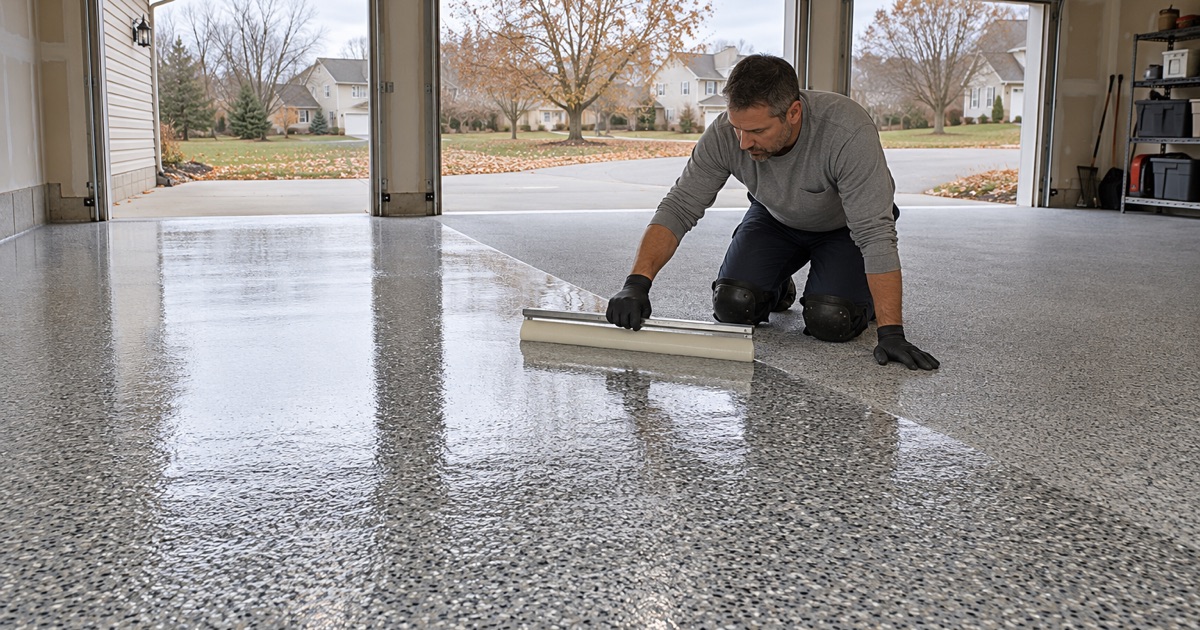
Garage Floors With a Polyaspartic Topcoat
Most of the garage floors we install use polyaspartic as the wearing layer. It resists the abrasion of tires and boots, holds up to calcium chloride brine and road salt, and keeps its color with the door open all summer. Underneath, a base coat builds thickness and a vinyl flake broadcast adds texture and hides dirt.
The topcoat is the layer you actually walk and drive on, and it is the layer most often thinned to cut a price. We specify it by product and thickness in the proposal. Where the apron end of the garage stays wet through the winter, we can add a fine aggregate to the topcoat there for grip without roughening the whole floor.
Fast-Return Floors for Busy Households
A household with two cars and no driveway space to spare often cannot give up the garage for several days. A full polyaspartic system can return a floor to foot traffic the same day and to vehicles much sooner than a full epoxy build. We give you the actual times for the products we use rather than the most optimistic number on a brochure.
Faster does not mean careless. On a slab with cracks to fill or an old coating to remove, the repair work sets the schedule rather than the resin. We tell you which kind of job yours is when we look at the floor, so the day count in the proposal is one you can plan around.
Basements, Porches and Sunlit Rooms
In a basement, polyaspartic’s low odor after cure and quick return are useful, but moisture still decides everything. In a three-season porch or a room with large windows, its color stability is the main reason to choose it, because an epoxy topcoat in direct light ambers within months.
Townhome garages are a common fit as well. Where an association limits work hours or a shared drive means neighbors need their garages back quickly, a system that cures fast shortens the disruption. We confirm the association’s rules and color approvals before booking, and we plan the grinding for the hours that bother the neighbors least.
Commercial Polyaspartic Floor Coating
Stores, Restaurants and Tenant Spaces
A business losing a day of sales to a floor job wants that day back. Polyaspartic systems can be ground, coated and returned to service overnight or across a weekend in many store, restaurant dining room and tenant spaces. We plan the sequence around the hours the space has to be open and bring enough crew to keep the cure windows tight.
Hotel and Venue Back-of-House Floors
Service corridors, laundries and loading areas behind hotels and event venues take heavy carts and constant cleaning, and they rarely close for long. A quick-curing polyaspartic finish over a ground and repaired slab lets us coat these areas in sections between shifts, so the building keeps working while the floor is renewed.
Those spaces also see wet floors, so texture matters. We broadcast a fine aggregate into the polyaspartic where carts and staff move through water, and leave smoother finishes where the floor stays dry. The goal is a surface that can be mopped and scrubbed without holding dirt, while still giving shoes and cart wheels something to grip.
Showrooms and Lobbies in Natural Light
Showrooms, lobbies and offices with glass walls are where epoxy’s tendency to yellow shows first. A polyaspartic topcoat keeps whites white and grays gray under daylight, and it holds its gloss under the scuffing of shoes and display fixtures. We pair it with metallic or solid color bases depending on the look the space calls for.
What Makes Polyaspartic Work, and What Makes It Fail
Short Pot Life and Batch Discipline
Once mixed, polyaspartic begins curing quickly, which leaves a short window to spread and back-roll each batch. Crews that mix too much end up rolling material that has already started to set, leaving lap marks and thin spots. We mix small batches, work in planned sections, and keep a wet edge across the floor.
Moisture, Dew Point and Bond
Polyaspartic tolerates cold better than epoxy, but it still will not bond through condensation. We measure the slab temperature and the dew point spread before coating, and we test moisture with an in-situ relative humidity probe or a calcium chloride kit. A high reading calls for a moisture-mitigation primer underneath, typically an epoxy, before any polyaspartic goes on.
Strength Claims and Honest Comparisons
Polyaspartic is often marketed as several times stronger than epoxy. Those claims usually compare a single property, such as flexibility or abrasion resistance, against one particular epoxy. We would rather explain what each layer of your floor is doing than quote a multiplier, because no single number tells you how a garage floor will do after five winters.
What we can tell you is where each material earns its place. Epoxy is the economical way to build thickness and fill the profile of a ground slab, polyaspartic is the better wearing and weathering surface, and polyurea-family coatings flex more as a slab expands and contracts with the seasons. A well-built floor usually uses more than one.
VOC Content and Odor
Illinois limits the VOC content of floor coatings, and the rule applies to the contractor applying them as well as the company making them. We use polyaspartic products within that limit and ventilate during application. Odor fades quickly once the coating cures, and we keep doors into the living space closed while it does.
Our Step-by-Step Polyaspartic Floor Coating Process
Step 1: Inspection, Moisture Test and Proposal
We inspect the slab, map cracks and old coatings, and test moisture. The proposal names the products, the build and the finished thickness, and every home job comes with a written contract and the state’s consumer-rights pamphlet before we start.
Step 2: Grinding and Repairs
The floor is diamond ground with dust collection, edges are hand ground, and cracks and spalls are filled with fast-setting repair material so the coating schedule is not held up waiting on patches to cure.
Step 3: Base and Broadcast
A base coat goes down at the specified thickness. On flake floors, the vinyl flake is broadcast into the wet base, then scraped and vacuumed once it sets so the topcoat goes onto a tight surface.
Step 4: Polyaspartic Topcoat
The clear polyaspartic topcoat is mixed in small batches and rolled in planned sections. Before we leave, we give you walk-on and drive-on times for your floor and read the warranty exclusions with you, starting with moisture.
- 20+ Years Coating Floors
- Moisture Tested Before Coating
- Written Contract on Every Home Job