
Schaumburg Epoxy Flooring grinds and finishes polished concrete floors in Schaumburg, IL, serving surrounding cities including Wood Dale, Bensenville, Barrington, Prospect Heights and Winfield. After more than 20 years of grinding slabs for coatings, we know how a floor behaves under diamond tooling, and that knowledge is the whole of polished concrete: the finish is the slab itself.
A polished floor has no coating to peel. The concrete is ground flat, hardened with a lithium silicate densifier, and refined with progressively finer diamonds until it reflects light. What you end up looking at is the stone, sand and cement already in the slab, which is why two polished floors are never quite alike and why we grind a test area first.
Polished concrete suits showrooms, offices, retail floors and basements where a hard, bright, low-maintenance surface is wanted and the slab is sound. It suits a salted garage or a wet commercial kitchen far less well, and we say so when a coating is the better answer for the room.
Commercial Polished Concrete Floors
Retail and Showroom Floors
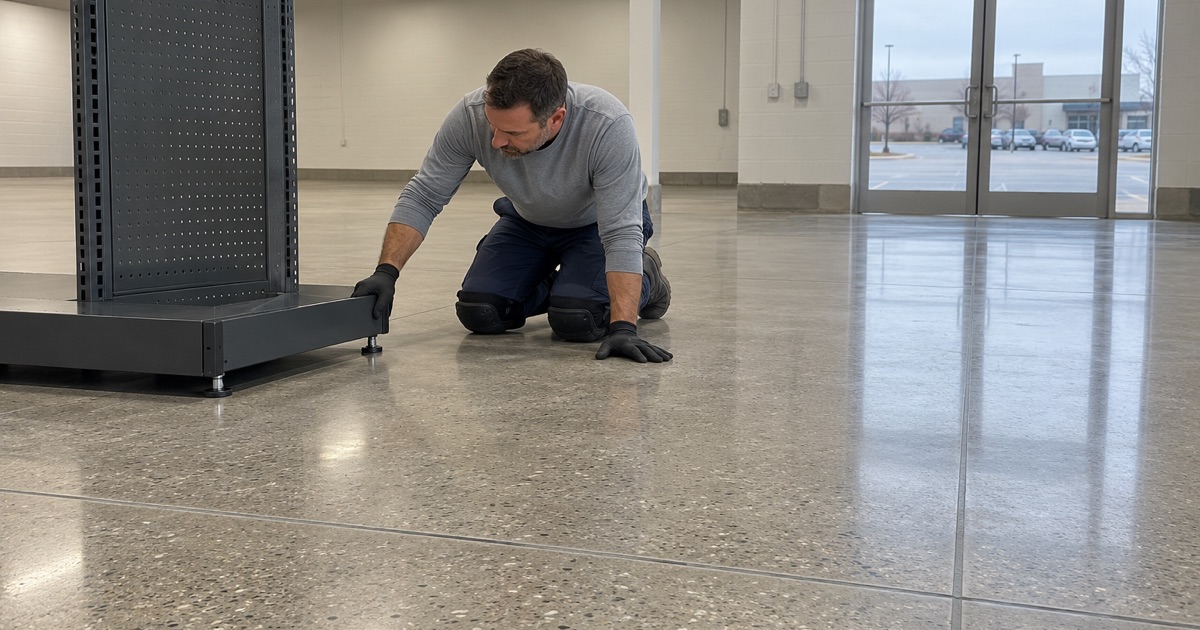
Retail floors take carts, pallet jacks and thousands of shoes, and they have to look clean under bright lighting. Polished concrete handles that traffic without a film to scuff, and its reflectivity helps a space read brighter. In tenant spaces we grind off old adhesive and coatings between leases, so the new tenant opens on a finished floor rather than a bare slab.
A store floor also has to be maintained by staff who are not floor specialists. We set the final sheen and the guard so the floor can be kept up with an auto-scrubber and a pH-neutral cleaner, and we show the maintenance crew what dulls it, which on a northwest suburban floor is grit and salt tracked in from the parking lot.
Offices, Lobbies and Corporate Floors
Office lobbies, break rooms and open work areas are increasingly left as polished concrete rather than carpeted. We schedule that work around business hours, grind with dust captured at the tool, and sequence sections so the building stays usable. Saw-cut lines and borders can break a large floor into zones that match the layout.
Corporate campuses often have several floor types under one roof: a lobby that should impress, a cafeteria that gets spilled on, a loading area that gets carts, and a fitness room that takes dropped weights. We polish where polish suits the use and recommend a coating where it does not, so the building is not given one answer for every room because one answer is easier to quote.
Warehouses and Light-Industrial Floors
In a warehouse, polishing the slab densifies the surface, reduces dusting from wear and makes the floor easier to sweep. It is a fit for areas that see rubber wheels and dry goods. Where forklifts carry steel wheels, chemicals are handled or joints are breaking down, we repair the joints first and may recommend a coating in those zones.
Older industrial slabs in the O’Hare corridor often carry decades of oil, old striping paint and patched joints. Polishing shows every one of those, so we grind a test strip across the worst of it before quoting. Sometimes the honest answer is a polished floor in the aisles and a coating in the shipping and maintenance areas, each priced as its own line.
Residential Polished Concrete Floors
Finished Basements
A polished basement floor is durable, easy to clean and works with radiant heat and area rugs. Moisture still matters even though there is no coating to blister: efflorescence can collect on the surface, and rugs and furniture can trap damp. We test the slab first and point out anywhere water appears to be moving before the floor is finished.
Main-Level Slabs and Additions
Slab-on-grade rooms, additions and sunrooms can be polished when the concrete is in good condition and the floor will not be carpeted later. Fresh slabs need time to cure before grinding, and we plan the schedule with the builder rather than polishing concrete that is still too green.
On new construction, the best polished floors are planned before the pour. A slab placed flat, finished without burn marks and protected from drywall mud and paint during the build polishes more evenly than one patched afterward. When we are brought in early, we tell the builder which finishing and protection steps make the difference, so the floor is not fighting the construction schedule by the time we arrive.
Garages and Workshops
We can polish a garage slab, but we usually recommend against it in this climate. Calcium chloride brine and rock salt sit on the floor for months, and a polished surface has no film to keep that brine out. A coated system is the more practical choice for a parking area, while a workshop or hobby space away from the cars can be a good candidate for polish.
Finishes, Aggregate and Sheen
Cream, Salt and Pepper or Full Aggregate
The depth of the first grind decides how much aggregate shows. A cream finish barely touches the surface and shows almost no stone, a salt-and-pepper finish exposes the fine sand, and a full exposure cuts into the coarse aggregate. Deeper cuts take more passes and reveal more of whatever is in the slab, including patches and old repairs.
The choice is partly practical. A full exposure hides dirt and small wear well and suits a store or a busy lobby, while a cream finish reads cleaner and more modern but shows every trowel mark and repair the original finishers left. We set the test patch at the depth you are leaning toward, then grind a second spot deeper if the first one does not show what you hoped.
Satin, Semi-Gloss and High Gloss
The final diamond and the burnishing step set the sheen. High gloss reflects light and looks dramatic in a showroom, but it shows swirl marks and dust. Satin is more forgiving in homes and offices. We match the reflectivity to the lighting and the cleaning routine rather than to a sample photographed under studio lights.
Dyes, Stains and Guards
Dyes can tint the concrete before it is densified, adding warmth or a gray tone to a slab that came out of the grind too blotchy. A penetrating guard applied at the end slows staining from spills. Neither one hides the character of the slab; they work with it, and we show color on the test area before committing a whole floor to it.
Our Step-by-Step Polished Concrete Process
Step 1: Test Area and Slab Assessment
We look at the slab’s condition, its patches, its cracks and anything glued to it, then grind a small test area. That patch tells us how hard the concrete is, what aggregate lies under the surface, and how many passes the finish you want will take.
Step 2: Removal and Initial Grind
Carpet adhesive, tile mortar, old coatings and sealers come off first. The initial metal-bonded diamond grind then flattens the floor and cuts to the depth chosen for the aggregate exposure, with dust captured at the machine.
Step 3: Crack Repair and Densifying
Cracks and holes are filled with a color-matched filler and ground flush. A lithium silicate densifier is then applied and allowed to react with the concrete, hardening the surface so the finer grinding passes can polish it.
Step 4: Polishing, Guard and Burnishing
Resin-bonded diamonds refine the surface pass by pass until the chosen sheen is reached. A guard is applied if the space calls for one, the floor is burnished, and we walk the owner through a simple cleaning routine before handing it back.
- 20+ Years Coating Floors
- Moisture Tested Before Coating
- Written Contract on Every Home Job