Schaumburg Epoxy Flooring brings more than 20 years of concrete coating work to epoxy flooring in Pingree Grove, and most of the floors we are asked to look at here are young ones. A young slab is easier in some ways and trickier in others. It usually has no failed coating to strip, but its age says nothing about the moisture it may still carry.
Our first visit is about the concrete itself. We check the surface for sealer or cure compound left from the pour, read every crack, and decide what moisture testing the slab needs before it can take a coating. The proposal that follows names the product, the system build and the finished thickness, so the floor that goes down can be measured against the paper.
The sections below follow the village as we find it: a place assembled mostly in the last two decades, slabs newer than their owners might expect to matter, garages handed over by a builder, and a permit desk still busy with new homes.
Half the village built since 2010
From 124 residents to more than 10,000
Pingree Grove is a village in Kane County, spread across Rutland and Plato townships. The census counted 124 residents there in 2000, then 4,532 in 2010 and 10,365 in 2020. The housing stock carries the record of that growth more plainly than any map.
Growth on that scale suggests most homes here have known only one or two owners. Often nobody living in the house watched the slab poured, and the builder’s paperwork rarely says what went under it or how it was cured. We treat that gap as the starting point of the job rather than something to fill in with a guess.
1,490 homes in the 2010s, 335 more since 2020
The Census Bureau’s five-year survey puts 3,637 housing units in the village. Of those, 1,490 were built between 2010 and 2019, and 335 more have gone up since 2020. Together that is 1,825 homes, about half the village, standing on concrete poured within roughly the last fifteen years.
Another 1,519 units date from 2000 to 2009, which leaves homes built before 2000 as a small remainder. For our crews, that points to a first coating over a builder-finished slab as the typical job, rather than removing a coating someone rolled on decades ago. We draw that from the build dates; we have not surveyed what is actually on each floor.
Owners, nearly without exception
Of the occupied homes, 98.5 percent are lived in by their owners, and only 53 households rent. The person choosing a new floor is almost always the person who will walk on it for years. That changes the questions we hear, because an owner asks how a floor will wear over a decade rather than how it photographs for a listing.
Looking for epoxy-flooring closer to Winnetka? See Epoxy-Flooring Services in Winnetka.
A slab under fifteen years old is not a tested slab
Why young concrete still gets a moisture test
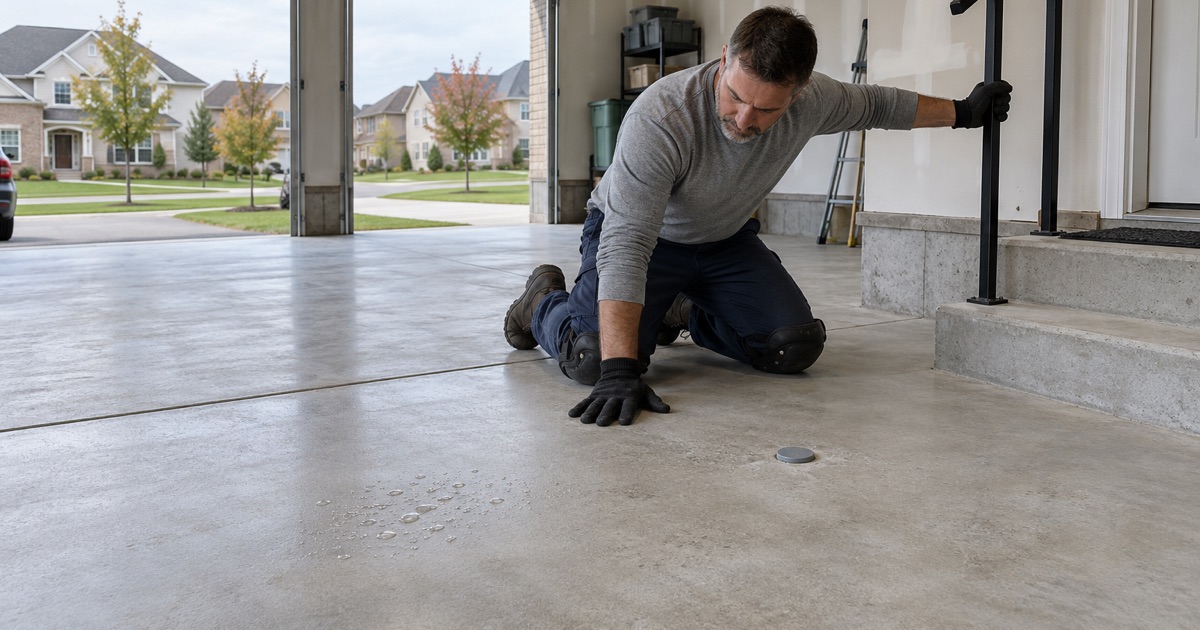
A slab’s age does not tell us whether vapor is still moving up through it. A garage poured in 2015 can be perfectly dry or still pushing moisture, depending on what lies beneath it and how the lot drains. So moisture testing appears in our scope as its own line, for a garage and a basement alike, before any product is chosen.
The model residential code exempts garage slabs from the vapor retarder it requires under other floors, an exception the 2021 IRC numbers as R506.2.3. We have not checked which IRC edition Pingree Grove has adopted, or whether it amended that section. In practice the exemption means a garage may have been poured with nothing between the concrete and the ground, and only a test tells us.
How we take the reading
On a garage we often begin with an ASTM D4263 plastic sheet test as a quick screen, then move to ASTM F1869 calcium chloride kits or ASTM F2170 in-situ relative humidity probes when the result needs a number. Those readings decide the system. A slab that tests high gets a moisture-mitigation primer under the coating instead of a hopeful assumption.
Before anything is signed, we read the warranty exclusions aloud, and moisture leads that list. An owner should hear that at the kitchen table, not discover it the first time a blister lifts.
Cure compound, trowel finish and young cracks
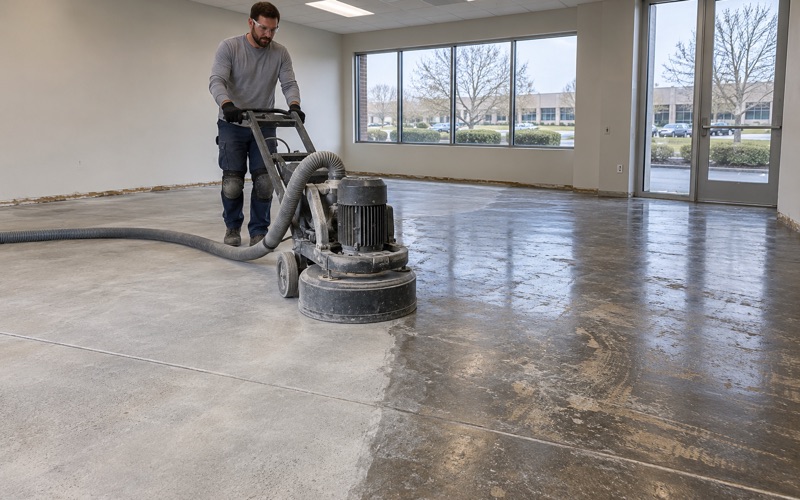
A newer slab sometimes still wears a curing compound or a hard, burnished trowel finish that a coating cannot grip. We open the surface with a diamond grinder or shot blaster to a measured ICRI concrete surface profile, and we never acid etch. Grinding also takes off the weak top layer so the epoxy bonds to sound concrete.
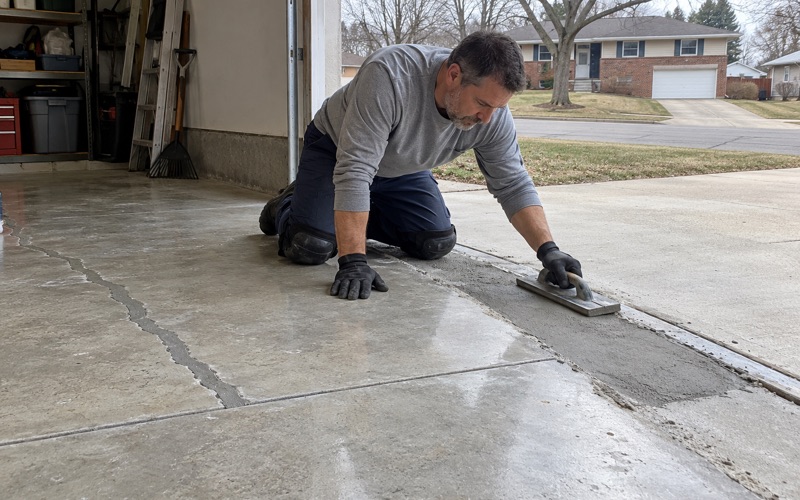
Shrinkage cracks are common in young concrete, and we read each one for whether it is still moving. A coating is a film that follows the slab beneath it. It will not hold a moving crack shut, and we say that before we quote rather than after the floor is down.
Garages finished by the builder, decided by the owner
What a builder-finished garage usually needs
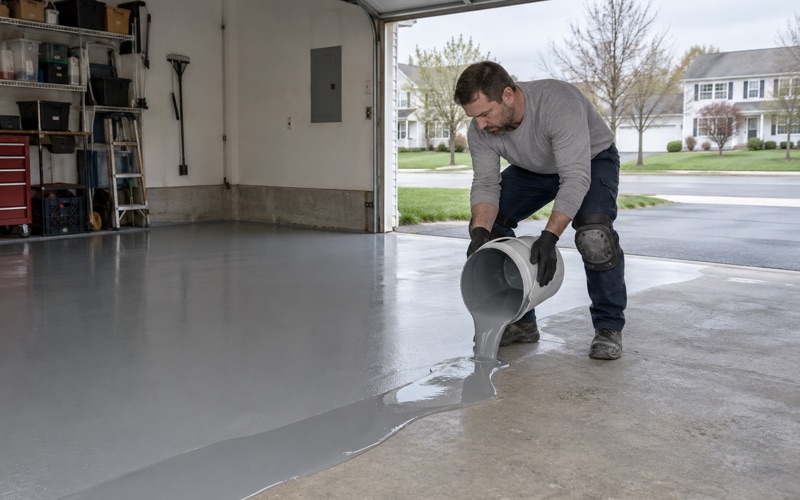
In a subdivision home the builder hands over the garage, and the coating decision falls to whoever owns the house. Most floors we expect to meet here have never been coated, though that is inferred from the build era rather than from walking every garage. For those, the work is grinding, crack repair where the slab calls for it, and a system sized to how the space gets used.
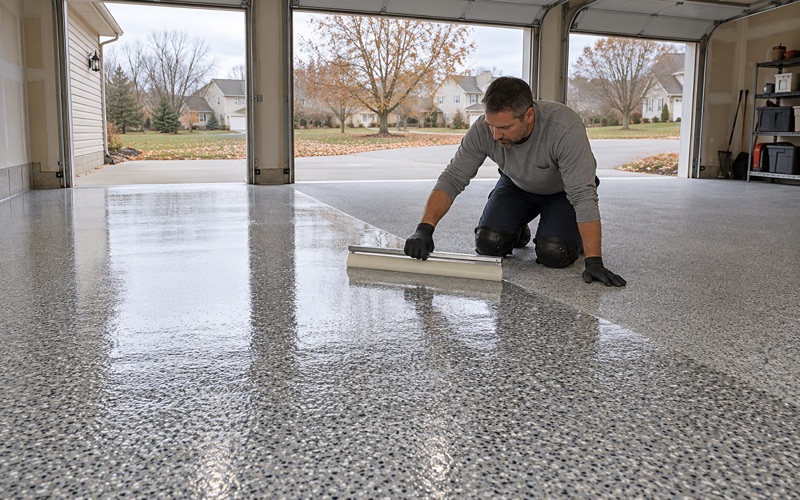
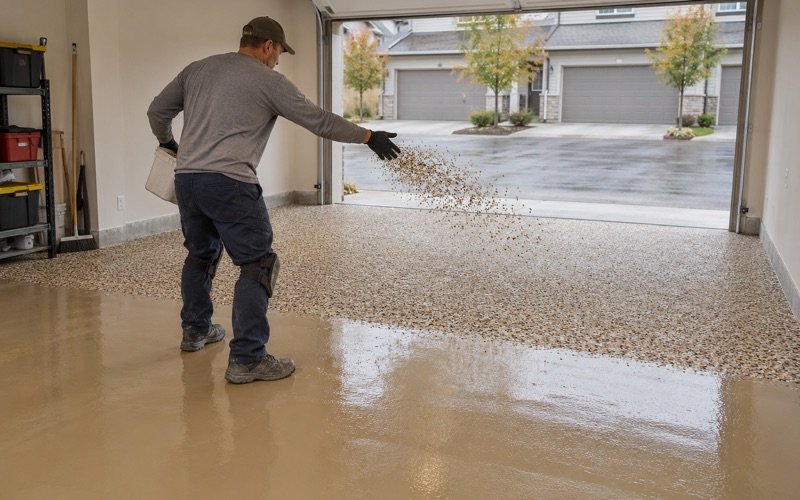
A common build is a 100% solids epoxy base, a vinyl flake broadcast for texture and to hide dust, and a polyaspartic topcoat that resists hot tire pickup. Owners who want more grip at the step into the house can choose a quartz aggregate broadcast instead. Whichever build is chosen, its layers and finished thickness are written into the proposal.
Not every owner wants a full coating. Some only want the dust to stop, and a lithium silicate densifier hardens the top of the concrete without laying a film over it. Others want a durable color but expect to park a heavy vehicle on it daily, which pushes us toward a thicker base. We lay out those choices side by side with what each one costs and how long each takes to cure.
Attached homes and shared edges
About 41.5 percent of homes here are single-family attached, and 1,486 of those are owner-occupied. In an attached home the garage may share a wall, an apron or a driveway with the neighbor’s. Exterior items there usually fall under an association’s rules and the interior floor usually does not, but that is a document for the owner to check, not something we assume.
On those jobs we plan around the neighbors’ need to reach their own garages. Grinding dust, vehicle access and cure time are all scheduled so that one owner’s new floor does not close a driveway two households depend on.
Cure time and the calendar
Epoxy cures according to slab temperature and the dew point spread at the surface, not according to the date on the contract. We schedule against those readings. When an unheated garage is simply too cold, we tell the owner it has to wait for spring rather than coat a slab that will not cure properly.
Cold, damp air also invites amine blush, a waxy film that can rise on curing epoxy and keep the next coat from bonding. We watch for it between layers and clean it off before recoating when it appears. That step costs a little time and saves a topcoat that would otherwise peel.
Permits in a village still building
Who signs off on what
The Village of Pingree Grove is the building authority, and its building-permit fees are set in Title 10, Chapter 4 of the Village Code, amended by Ordinance 2025-O-26. We have not read the ordinance text, so we do not guess at what it says about floor coatings. Before each job we call the permit desk, ask whether a coating counts as decorating or needs a permit, and go by the answer.
New construction in the village must also notify the Pingree Grove & Countryside Fire Protection District and meet its submittal, inspection and occupancy requirements. Kane County’s building division notes that Illinois fire protection districts may adopt and enforce ordinances independent of the county’s building codes. That is one more reason we confirm the local rules before a job rather than borrow them from the next town.
Working beside active construction
Because the village is still issuing new-construction permits, some of our jobs may sit next to lots where new homes are still going up. Dust control and access for our equipment matter more in those settings. We plan the grinding and the cure window around crews on neighboring lots, not only around the household.
New homes also bring new routines. An owner who has just closed on a house may want the garage done before the first car parks in it, while a household that has lived there since the 2010s needs the garage emptied and a place to park during the cure. We build the schedule around whichever case we are walking into.
Registration, contracts and VOC limits
Illinois issues no license for flooring or coating contractors, so we confirm any village registration, bond and insurance rules before a job reaches the calendar. Every home job comes with a written contract and the state’s Home Repair: Know Your Consumer Rights pamphlet, as the Illinois Home Repair and Remodeling Act requires. The coatings we choose sit within the state’s VOC content limits, which bind the crew applying them as well as the company making them.
A floor coating is also not a radon fix. In Illinois, radon mitigation takes a license through IEMA, and we do not sell a floor system as a substitute for that work.
- 20+ Years Coating Floors
- Moisture Tested Before Coating
- Written Contract on Every Home Job