Schaumburg Epoxy Flooring approaches epoxy flooring in Northlake with a question most color charts skip: where has the water been? After more than 20 years coating basements, garages and commercial rooms, we have learned that the parcel and the slab decide how a floor turns out long before the product does.
A floor coating is a thin film bonded to concrete. It can be a very good film, built from 100% solids epoxy and finished with a polyaspartic topcoat, but it only performs as well as the slab under it and the moisture moving up through it allow.
So a Northlake job with us starts with two checks before any product is named. One is a question to the city about the parcel. The other is a moisture test on the slab itself, priced into the scope rather than offered after something has already gone wrong.
Addison Creek, the Doyle Retention Basin and the 2005 Ordinance
A creek with a flooding record
Addison Creek runs through Northlake, and its recurring flooding is part of the public record. The Cook County hazard mitigation plan’s 2024 annex for Northlake notes that the Doyle Retention Basin was built to relieve that flooding. A retention basin is meant to reduce how often and how badly a creek causes trouble, but it cannot tell any one owner what has happened under their own floor.
The same annex places Northlake inside the Lower Addison Creek Watershed planning area of the Metropolitan Water Reclamation District’s stormwater master planning program. That is the regional layer of stormwater planning. At the city level, Northlake has carried its own stormwater code since 1990.
Who administers the floodplain
Since June 6, 2005, Northlake has administered a flood damage prevention ordinance, and the Building Department serves as the city’s floodplain administrator. That is the same office that registers contractors and enforces the building code the city adopted as municipal code 8-1A-1 in 2003. The annex also records a November 2023 FEMA contact meeting with the city, so the floodplain program has seen recent federal attention.
For an owner, that means there is one office to ask, and it is the right one. We would rather put a floodplain question to the people who administer the ordinance than guess at an answer from a map.
What the record does not say
Nothing in that history tells us how many Northlake homes have taken water, and we do not pretend otherwise. Plenty of floors near the creek may be perfectly dry. The point is narrower: on a parcel the city treats as floodplain, the floor job carries a question that a floor elsewhere may not.
Looking for epoxy-flooring closer to Franklin Park? See Franklin Park Epoxy-Flooring.
Asking the City Before the Work Is Scheduled
The floodplain question comes first
Whether a floor coating on a floodplain parcel needs anything from the city is a question we take to the Building Department before the job goes on the calendar. We do not assume that resurfacing a basement or garage floor counts as decorating, and we do not assume it triggers a permit either. We ask, we note who answered, and we write the answer into the scope.
That habit costs a phone call or an email. Skipping it can mean a stop-work conversation halfway through a cure, which is the worst possible moment to have a floor out of service.
Registration, bond and insurance
Illinois issues no state license for flooring or coatings work, so no installer here can show you a state coatings license. What Northlake requires is local: every contractor and subcontractor registers with the city for a $100 annual license that runs one year from issuance, posts a $10,000 bond and files a certificate of insurance naming the City of Northlake. We confirm that paperwork is current before we schedule, not after a neighbor asks.
Most of the residential floors in Northlake belong to the people who live on them; Census figures count 2,627 owner-occupied single-family detached houses in the city. For those owners, the registration check is a simple way to know the crew in the driveway is answerable to the same Building Department that administers the city’s floodplain ordinance.
Paperwork you get from us
Every home job comes with a written contract and the Home Repair: Know Your Consumer Rights pamphlet before work begins, as the Illinois Home Repair and Remodeling Act requires. Our proposal names the product, the system build and the finished thickness. If an answer from the city changes the scope, that change goes into the same document, so what you agreed to and what went down can be compared line by line.
On commercial rooms, a fire-code question goes to the Northlake Fire Protection District, which operates from a station on Parkview Drive. Fire protection here is a separate district rather than a city department, so City Hall is not the place to ask it.
Testing a Slab That May Already Have Been Wet
Why a once-wet slab is a different slab
Concrete that has sat under water, or beside a seeping wall, can hold moisture and dissolved salts long after the surface looks dry. Those salts surface as efflorescence, a white crust that a coating will sit on rather than bond through. Moisture pushed up by hydrostatic pressure under a basement slab is one of the most common reasons a coating blisters or peels early.
Northlake’s housing leans older, with 1,799 of its 4,526 units built in the 1950s. A slab from that era may have no under-slab vapor retarder at all, and a newer garage slab poured to code can lack one too, because the model code exempts garages. Either way, we test rather than assume.
The tests we run
Moisture testing is a line item in our scope on every basement and garage slab. Depending on the floor, that means ASTM F1869 calcium chloride vapor emission testing, ASTM F2170 in-situ relative humidity probes set into the slab, or an ASTM D4263 plastic sheet test as a first read. We compare the results against the manufacturer’s limits and the ASTM F710 thresholds, and we record the numbers.
If a slab reads high, a moisture-mitigation primer designed for that condition can go down first, and we price it as its own step. If the reading is far enough out that no primer is an honest fix, we say so and recommend dealing with the water before anyone talks about color.
When a basement has taken water recently, we would rather wait than rush. A slab that is still drying out will read differently next month than it does today, so we may test once, let the space dry with the source of the water addressed, and test again before we commit to an install date.
Reading cracks, drains and the old coating
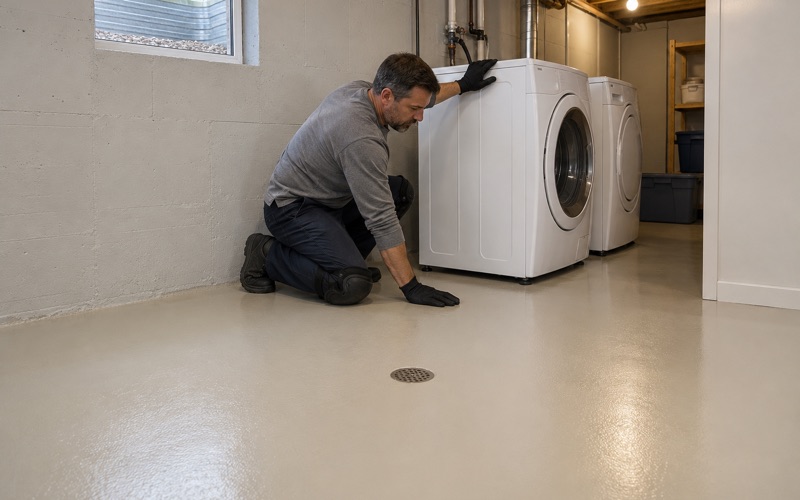
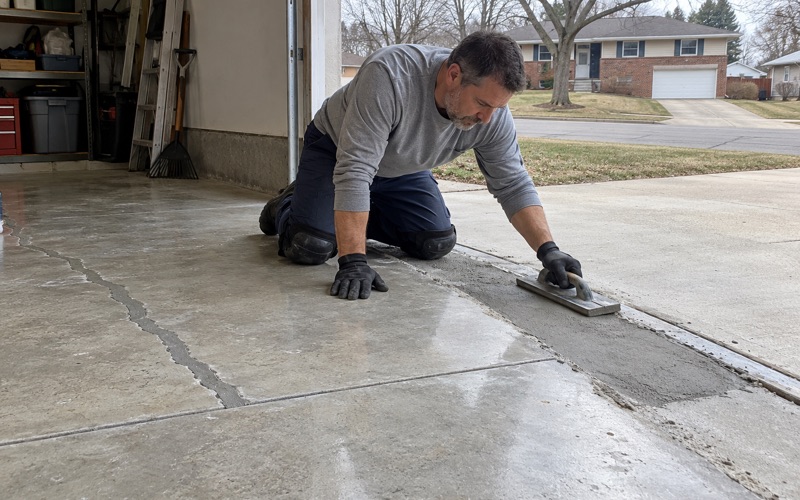
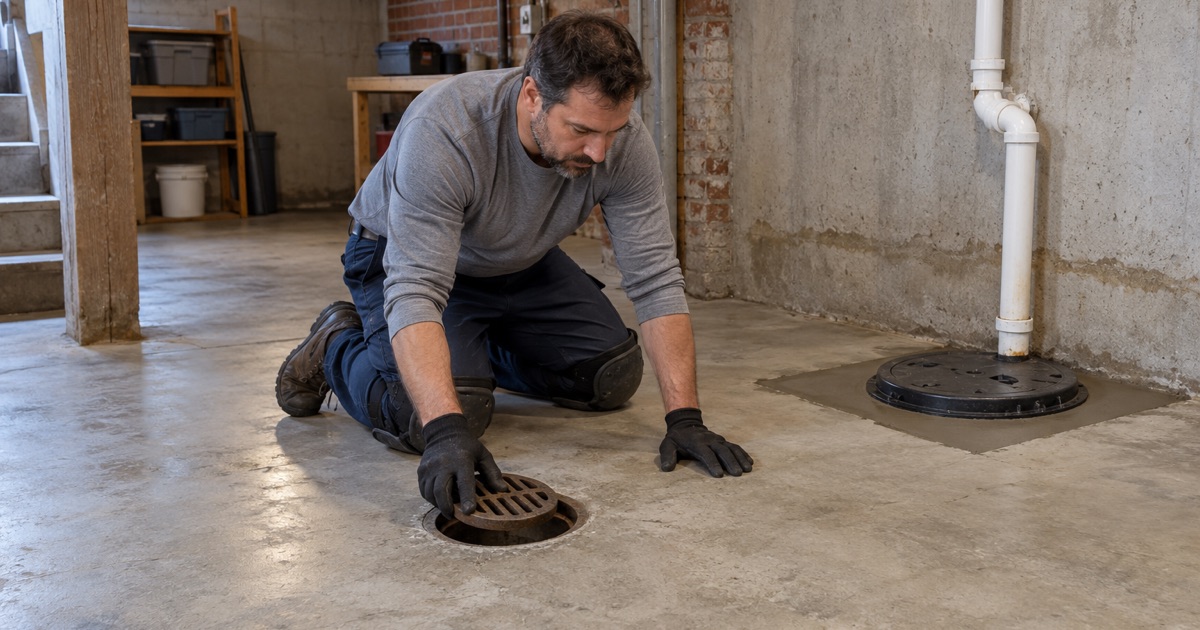
We look at the cracks, the sump pit and the floor drain before quoting. A floor drain that has backed up, a stained sump rim or an old coating lifting in a band along the walls all show where water has been. Where a slab needs patching or crack repair before it can carry a coating, that goes in the proposal as a separate line.
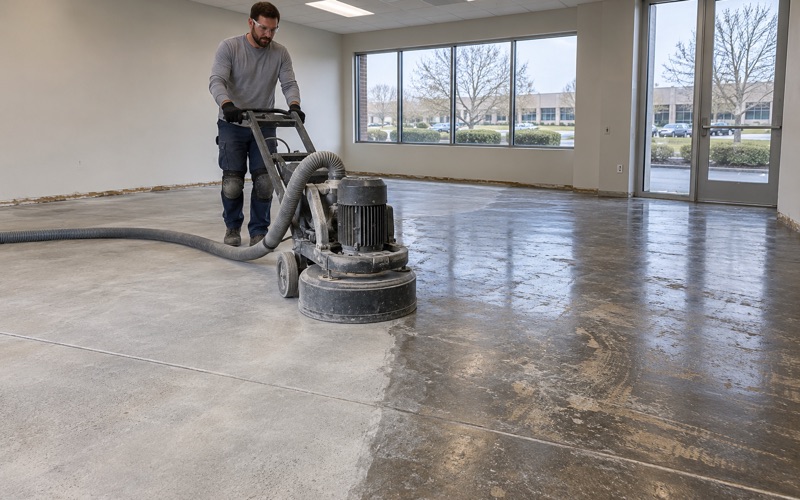
Every floor is then opened mechanically, by diamond grinding or shot blasting to an ICRI CSP profile suited to the system. We do not acid etch, because acid leaves residue and added water in exactly the slab we are trying to read and dry.
What a Coating Does and Does Not Do Near a Creek
What it does
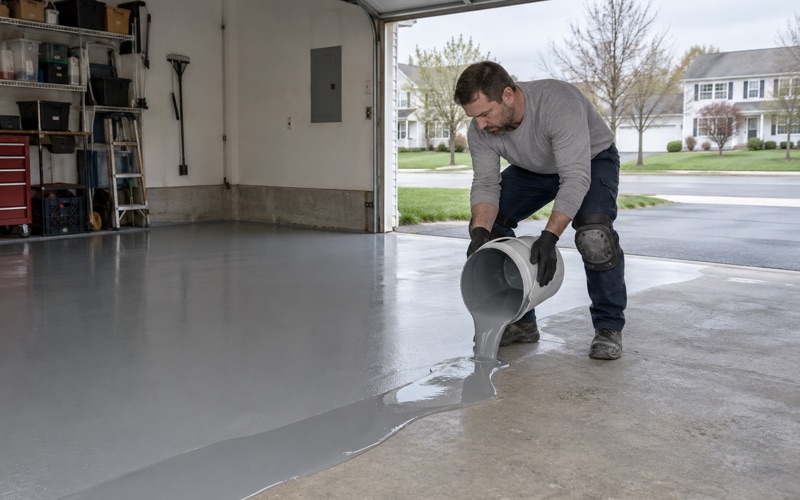
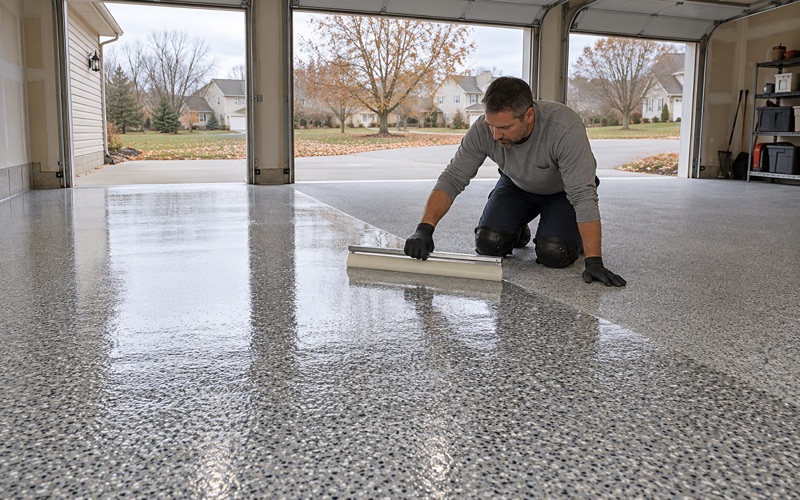
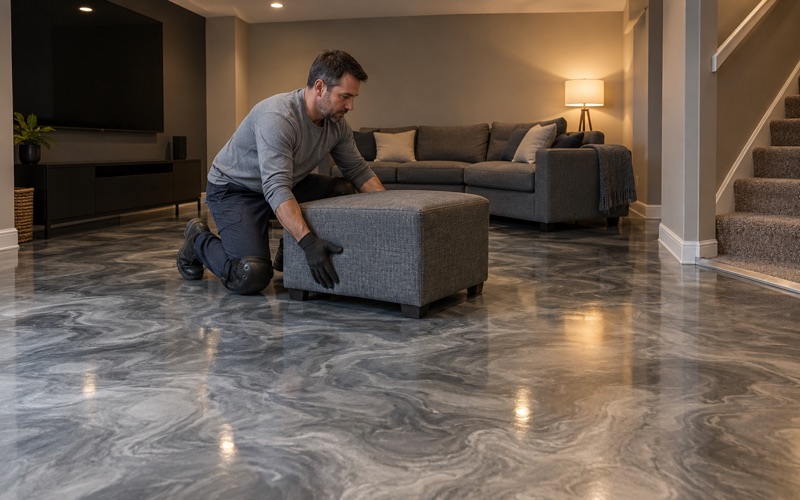
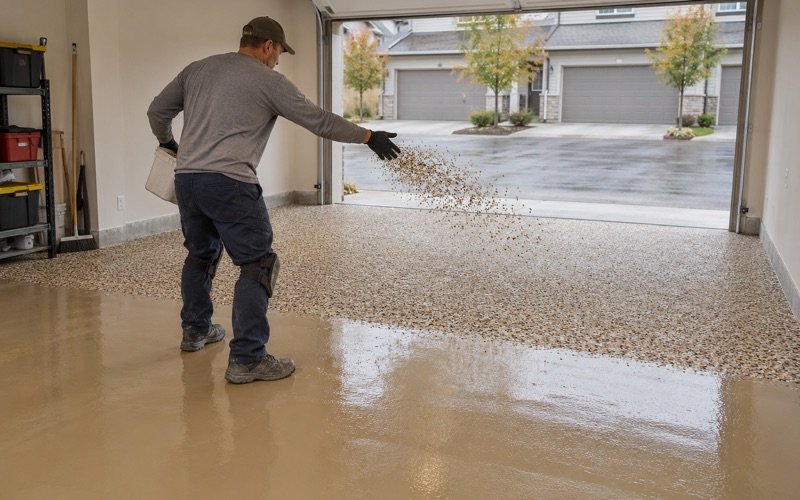
A properly prepared, moisture-tested floor coated with 100% solids epoxy gives you a sealed, cleanable surface that sheds spills, grime and tracked-in salt. In a garage, a vinyl flake or quartz aggregate broadcast adds texture, and a polyaspartic or polyurea topcoat resists hot tire pickup and the calcium chloride brine and rock salt that ride in on the tires each winter. In a basement, it turns a dusty slab into a floor you can mop.
Around a sump pit or floor drain, the detailing matters as much as the open floor. We finish the coating cleanly at the drain body and the sump rim so that any water that does arrive can still reach them, instead of pooling behind a raised lip of resin. Where a home has an overhead sewer or other backup protection, we keep cleanouts and access points uncoated and reachable.
What it does not do
A coating does not stop floodwater, seepage or a sewer backup. It does not waterproof a basement, does not change a parcel’s flood-zone status and has no bearing on flood insurance. If water comes up through a floor drain, it will sit on top of epoxy just as it would on bare concrete.
A coating is also a film that follows the slab under it, so it will not hold a moving crack together. We say that before the job, not after a line reappears. Nor do we sell a floor coating as radon reduction, since in Illinois that work takes an IEMA radon mitigation license and belongs to a separate trade.
Warranty and curing, stated up front
Warranty exclusions are read to you before the job is sold, and moisture is the first one named. On a slab that has taken water before, that conversation is the honest center of the sale rather than the fine print.
Curing is scheduled against slab temperature and the dew point spread at the slab surface rather than the calendar. Every coating we use is chosen within the Illinois limit on VOC content for architectural coatings, which binds the installer as well as the manufacturer.
- 20+ Years Coating Floors
- Moisture Tested Before Coating
- Written Contract on Every Home Job