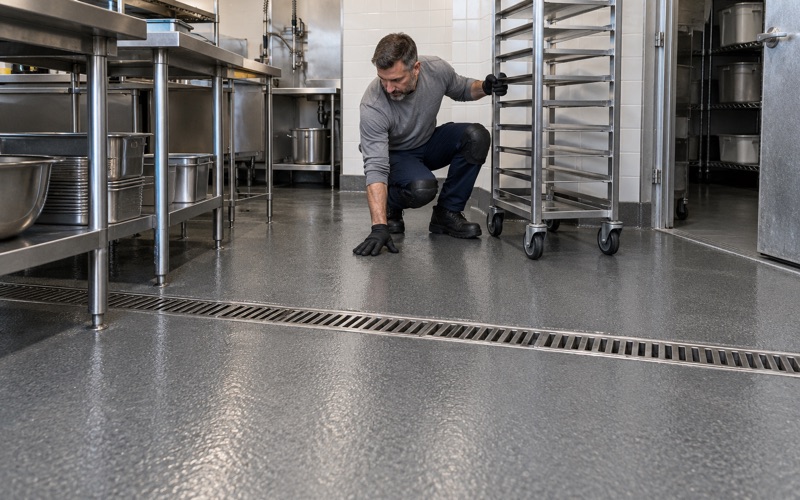
Schaumburg Epoxy Flooring has spent more than 20 years on concrete, and our epoxy-flooring in Lincolnwood work leans toward a kind of floor most suburbs do not have much of: older warehouse slabs that trucks and vans drive straight onto. A floor like that has already lived a working life before anyone calls us. Our job is to recondition it so it can carry the next one.
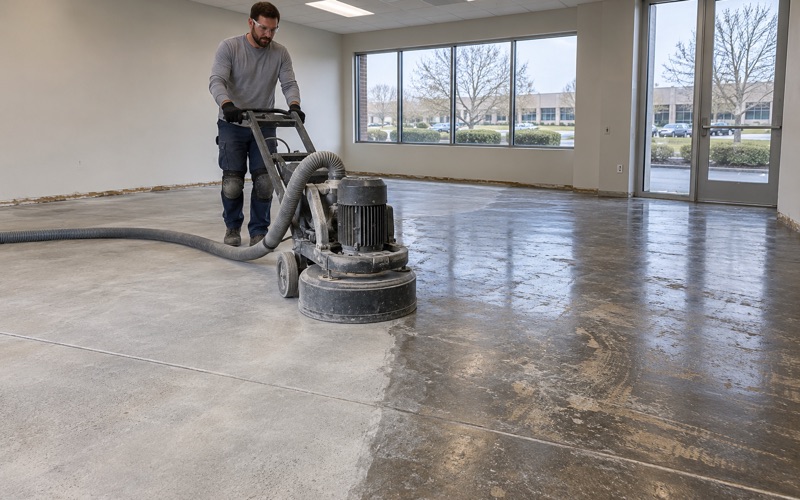
That starts with mechanical prep. We open the surface with a diamond grinder or a shot blaster before any resin touches it, and acid etching is not part of how we work. Before a price goes on paper, we walk the cracks, joints and any old coating, and when a section has to be repaired before it can be coated, we tell the owner that directly.
The proposal we hand over lists the product, how the system is built up and the finished thickness. That gives a property manager or tenant something concrete to hold the finished floor against. Moisture testing appears on it as its own priced line rather than as a fix sold after a coating lets go.
The Northeast Industrial District After Its TIF
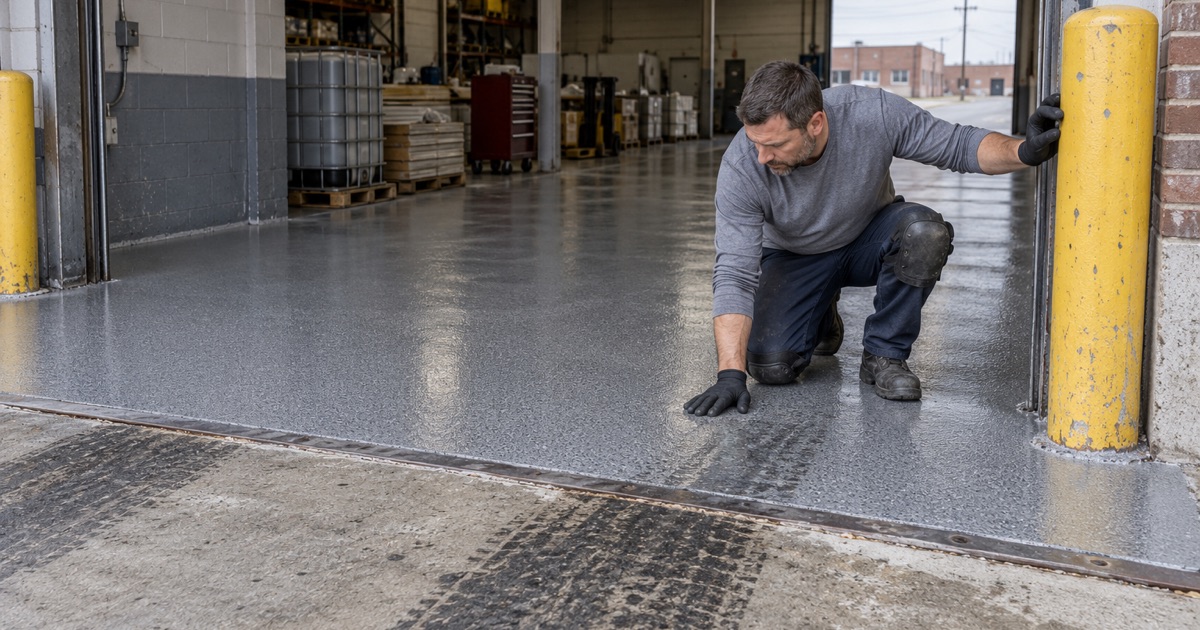
Lincolnwood sits in Niles Township, Cook County, an inner suburb that shares much of its boundary with Chicago. Its industrial floors are concentrated in what the village calls the Northeast Industrial District, a stretch of warehouse and light industrial buildings rather than a scattering of shops. That concentration is why so many of the floor questions we hear from this village are about loading areas and vehicle lanes rather than basements.
What the End of a TIF Changes for an Owner
The village says the Northeast Industrial District TIF expired at the end of 2020, and it prepared a NEID TIF Conceptual Development Plan afterward. We have not read that plan and will not guess what it proposes. What matters on our side is simpler: an owner reconditioning a building here is generally paying for the floor out of the building’s own budget, so the scope has to be honest about where the money does the most good.
Reconditioning, Not New Construction
A district built out decades ago means the slab is already in place, already cured and already carrying history. There is no fresh pour to schedule around and no chance to put a vapor retarder under it after the fact. Our work is to read what the existing concrete is telling us and choose a system that suits it, not to pretend it is a new floor.
Splitting the Work by Use
Most warehouse buildings have zones that ask very different things of a floor. A drive-in lane, a racking aisle, a parts cage and a small office or break room do not need the same coating. We price them separately so the owner can put the heaviest build where the vehicles go and spend less where the floor mostly sees foot traffic.
Looking for epoxy-flooring closer to Western Springs? See Western Springs Epoxy-Flooring.
A 1975 Warehouse on McCormick Boulevard
The clearest picture of the local stock is a single building. A lease listing describes 7080 North McCormick Boulevard as a 229,540-square-foot industrial warehouse built in 1975 and renovated in 1984, with 20-foot clear height, 2 exterior dock-high doors and 6 drive-in doors. We have not been inside it and are not describing its floor; we use it because it shows what a typical box in this part of the village looks like.
Fifty Years of Concrete
A slab poured in the mid-1970s has had about fifty years to shrink, settle and take whatever its tenants rolled across it. Over that span a warehouse floor commonly picks up saw-cut joints that have opened, edge spalls along those joints, patches from equipment changes and layers of paint or sealer from earlier owners. Every one of those affects how a new coating will bond, which is why we inspect before we quote rather than after.
What a 1984 Renovation May Have Left Behind
A building that was renovated in 1984 may carry floor work from that period on top of the original slab. Old striping paint, a worn sealer, a cut-in patch where a wall used to stand: none of it is a problem until a new coating is asked to stick to it. Grinding takes the surface back to sound concrete, and we bring it to an ICRI concrete surface profile matched to the thickness of the system going down.
Testing a Slab That Has No Retarder Under It
Concrete placed in that era was often laid without the under-slab vapor retarder that modern practice calls for, and nothing on top can add one later. We test before we coat, using ASTM F1869 calcium chloride kits or ASTM F2170 in-situ relative humidity probes depending on the floor, and compare the numbers to the coating maker’s limits. When readings run high, a moisture-mitigation primer goes into the scope, and moisture is the first warranty exclusion we read out before anything is signed.
Cracks, Joints and Honest Expectations
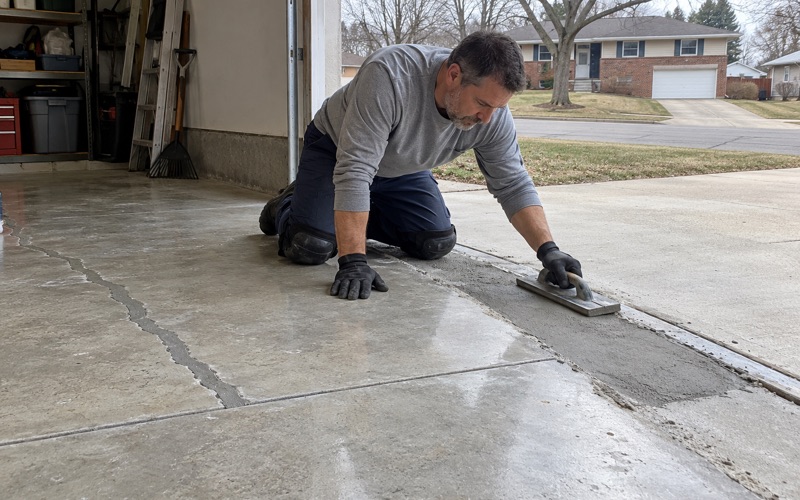
A coating is a thin film that follows the concrete under it. If a crack in a fifty-year-old slab is still moving, a new floor laid over it will show that crack again, and we say so plainly rather than promise otherwise. Joints that need to keep working are honored and filled with a flexible material, while dormant cracks can be routed and repaired before the base coat.
Six Drive-In Doors: Vehicles on the Slab
Dock-high doors put trucks at the edge of the building, with only forklifts and pallet jacks crossing onto the floor. Drive-in doors are different. They bring vans, box trucks and service vehicles straight onto the slab, so the floor near those openings is treated as a driving surface rather than a warehouse aisle.
Hot Tire Pickup and Turning Loads
A tire that has just come off the road is warm, and a soft or thin coating can lift and stick to it, a failure the trade calls hot tire pickup. Turning a loaded vehicle on the spot also grinds the surface in a tight arc. We counter both with a 100% solids epoxy base at a real film thickness and a tougher polyaspartic or polyurea topcoat, instead of a single thin coat that cannot stand up to rubber.
Footing Where Vehicles Track In Water
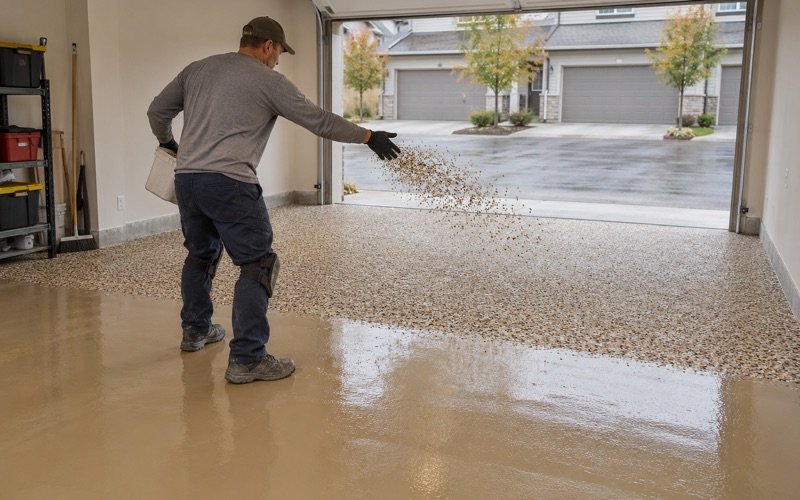
Anything that rolls in through a drive-in door can bring water and grit with it, and a glossy floor near the threshold turns slick fast. A quartz aggregate broadcast locked between coats gives that zone a textured wearing surface. Farther into the building, where traffic is mostly people and carts, the texture can ease off so the floor stays easy to sweep.
Oil, Fluids and the Parking Footprint
Where vehicles park inside, they leave drips, and decades of those drips can soak deep into old concrete. We check stained areas for contamination and grind test patches to see how far it goes, because oil left in the slab can push a new coating off within weeks. Light staining usually comes out with degreasing and mechanical prep, while heavily saturated spots may need cutting out and patching, and the proposal names which one applies.
Keeping Doors in Service During the Work
A building with several drive-in doors rarely wants all of them closed at once. We sequence the job by bay so one door and its lane are out of service while the others keep moving. Polyaspartic topcoats help here because they return a section to foot traffic quickly, and we state separately when each lane can take vehicles again, which is later than when it can take boots.
Pratt Avenue Space and Who Signs Off
Industrial use in Lincolnwood is not limited to McCormick Boulevard. Along Pratt Avenue, near 3600 West Pratt, commercial and industrial space sits side by side, which often means a single building holds a showroom or office up front and a working floor behind it. Those mixed buildings are where scheduling and finish choices matter most.
Front Rooms and Back Floors
A customer-facing front room might suit a decorative vinyl flake broadcast or a clean, sealed finish, while the back area needs a build closer to the warehouse systems above. Where a stretch of floor sees only light traffic, a ground and lithium silicate densified slab can be a lower-cost alternative to a full coating. We lay out those choices room by room so the owner can compare them on one page.
Working Around Open Hours
Commercial spaces still have to serve customers and ship orders while their floors are redone. We schedule grinding and coating overnight, over weekends or in the gap between one lease ending and the next starting, whichever keeps the business running. Cure is timed by slab temperature and its margin above the dew point, not by the calendar, so we measure before each coat rather than assume.
The Village License Comes First
Illinois issues no state license for flooring or coatings work, so the binding requirement here is local. The Village of Lincolnwood requires every contractor to hold a current village contractor license, valid for one year, and a general contractor also posts a $10,000 bond and a $1,000,000 certificate of insurance naming the village as additional insured. A permit is not issued until all contractors are identified and registered, so we confirm our standing with the village before a date goes on the calendar.
Permits, Inspections and Coating Rules
We also ask the village permit desk whether a particular coating job is treated as decorating or needs a permit, rather than assuming either answer. The Lincolnwood Fire Department provides fire inspection services, and on commercial projects we expect to coordinate with that office where the scope calls for it. Every product we specify falls within the Illinois limit on VOC content, a rule that binds the installer as well as the manufacturer.
- 20+ Years Coating Floors
- Moisture Tested Before Coating
- Written Contract on Every Home Job