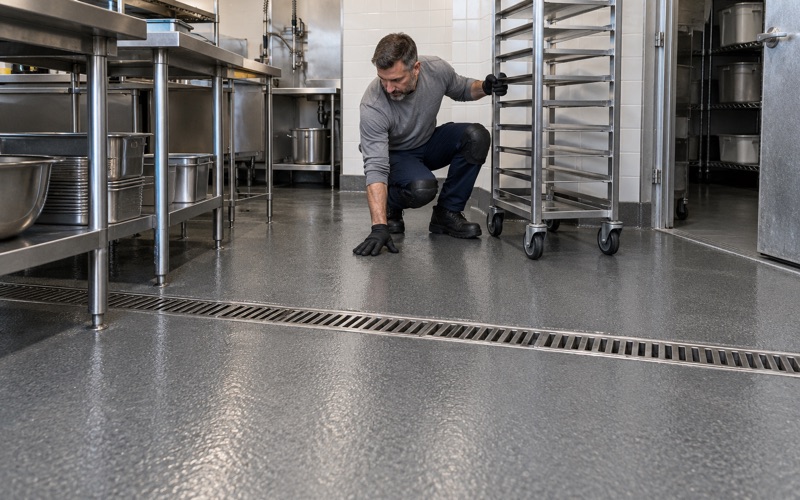
Schaumburg Epoxy Flooring brings more than 20 years of epoxy-flooring in Lake Zurich and across the northwest suburbs to a kind of job that rarely looks like a single open plant floor. Much of the industrial space we see in this village is leased in bays, which means the floor we are asked to coat is usually one tenant’s share of a larger building, with neighbors on either side who still have work to do.
That changes how a proposal gets written. Ours names the product, the system build and the finished thickness, so a property owner, an incoming tenant and a facilities manager can all check the same document against the floor that went down. It also lists moisture testing as its own line, priced up front, instead of something offered after a coating has already lifted.
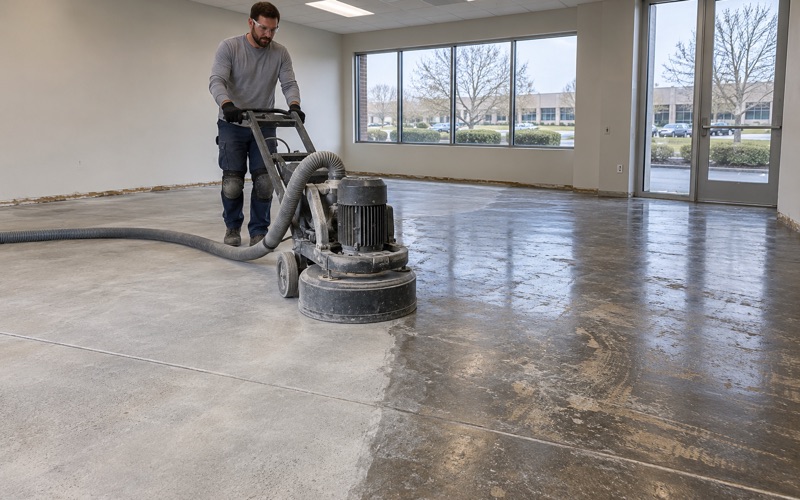
Before any primer goes on, the slab is opened mechanically with a diamond grinder or a shot blaster. We do not acid etch, and we do not quote a bay we have not walked, because cracks and old coatings tell us whether the concrete needs repair first.
Nine Units, Seven Tenants on Oakwood Road

Commercial listing descriptions for 61-95 Oakwood Road describe one building split into nine units and leased to seven tenants. One of them, according to those listings, is Bureau Veritas of North America in about 22,104 rentable square feet. Those numbers come from listing summaries rather than village records, but they describe a pattern we see across the Lake Zurich Industrial Park: many separate operations sharing walls, docks and a parking lot.
What a multi-unit building does to a floor job
In a building like that, each bay is its own customer with its own schedule. One space may be empty and ready for work while the unit next door is shipping product that morning. Our crew plans dust control, equipment staging and dock access so that the work stays inside the bay we were hired for.
Reading the slab one bay at a time
Bays in the same building do not always share the same floor history. One may carry a worn industrial coating, another a sealer, a third bare concrete with oil stains soaked into the surface. We test and profile each space on its own terms, aiming for the ICRI CSP range the chosen system calls for rather than assuming the slab next door tells us anything.
The line where one unit meets the next deserves its own look. A demising wall often sits on or near a joint, and a coating carried across that line can crack where the slab moves. We stop the system at the joint or detail it so the movement has somewhere to go, and we keep our work on our client’s side of the wall.
Square footage sets the scale, not the system
A bay of more than 20,000 square feet is a large floor to coat in a single window, and a small bay can be done in a few working days. Size changes the crew, the equipment and the number of mixing stations. It does not change the testing or the surface preparation, which stay the same on every bay we take.
Looking for epoxy-flooring closer to Schiller Park? See Epoxy-Flooring in Schiller Park.
The Floor Between One Lease and the Next
The cleanest moment to replace an industrial floor is when a space is empty. Racking is down, machinery is gone, and nobody needs the bay until the next tenant moves in. That window is usually set by a lease date, so the coating schedule has to fit inside it rather than the other way around.
Testing first, even on a tight turnover
A short window tempts everyone to skip the moisture check. We do not. Depending on the slab and the system, we run ASTM F1869 calcium chloride tests, ASTM F2170 in-situ relative humidity probes, or a quick ASTM D4263 plastic sheet test to screen for trouble. If readings sit above what the product allows under ASTM F710 thresholds, the proposal adds a moisture-mitigation primer instead of hoping the floor stays down.
What the last tenant left behind
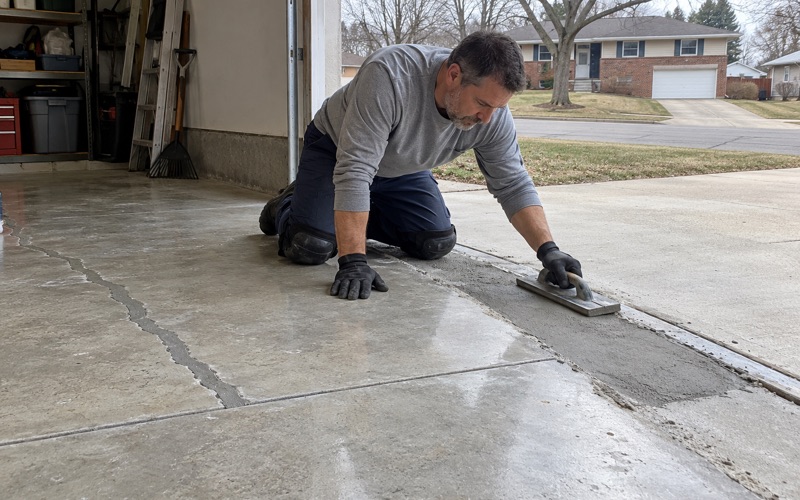
Turnover floors often carry anchor holes from removed racking, forklift ruts, and chemical stains from whatever the previous occupant ran. We read those before we quote and say plainly when the concrete needs patching or joint repair before it can be coated. A coating is a film that follows the slab under it, so a crack that is still moving will show through, and we tell the owner that before the job starts.
Matching the system to the next use
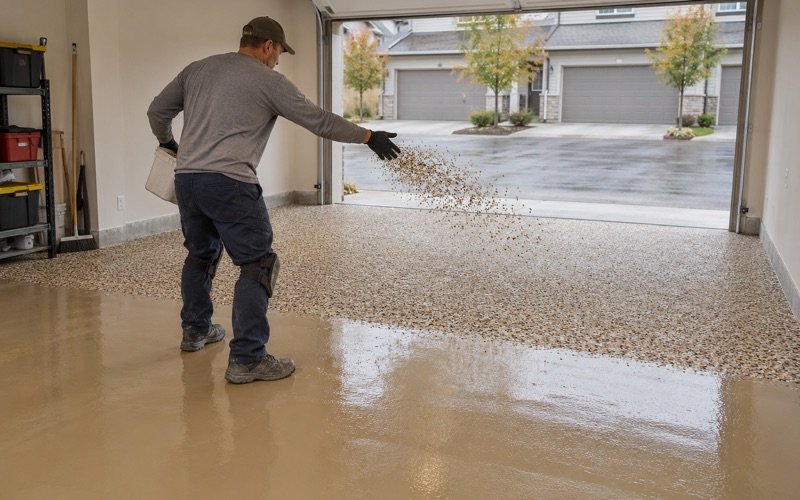
An incoming tenant’s operation decides the build. A light assembly or storage bay may only need a densified and sealed slab using lithium silicate. Heavier traffic points toward 100% solids epoxy with a quartz aggregate broadcast for texture.
Spaces that see thermal shock or washdowns may call for urethane cement. Rooms handling sensitive electronics may need static-dissipative or ESD flooring within a stated resistance range.
When the next occupant is not yet known, we suggest a durable, neutral build that a future tenant can recoat rather than remove. A well-bonded epoxy base with a polyaspartic or polyurea topcoat can be scuffed and refreshed at the following turnover. That keeps the next floor job shorter than this one.
Handing the bay back on schedule
We build the timeline backward from the date the space has to be usable. Grinding, repairs, primer, body coats and topcoat each get a slot, with cure time shown between them. If something found during preparation will push that date, the owner hears about it the same day, along with what it costs to hold the original date and what it costs to move it.
Landlord’s Slab, Tenant’s Schedule
In a leased industrial bay, the concrete belongs to the building while the calendar often belongs to whoever is about to occupy it. Who orders the floor and who pays for it depends on the lease, and that is a question for the parties rather than for us. What we can do is make the scope clear enough that either side can read it.
One proposal, several readers
Our written scope lists the testing, the surface profile, each coat and the finished thickness. An owner can file it with the building’s records, and a tenant can see exactly what was installed in the space they are moving into. If a later tenant asks what is under their feet, that document answers it.
Warranty terms read out loud
Before a job is sold, we walk through the warranty exclusions, and moisture is named first. Vapor rising through a slab is a common reason a coating lets go, so we would rather have that conversation before anyone signs. The same goes for movement in cracks and joints, which no coating can stop.
Curing set by the slab, not the move-in date
A move-in date is fixed, but cure time depends on the concrete. We schedule against slab temperature and the dew point spread at the surface, because a coat laid on a cold, damp slab can develop amine blush or cure soft. If an unheated space cannot hold the conditions a product needs, we say so and plan around it rather than promising a date the chemistry will not meet.
Rose Road, the Industrial Districts and Keeping Neighbors Working
Listing descriptions for Rose Road place it inside the Lake Zurich Industrial Park and show I-1 and I-2 industrial zoning there. We do not read zoning as telling us what a floor must be; that is set by the operation, the product data and any review the space goes through. What the zoning does tell us is that the street is home to working industrial buildings, where our crew shares the drive with trucks and other trades.
Checking with the village before work starts
Lake Zurich is a village in Ela Township, Lake County, and the village runs its own permit desk for work inside its limits. Because a Lake Zurich mailing address does not always mean a parcel inside the village, we confirm the parcel before naming the permitting authority on a proposal.
Illinois issues no state license for flooring or coatings work, so we confirm the village’s own contractor registration, bond and insurance requirements before scheduling. We also ask the Village of Lake Zurich Building and Zoning Division, part of the Community Services Department, whether a particular coating job counts as decorating or needs a permit. We ask instead of assuming, because the answer depends on the scope.
Sharing a building without stopping it
When one bay is being ground and coated, the tenants beside it still have deliveries and staff arriving. We keep grinding dust contained with vacuum-attached equipment, stage materials away from shared docks, and talk with the property manager about when the noisiest steps should run. Overnight and weekend work is available when a neighbor’s operation cannot tolerate daytime grinding.
Coatings that fit the rules and the room
Every product we install is chosen within the Illinois VOC limits for architectural coatings, which bind the installer as well as the manufacturer. Those limits sit in 35 Ill. Adm. Code Part 223 Subpart C.
The national architectural coatings rule in 40 CFR 59 Subpart D applies alongside the state limits. In a shared building that matters beyond compliance, because odor carries through common walls. We choose low-odor systems and ventilate the space when a neighboring tenant’s staff will be working next door during cure.
Owners with a home slab too
Some of the people who manage these buildings also ask about a garage at home. Residential jobs get a written contract and the Home Repair: Know Your Consumer Rights pamphlet before work starts, as the Illinois Home Repair and Remodeling Act requires, along with the same moisture testing and mechanical preparation we bring to an industrial bay.
- 20+ Years Coating Floors
- Moisture Tested Before Coating
- Written Contract on Every Home Job