Schaumburg Epoxy Flooring brings more than 20 years of slab work to epoxy-flooring in La Grange Park, and on most jobs here the first useful thing we do happens before any grinder comes off the trailer. We find out who reviews the work. That sounds like paperwork, but it decides how a schedule gets built, and a schedule built on a guess tends to slip.
The reason is simple. A garage coating, a basement floor and a restaurant kitchen floor can each end up in front of a different reviewer, and some may not need one at all. We do not assume which case a job falls into. We ask, write the answer into the plan and then quote.
Once that question is settled, the floor itself gets the same treatment it would anywhere we work: mechanical surface preparation, moisture testing as a scoped line item and a written proposal that names the product, the system and the finished thickness. The sections below walk through how that plays out in this village.
A Village Without Home-Rule Powers, and the Desk That Routes the Review
The Village of La Grange Park describes itself, in its own disclosure sheet, as a non-home-rule municipal corporation. In Illinois, that status means the village works within the powers state law grants it rather than the broader authority a home-rule community carries. For a floor contractor, the practical effect shows up in how the building department is staffed and how review is handed out.
Building and Inspectional Services
Building questions start at the Department of Building and Inspectional Services, which the village runs under a Building Director. That department is the front door. It is the office that decides whether a given scope is something to review, and if so, which reviewer sees it.
Village Hall sits at 447 N. Catherine Avenue, sharing the address with the Police Department and Fire Station 1. That is where we direct the first question on any job that might touch a permit, whether the answer comes back as a form to fill out or a note that the work needs nothing further.
Contracted building code services
The same disclosure sheet lists the village’s consultants, and building code services are among them, contracted to an outside firm the sheet names as Lakeside. In practice, that means plan review in La Grange Park runs through a consultant rather than an in-house plans examiner on the village payroll. We have not read that firm’s scope or turnaround, so we never promise a review time on its behalf.
What we can do is ask the Building Department early what a coating scope requires, and plan the calendar around the answer rather than around an assumption. If the work routes to the consultant, we build that step into the timeline. If it does not, we say so in writing and move on to the slab.
Why we ask instead of assuming
Floor coatings sit in a gray area in a lot of villages. Some treat a garage coating as decorating, while others look harder once a job touches drains, kitchens or a commercial space. Rather than assume either answer, we ask the permit desk whether a coating counts as decorating or needs a permit, then quote the job to match.
The same care goes into contractor rules. Illinois issues no state license for flooring or coating work, so before scheduling we confirm the village’s own requirements on contractor registration, bond and insurance. That conversation happens before the job, not after a crew is on site.
Looking for epoxy-flooring closer to Forest Park? See Epoxy-Flooring Services in Forest Park.
When a Basement Floor Job Reaches the Plumbing Inspector
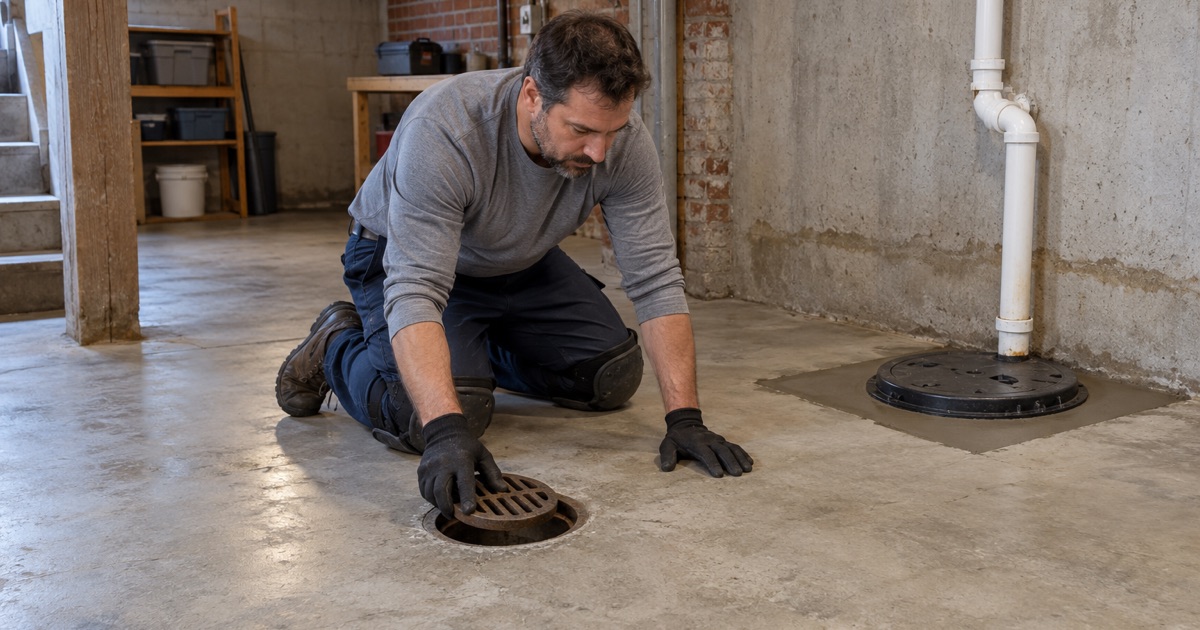
The village’s consultant list names a separate plumbing inspector, distinct from the building code services firm. For most garage floors that inspector will never come up. A basement floor is a different story, because basements are where floors meet drains, sumps and the plumbing that runs under the slab.
Drains, sump pits and slab cuts
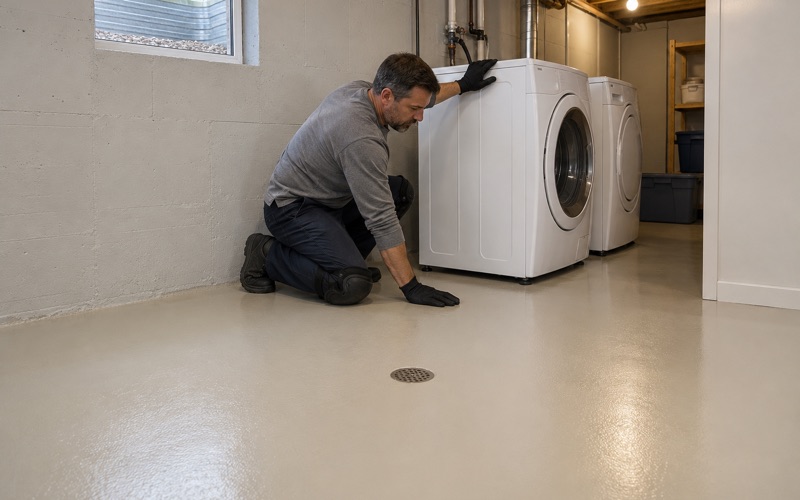
A coating on its own does not move a pipe. But basement floor jobs often grow beyond the coating. A homeowner may want a floor drain relocated, a sump pit rebuilt, a trench cut for a new line or an overhead sewer installed to guard against basement backup. Any of those can bring the plumbing side of review into the picture.
We keep the two scopes separate in our proposal. The coating is ours, from grinding through topcoat. Plumbing changes belong to a plumber and to whatever review the village applies, and we ask Building and Inspectional Services where that review goes before the floor schedule is set. Sump pit and floor drain detailing then gets done around finished plumbing, not ahead of it.
Moisture before anything goes down
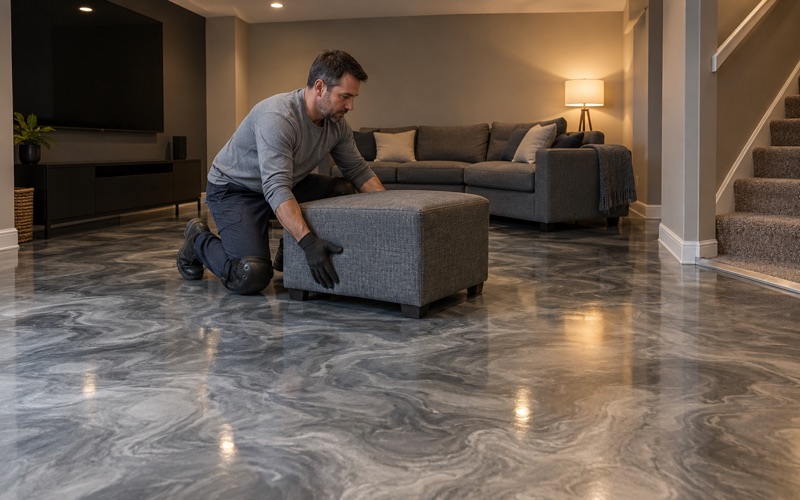
A basement slab is the floor most likely to fail from below. Hydrostatic pressure under the slab, efflorescence on the surface and a slab with no under-slab vapor retarder can each push moisture up into a coating and lift it. So moisture testing is a line item in our basement scope, not an upsell after the floor has already blistered.
Depending on the slab, we use an ASTM F1869 calcium chloride test for vapor emission, ASTM F2170 in-situ relative humidity probes, or an ASTM D4263 plastic sheet test as a first read. Results are compared against the coating maker’s limits and the ASTM F710 thresholds. Where readings run high, a moisture-mitigation primer goes into the build before the body coat.
Reading the slab before we price it
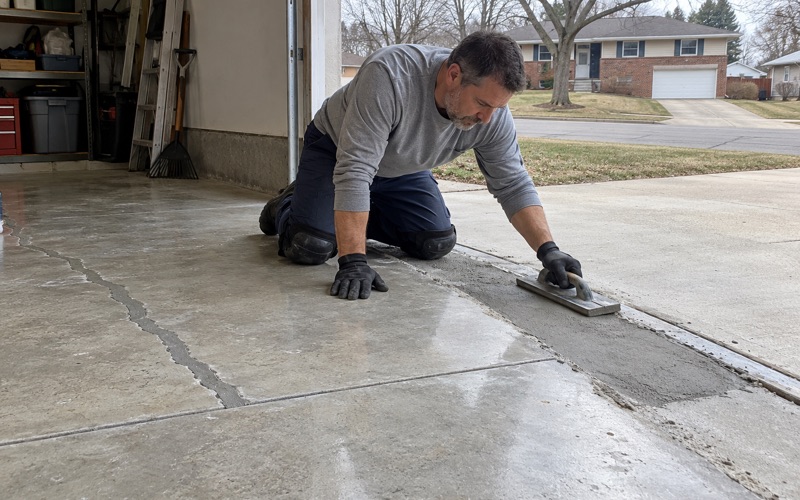
Before quoting, we read the cracks and any old coating on the floor. A hairline shrinkage crack can usually be filled and coated over. A crack with one side higher than the other, or a patch that sounds hollow, tells us the slab needs repair first, and we say so plainly.
We also say up front that a coating is a film that follows the slab under it. If a crack moves after the job, the floor will show it. And we do not sell a floor coating as radon reduction; in Illinois, that work takes a state radon mitigation license through IEMA, and it is not what a coating does.
Kitchens and Food Floors: The County Inspector the Village Names
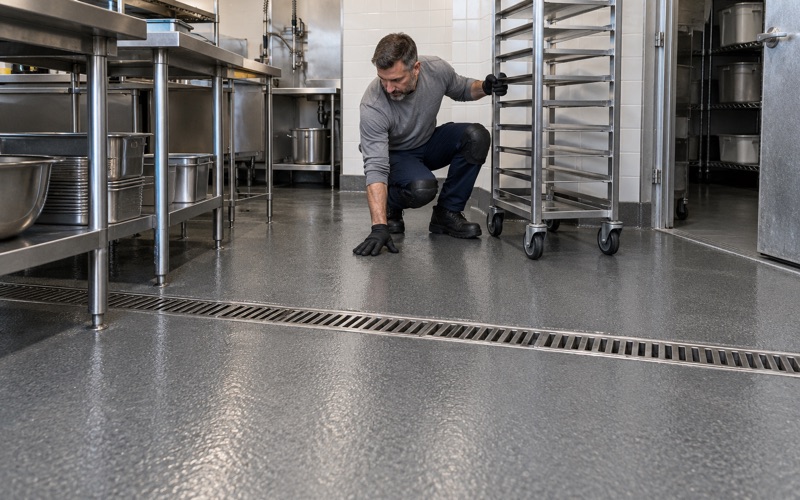
Among the consultants on the village’s list is a Cook County health inspector. That matters to anyone running a food-service floor here, because a commercial kitchen floor answers to Cook County Department of Public Health inspection, and the village names that inspector by name.
What a food floor has to do
The Illinois Food Code adopts the 2022 FDA Food Code, and its floor rules are more specific than most owners expect. Section 6-201.13 calls for coved junctures where floors meet walls in the areas it covers, so the joint can be cleaned rather than collecting grease. Section 6-201.11 requires floors to be smooth, durable and easily cleanable, with an exception that allows antislip surfaces where safety calls for them.
For a coating, that usually points to a seamless system with an integral cove base and a broadcast texture tuned to the work area. Urethane cement is a common choice where hot water, steam and thermal shock are part of the daily routine. Behind heavy equipment, cement board wainscot gives the cove a sound substrate to tie into.
Scheduling around the hours the doors are open
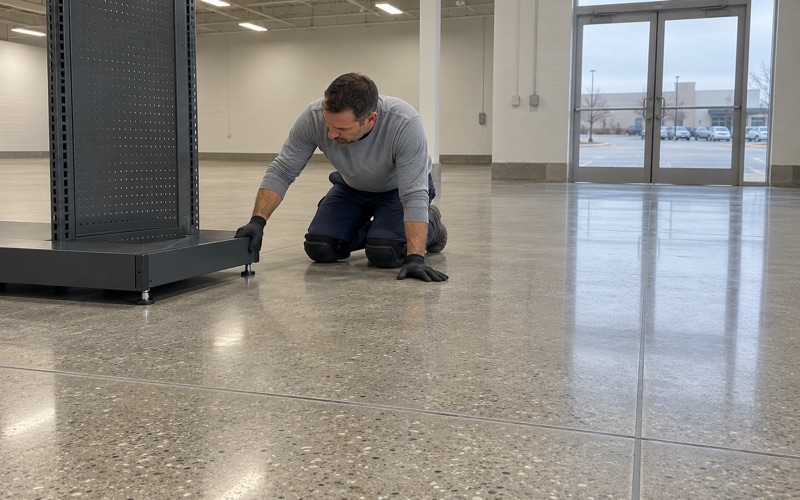
Restaurants, stores and offices cannot shut down for a week because the floor is being redone. We schedule commercial work around the hours a building has to stay open, which can mean overnight shifts, a closed weekend or a window between leases. Faster-curing systems, such as polyaspartic and polyurea topcoats, can shorten the time a space sits empty.
Before any of that is booked, we ask the village which reviewer the job goes to and whether the health inspector needs to see the finished floor. We do not answer that question for the county, and we do not guess at it.
Asking the Question Before the Quote, Not After
Most of what goes wrong on a coating job is decided before the crew arrives. A schedule that ignored a reviewer, a moisture problem nobody tested for, or a proposal too vague to check against the finished floor all start at the quoting stage. So that is where we put the work.
The garage floor, done the long way
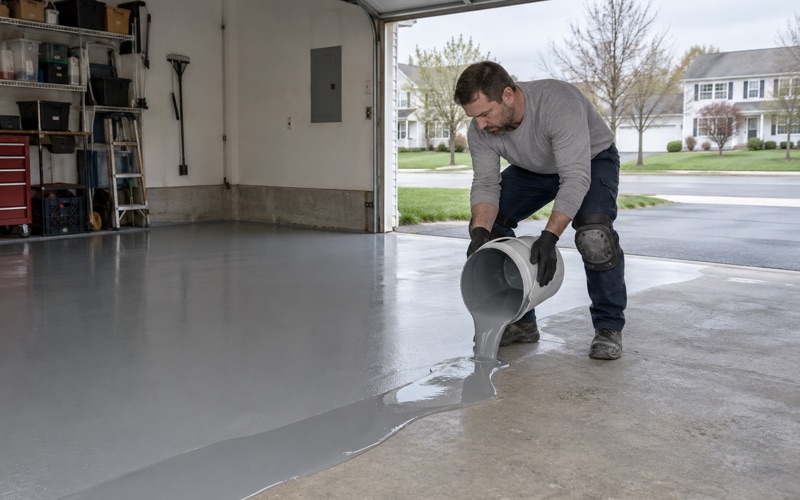
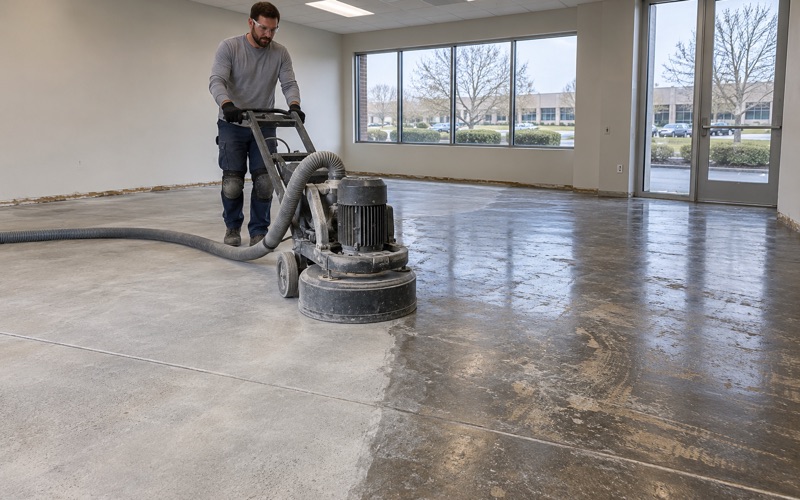
La Grange Park’s housing is mostly detached, with 3,452 owner-occupied detached houses in the Census count, and a detached house usually means a garage floor the owner decides on. Every slab we coat is opened mechanically with a diamond grinder or shot blaster to an ICRI CSP profile that suits the system. We do not acid etch.
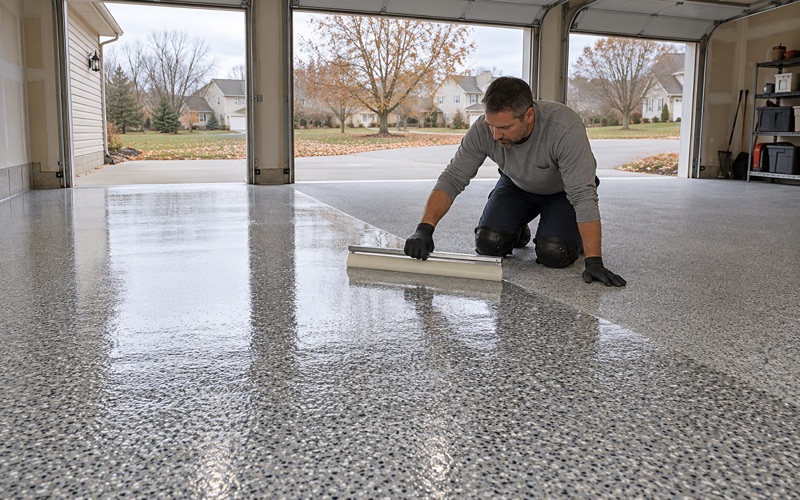
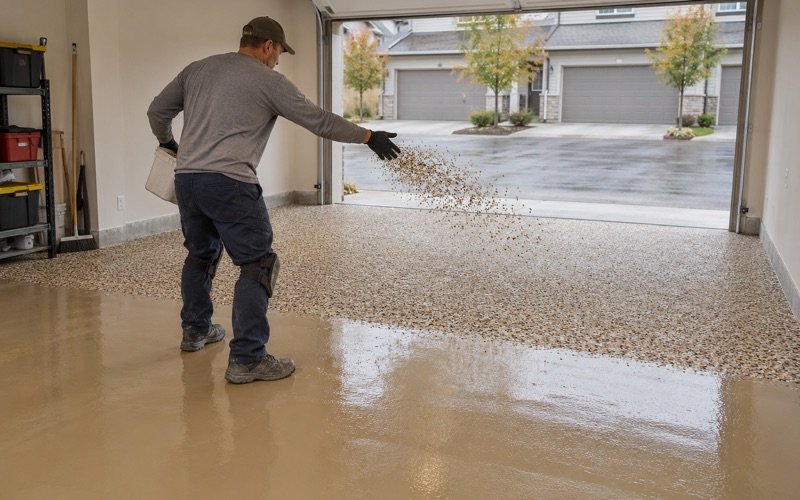
A typical garage build is a 100% solids epoxy base, a vinyl flake or quartz aggregate broadcast and a polyaspartic topcoat that resists hot tire pickup. That build is chosen for the calcium chloride brine and rock salt that winter tires carry in. Garage slabs get moisture tested too, because a slab poured to code may have no vapor retarder under it, given the garage exception in IRC R506.2.3.
Paperwork that matches the floor
Our proposal names the product, the system build and the finished thickness, so what was quoted can be checked against what went down. Warranty exclusions are read out before the job is sold, with moisture named first. Every home job gets a written contract and the state’s Home Repair: Know Your Consumer Rights pamphlet before work starts, as the Illinois Home Repair and Remodeling Act requires.
Coatings are chosen within the Illinois VOC limits for architectural coatings, which bind the installer as well as the manufacturer. Curing is scheduled against slab temperature and the dew point spread at the surface rather than the calendar, and when an unheated garage has to wait for warmer weather, we say so.
Condos, townhomes and shared driveways
Not every floor in the village sits under a detached house. Townhome and condominium jobs are scheduled around the association’s rules and around neighbors who still need their own garages. We confirm those rules first, then ask Building and Inspectional Services where the work routes, and only then put a date and a price on paper.
- 20+ Years Coating Floors
- Moisture Tested Before Coating
- Written Contract on Every Home Job