Schaumburg Epoxy Flooring brings more than 20 years of epoxy-flooring work to La Grange, and this page is about the kind of floor that has to keep earning while it is being redone. A storefront between tenants, a salon that cannot close for a week and a restaurant kitchen that answers to an inspector each need a different system and a different schedule.
We start every job the same way, by looking before we price. We read the cracks, the patches and whatever coating is already down, and if the slab needs repair before anything can bond to it, the proposal says so in plain words. That proposal then names the product, the system build and the finished thickness, so an owner or a landlord can hold the finished floor up against the paper.
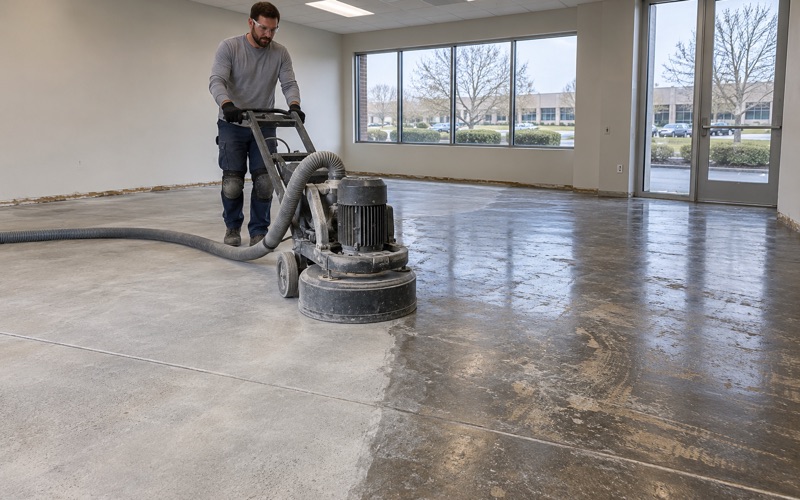
We open the surface mechanically, with a diamond grinder or a shot blaster, and acid never touches the concrete. On a working floor that choice matters twice: it gives the coating a profile it can grip, and it leaves no rinse water to chase across a sales floor or into a kitchen drain.
Where La Grange Road meets the BNSF line
Downtown La Grange centers on the spot where La Grange Road (US 45) crosses the BNSF Railway, and the commercial blocks gather around that crossing. Metra trains stop at the La Grange Road station and again at Stone Avenue, and Amtrak’s Illinois Zephyr and Carl Sandburg both call at La Grange Road. A floor in this district is a floor that commuters, diners and shoppers walk on, often in the same afternoon.
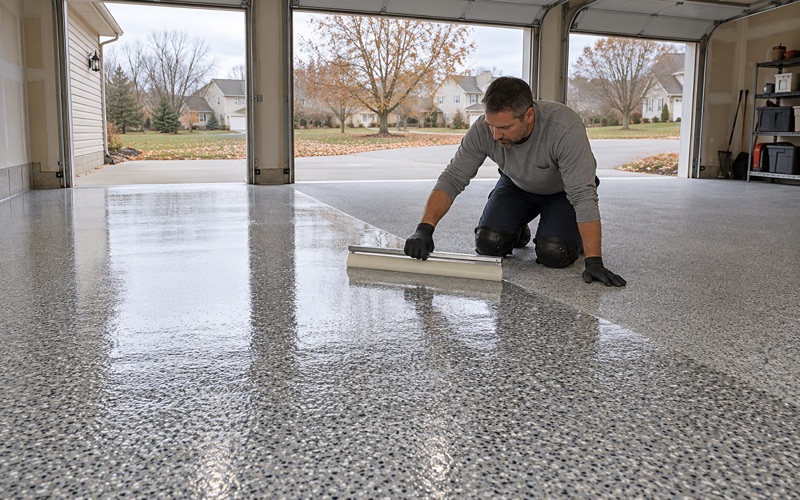
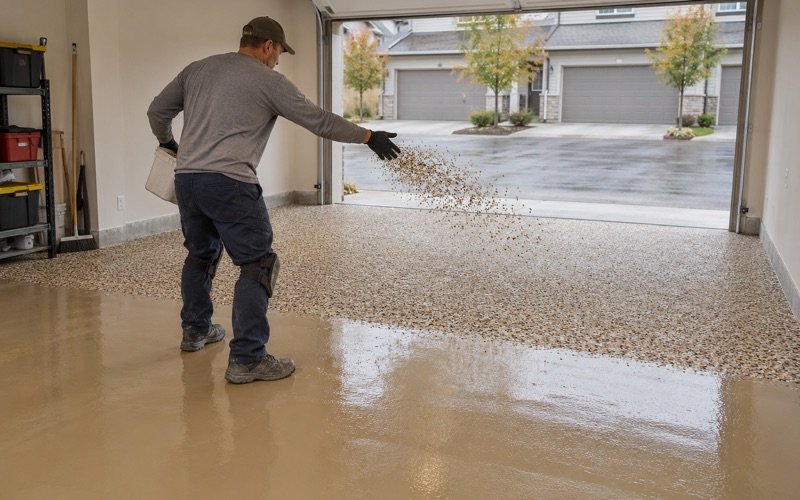
What that means for us is traffic and grit. Station foot traffic carries sand and street dirt through a front door all day, and a glossy, thin finish tends to show scratches quickly. We lean toward a broadcast system, vinyl flake or quartz aggregate locked under a polyaspartic or polyurea topcoat, where the texture hides wear and gives shoes something to hold.
The first few feet inside a downtown door take most of that abuse. We can run a heavier broadcast at the threshold than in the back of the space, and we ask where the entry mats will sit so the finish under them is planned rather than discovered.
The shop floor
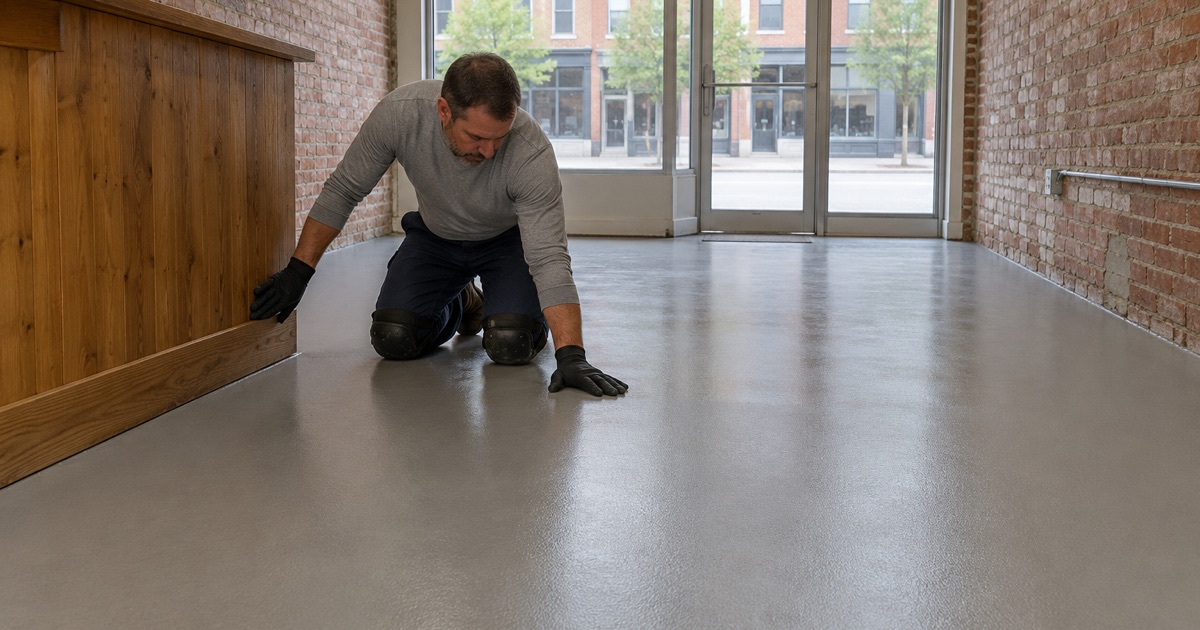
A retail floor is judged by how it looks at opening and how it has worn by closing. Quartz or flake broadcast in a color that suits the fixtures, sealed under a clear topcoat, stands up to carts, display moves and wet boots. Where a tenant wants a quieter look, a lithium silicate densifier on a ground slab is a lighter option we price beside the coating.
The salon floor
Salons put a different load on a floor: rolling chairs, hair color, bleach, and a mop that never seems to stop. A 100% solids epoxy body coat under a chemical-resistant topcoat handles the spills, and we keep the texture fine enough that a stylist can still sweep clippings off it in one pass. The tradeoff between grip and easy cleaning is one we talk through with the owner before choosing a broadcast size.
The kitchen floor
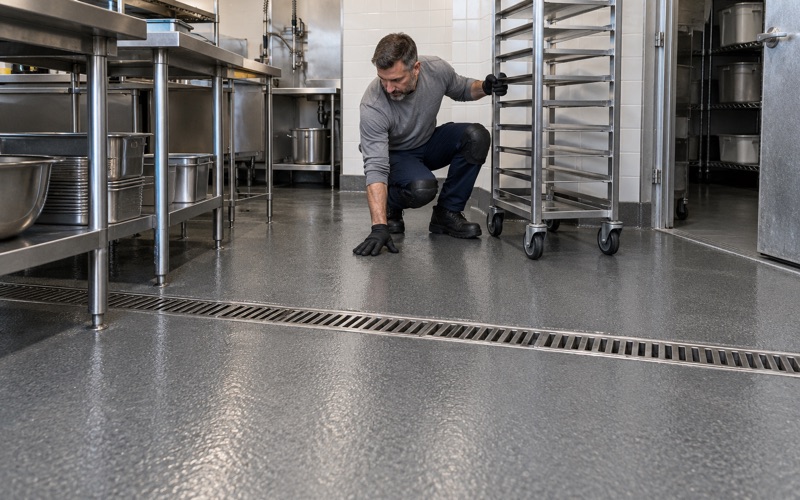
A restaurant’s back of house is the hardest of the three: hot water, grease, floor drains and staff moving fast with full hands. That floor is also the one whose finish answers to a health inspector, which is why it gets its own section below.
Looking for epoxy-flooring closer to North Aurora? See North Aurora Epoxy-Flooring.
What the county health department looks at underfoot
For a restaurant, cafe or bakery in La Grange, the local health department is the Cook County Department of Public Health. It covers suburban Cook County except Evanston, Oak Park, Skokie and Stickney Township, which run their own, and La Grange sits squarely inside its jurisdiction. The rules it applies come from the Illinois Food Code, which adopts the 2022 FDA Food Code.
It is worth being exact about what that means. We hold no health department approval, and we do not present any product as having one. What the code speaks to is the floor surface itself: smooth, durable, nonabsorbent and easily cleanable where food is stored, prepared and washed up.
Before a kitchen floor is scheduled, we ask the operator to check the planned finish and cove detail with their county inspector, because that reading is the one that counts at the next inspection. Our part is to write the agreed detail into the proposal and then build exactly that.
Coved bases and the wall behind the line
FDA Food Code 6-201.13 asks for floor and wall junctures to be coved and closed, so the corner where a mop stops cannot collect grime. We build that cove in the same resin system as the floor, usually a urethane cement, which tolerates hot washdown better than a standard epoxy. Behind fryers and ranges, cement board wainscot gives the cove a solid surface to turn up onto.
Texture that still cleans
Section 6-201.11 of the same code leaves room for antislip floors in areas that need them, which is how a textured coating fits a kitchen at all. We size the aggregate to grip a wet sole, then seal it with enough topcoat that a deck brush can still clean the valleys. Drain bodies and floor sinks get detailed by hand, because that is where a coating either seals to the metal or starts to lift.
Turning a storefront between tenants, or overnight
Older downtown commercial spaces turn over with their tenants. A space that was a boutique can become a salon, a salon can become a sandwich shop, and the slab under all three carries the history: carpet glue, tile mastic, a painted patch where a wall once stood, and sometimes an old coating that has started to peel at the door.
The gap between leases
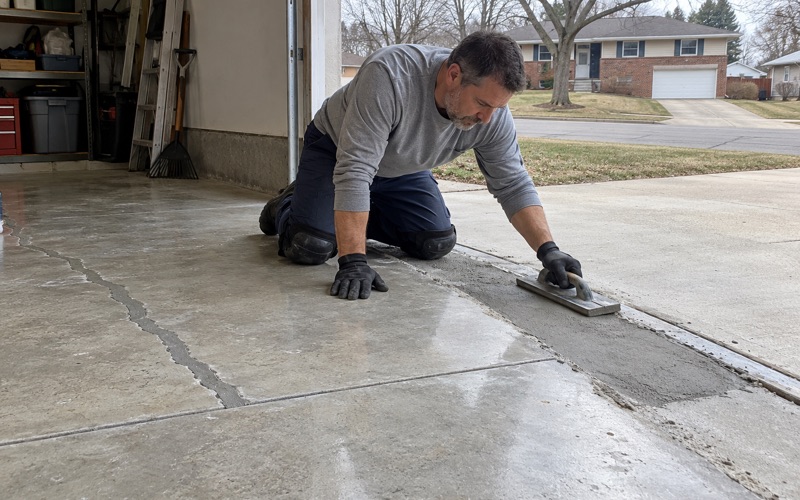
The weeks after one tenant moves out and before the next moves in are the cleanest window a floor will ever get. With the space empty, we can grind off adhesives and old film, fill cracks, test the slab and lay the full system without working around fixtures. A coating is a film that follows the concrete under it, so a crack that moves may show through, and we say that to the landlord up front rather than promise the floor will hold the slab still.
Tenant improvements also tend to stack trades in the same few weeks. We ask where the floor falls in the landlord’s sequence, because a coating laid before the electrician and the shelving crew finish can carry their ladder marks into opening day. The best slot is usually last, after the walls are painted and before fixtures go in.
Nights and Mondays
An occupied storefront is a different job. Where a salon or restaurant has a regular closed day, such as a Monday, that day and the night before it can be enough for a fast-cure system on a modest floor. Polyaspartic topcoats return to foot traffic far sooner than standard epoxy, which is why we reach for them when a space can only close overnight.
Odor and ventilation matter more in a building with neighbors upstairs or next door. We plan the sequence so grinding dust is captured at the machine, solvent-heavy products stay off the job, and the space is aired out before the doors open again. On a longer job, we can work the floor in halves so a shop keeps a path to its register.
When we hand a floor back, the owner gets the cure times in writing: when staff can walk on it, when chairs and carts can roll, and when a full wet mopping is safe. Rushing a floor into heavy use before it has cured is the most avoidable way to lose one, on a sales floor as much as in a kitchen.
What we check before a La Grange job is scheduled
La Grange was incorporated on June 11, 1879, and a good share of its building stock is old: 2,237 of the village’s 6,196 housing units, or 36.1 percent, date from 1939 or earlier. Every one of those slabs predates ASTM E1745, first published in 1997, which defines a modern under-slab vapor retarder, so we test the concrete for moisture rather than assume it is dry.
Moisture is part of the price
Testing is a written line in our scope, not an upsell after a floor fails. Depending on the slab and the schedule, that means ASTM F2170 relative humidity probes set into the concrete, ASTM F1869 calcium chloride tests on the surface, or a quick ASTM D4263 plastic sheet check as a first read. If the numbers come back high, a moisture-mitigation primer goes into the build, and moisture is the first exclusion we read aloud when we go over the warranty.
Permits, registration and paperwork
The Village of La Grange issues its own building permits, and we call the permit desk before the job to ask whether a floor coating counts as decorating or needs a permit, rather than guessing either way. Illinois issues no state license for coatings work, so we also confirm what the village asks of contractors for registration, bonding and insurance before a date goes on the calendar.
Not every floor in La Grange is downtown. Owner-occupancy runs at 81.5 percent, and for a house, the Illinois Home Repair and Remodeling Act puts a written contract and the state’s Home Repair: Know Your Consumer Rights pamphlet in the homeowner’s hands before we begin. A commercial client gets the same written scope, signed before any grinding starts.
Coatings within the VOC limit
Every product we spread is chosen under the Illinois VOC limits in 35 Ill. Adm. Code Part 223, which bind the person applying a coating as well as the company that made it. We name the product in the proposal, so its VOC content can be checked against the rule rather than taken on trust.
- 20+ Years Coating Floors
- Moisture Tested Before Coating
- Written Contract on Every Home Job