Schaumburg Epoxy Flooring has spent more than 20 years on concrete coatings, and our epoxy-flooring in Hinsdale work increasingly lands in houses whose owners plan to stay put. That changes the conversation at the first visit. A family keeping a house wants a floor that suits the next fifteen years in it, not a quick finish ahead of a sale or a demolition.
So we start with the slab as it is today. We look at what has been applied to it before, how the cracks are behaving, and whether moisture is moving up through it, and the written proposal reflects what we found rather than a stock package. If the concrete needs repair before it can hold a coating, that is said at the first walk-through.
The sections below cover the houses we expect to meet most often here: garages poured in the 1990s, homes from the 1960s that were renovated instead of replaced, and the attached homes that make up a smaller but real share of the village. The last part deals with the permit question, which we settle with the village before a date goes on the calendar.
Fewer New Houses, More Floors in Houses Being Kept
The pace of new construction in the village has dropped sharply. The Hinsdalean reported in May 2024 that Hinsdale issued 26 new-home permits in 2023, against roughly 120 a year in earlier years. The paper reported the drop without settling on a reason, and we will not guess at one either.
The April 2024 ordinance
A month before that report, the village board unanimously passed an ordinance designed to encourage the renovation of historic homes. It adds a preliminary application and a design review team meeting ahead of a certificate of appropriateness for demolition, relocation or new construction in the Robbins Park Historic District, and for changes to landmarked properties. The process is still non-binding, and nothing in it reaches interior floor work.
That last point matters to a homeowner reading the headlines. Coating a garage or basement floor in an existing house is not a historic-preservation matter, and we do not treat it as one. The ordinance is relevant to us only as a signal of where the village wants its housing stock to go.
What a kept house means for its slab
When a house is replaced, the garage and basement get new concrete with no history. When a house is kept, the slab under it carries every decision made since it was poured: sealers, paint, patch compounds, an earlier epoxy, oil from decades of cars. Each of those affects how a new system bonds.
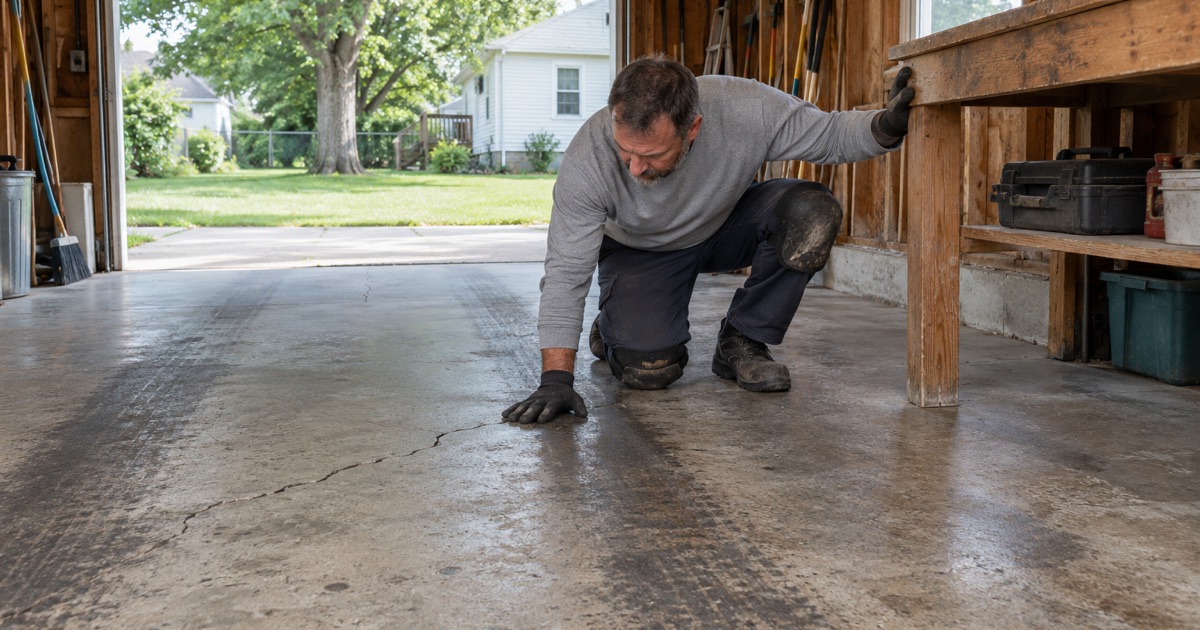
That is why our first step on any Hinsdale renovation job is a careful look at the surface. We check for prior films with a scrape and a water drop, mark cracks that have moved since they were patched, and note any spots where the concrete has gone soft or dusty. The findings shape the scope we write.
Planning the floor inside a larger renovation
Many of these floors are part of a bigger project, with kitchens, mudrooms or finished basements going in at the same time. We schedule our grinding and coating so other trades are not walking across a curing floor, and we ask the general contractor where heavy equipment will be staged. A coating that gets dragged on by a cabinet delivery the next morning is a wasted day for everyone.
Looking for epoxy-flooring closer to Campton Hills? See Epoxy-Flooring in Campton Hills.
A 1990s Garage on Its First or Second Coating
The 2024 American Community Survey five-year estimates count 831 housing units in Hinsdale built during the 1990s. Those houses are now roughly 25 to 35 years old, which puts their garage floors in one of two situations. Some have never been coated and show three decades of tire wear and staining, while others carry a first coating that is now peeling, yellowing or worn through at the tire lanes.
When the floor has never been coated
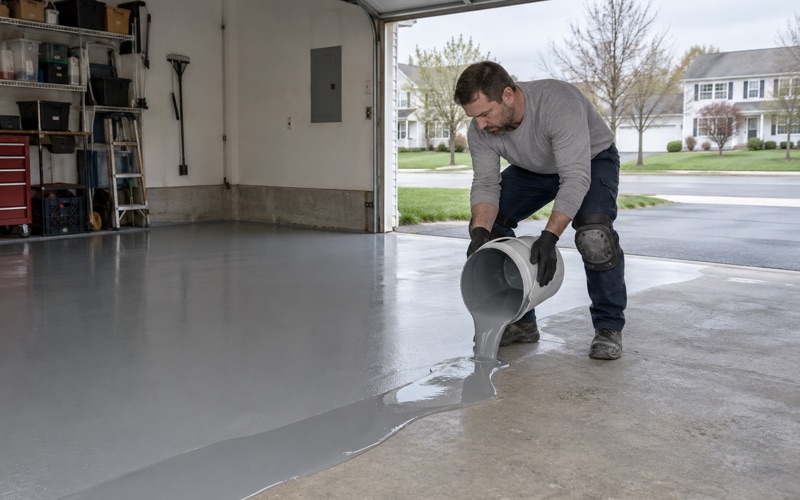
A bare slab of that age is usually well cured, but it is rarely clean. Oil soaks deep into concrete over the years, and a coating laid over saturated spots will lift there first. We grind the full floor with diamond tooling to an ICRI surface profile suited to the system, then treat or cut out contaminated areas before primer goes down.
We do not acid etch. Etching leaves an uneven profile and residue in the pores, and it cannot remove an oil stain or an old sealer. A mechanical profile is the only way we know of to give the primer consistent concrete to grab across the whole slab.
When an older coating is failing
A peeling first coating tells us something. If it is letting go in sheets, the original prep was probably thin; if it is blistering in spots, moisture may be pushing from below. We remove the old film completely by grinding or shot blasting rather than coating over it, because a new system is only as sound as the layer it sits on.
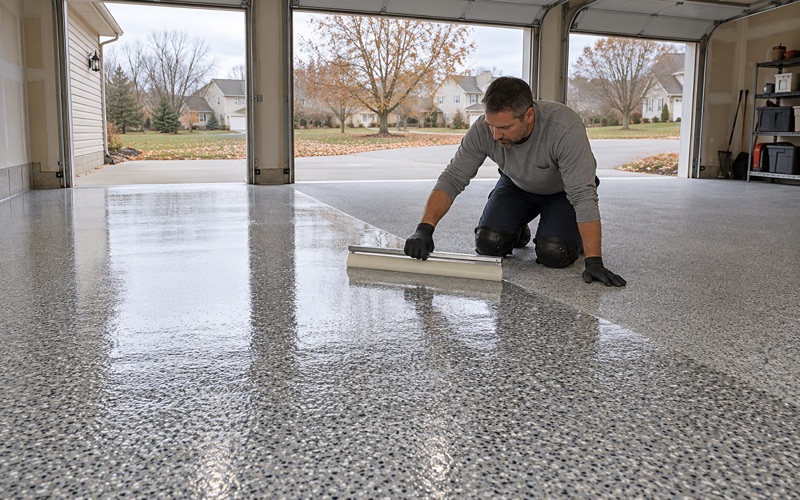
Hot tire pickup is a common complaint on 1990s garages coated with thin, water-based kits. Warm tires soften those films and pull them up in the shape of the tread. A 100% solids epoxy base with a polyaspartic or polyurea topcoat holds up far better, and our proposal names the products and the finished thickness so you can compare the quote with the floor you get.
Testing before assuming
A garage slab from the 1990s may have been poured with no vapor retarder beneath it, since the residential code has long exempted garages from that requirement. Age does not prove a slab is dry. We run a moisture test as a priced part of every job, using the ASTM F1869 calcium chloride method or ASTM F2170 relative humidity probes depending on the slab, and a high reading moves us to a moisture-mitigation primer before anything else.
The 1960s Houses That Stayed
The same survey counts 819 Hinsdale units built during the 1960s, and many of those homes have now been updated rather than torn down. A 60-year-old house tends to have a basement slab that has seen more than one finish and at least one water event. Those floors call for a slower read than a garage.
Basement slabs with a past
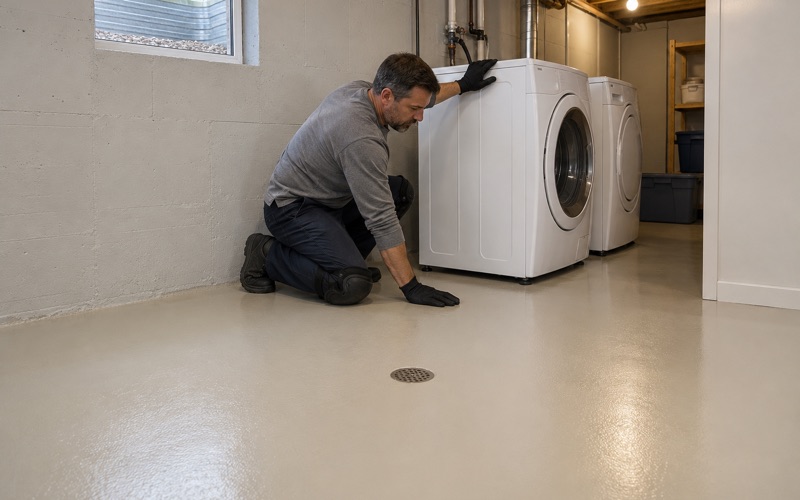
On a basement floor of that age we look first for efflorescence, the white mineral crust that shows water carrying salts up through the concrete. We check around the sump pit and floor drains, where cracks and old patches cluster, and we ask whether the basement has ever taken on water from a sewer backup. A coating is not a waterproofing system, and we say so before the job rather than letting it be assumed.
Where hydrostatic pressure is pushing moisture into the slab, a coating alone will eventually blister. In that case the proposal either includes a moisture-mitigation primer rated for the reading we measured or recommends that drainage be addressed first. Moisture is also the first exclusion we read aloud when we go over the warranty.
Old finishes and old cracks
A 1960s basement might have floor paint, old tile adhesive residue, or a mastic from carpet that came up years ago. We identify what is there before grinding, and anything we cannot safely remove ourselves is flagged in writing for a qualified abatement contractor. Cracks are mapped and repaired with a suitable filler, but a coating will follow a slab that moves, and we do not claim it will stop the movement.
We also hear questions about radon in older basements. We do not sell a floor coating as radon reduction. In Illinois that work requires a radon mitigation license issued by the state, and we will point you toward a licensed mitigator if testing calls for one.
A house older still
The survey also counts 984 Hinsdale units built in 1939 or earlier. Floors in those houses can be thinner, softer or patched many times, and some basements were finished long after the house was built. We test the concrete’s surface strength before committing to a full broadcast system, since a heavy build laid over weak concrete can pull the top of the slab away with it.
Attached Homes, Owners and the Permit Desk
Most Hinsdale housing is detached, but the survey counts 380 owner-occupied single-family attached homes in the village. A townhome garage floor is often smaller than a detached garage, yet the job carries more coordination. Neighbors share drives and walls, and an association may control when contractors can work and where they can park.
Working around an association
Before we schedule an attached-home job, we ask for the association’s contractor rules and any notice it requires. Grinding produces noise and dust that we control with vacuum-attached equipment, but neighbors still need to know when we will be there and whether a shared drive will be partly blocked. We plan the work so nobody loses access to their own garage while a floor cures.
Cure time itself is scheduled against the slab’s temperature and the dew point spread at its surface, not a fixed number of hours. In an attached garage that shares a heated wall, conditions can be friendlier than in a detached one, but we still measure before the topcoat goes on. If the readings are wrong for curing, we tell you and reschedule.
Which Community Development permit, if any
The Village of Hinsdale Community Development department handles building permits, and most residential and commercial projects there take a combination permit. Whether a floor coating by itself needs one is a question we put to the permit desk before the job, instead of assuming it is exempt as decorating or assuming it is not. When the coating is part of a larger renovation, it may already fall under the project’s permit.
Paperwork before the first grinder pass
Illinois issues no state license for flooring or coating work, so we check the village’s own contractor registration, bonding and insurance requirements before a job is booked. Every home job gets a written contract and a copy of the state’s Home Repair: Know Your Consumer Rights pamphlet before work begins, as the Illinois Home Repair and Remodeling Act requires. The coatings we specify fall within the Illinois limits on VOC content, which apply to us as installers and not only to the manufacturer.
- 20+ Years Coating Floors
- Moisture Tested Before Coating
- Written Contract on Every Home Job