Schaumburg Epoxy Flooring brings more than 20 years of slab work to epoxy-flooring in Franklin Park, and the floors this page is about are some of the hardest-working in any public building: the bays where fire apparatus and ambulances park, idle, wash down and roll out. Those floors take a loaded engine’s weight on a few tire patches, a steering turn on the same spot several times a day, diesel drips and a film of wash water that rarely gets the chance to dry.
The answer to a floor like that is less about color than about preparation, thickness and scheduling. A coating that looks fine in a family garage can soften, lift or wear through along the tire track of a heavy truck if the slab under it was never opened or tested. We would rather explain that before a proposal than after a failure.
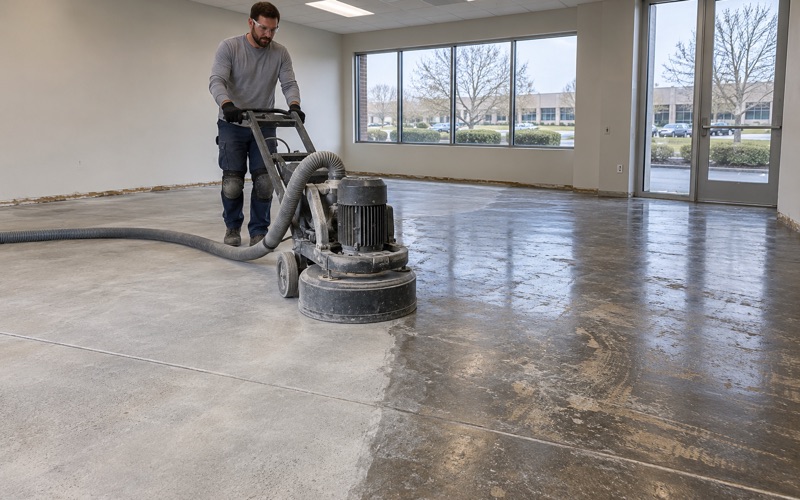
Our method does not change with the size of the building. We grind or shot blast before anything is applied, we put moisture testing in the written scope, and the proposal names the product, the system build and the finished thickness so it can be checked once the floor is down.
Three Stations, Six Engines and Trucks, Three Ambulances
The Franklin Park Fire Department is a department of the village itself. The village’s FY2025 audit report lists three stations, six fire-fighting vehicles and three ambulances in its 2024 capital asset statistics, and 43 sworn fire personnel on its staffing schedule. That puts apparatus bays squarely in the village’s own building stock, maintained alongside its streets and water system.
Franklin Park is a village in Leyden Township, Cook County, incorporated in 1892 and named for real estate broker Lesser Franklin, who bought acreage here when the area was mostly farm fields. It covers about 4.78 square miles. Three stations spread across a footprint that size are working buildings, not ceremonial ones.
What a nine-vehicle fleet means for the floor
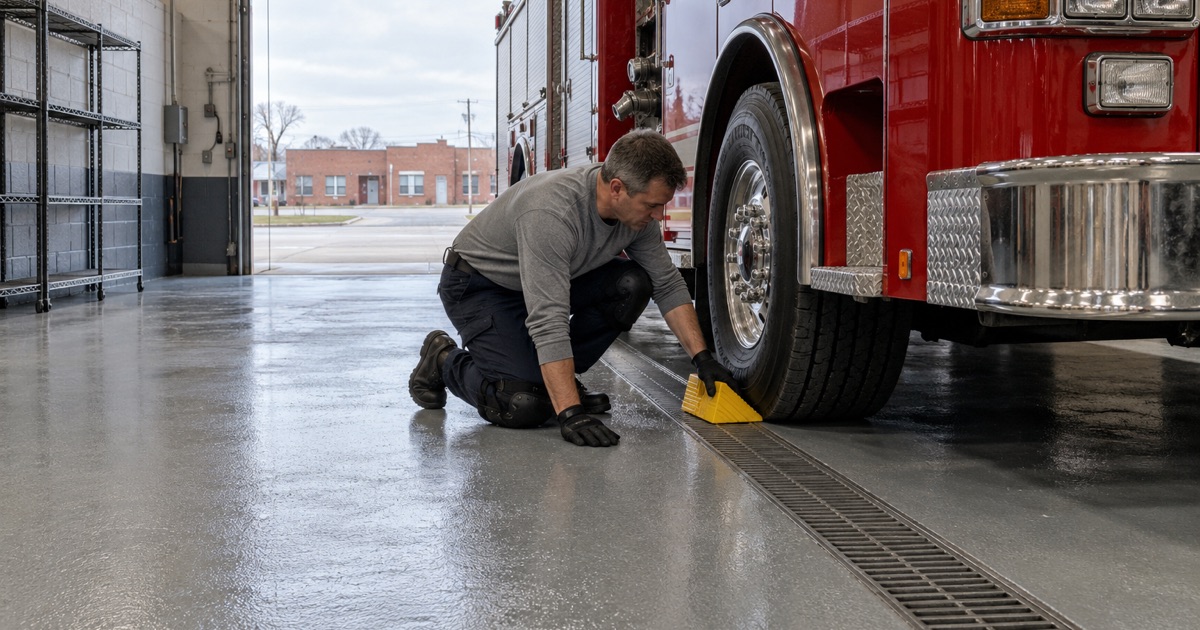
Nine vehicles across three stations is a modest fleet, but each one typically returns to the same bay after each run. It parks on the same tire marks and backs in along the same line. Wear concentrates in a few predictable strips rather than spreading across the slab, and those strips are exactly where a thin coating fails first.
That pattern shapes how we quote. We look at where the tires sit, where they pivot and where the crew walks, and we build the system thickest where the load is heaviest. A floor coated to one uniform thin build is usually a floor that needs recoating along the tire paths long before the rest of it shows any wear.
Who decides, and who registers the contractor
A station is a village building, so floor work there is a village decision rather than a homeowner’s. We do not assume how any department schedules or approves a project. We ask, and we plan the job around the answer.
Illinois issues no state license for flooring or coatings work, so the registration that matters is local. In Franklin Park, a contractor must hold a village license running May 1 to April 30, post a $10,000 trade-specific license and permit bond, and carry at least $1,000,000 in liability insurance. We confirm those requirements with the Village of Franklin Park Building Department on Belmont Avenue before a job goes on the calendar, and we ask the same desk whether the coating needs a permit.
Looking for epoxy-flooring closer to Norridge? See Epoxy-Flooring in Norridge.
What an Apparatus Bay Floor Carries: Weight, Tire Turns and Diesel
Weight on a small footprint
A loaded engine puts its whole mass onto a handful of tire contact patches. The concrete carries that load; the coating’s job is to stay bonded and resist abrasion where those tires sit. Bond depends on surface profile, so we open the slab to the ICRI CSP range the chosen system calls for with diamond grinding or shot blasting.
We do not acid etch. Etching leaves a shallow, uneven profile and residue in the pores, and a heavy tire load finds that weakness quickly. Before quoting we also read the cracks and any old coating, and we say plainly when a slab needs repair before it can take a new system.
Tire turns and hot tire pickup
Steering a heavy vehicle in place twists the tire against the floor, and a soft or thin film tears under that shear. Tires coming back warm from a run can also cause hot tire pickup, where a coating softens and lifts with the rubber. Both problems point the same way: toward a harder, thicker system rather than a single roll coat.
A 100% solids epoxy base at a real build thickness, finished with a polyaspartic or polyurea topcoat, handles that abuse far better than a thin film. Where heat and impact run high, urethane cement is the tougher option. Whatever we recommend, the proposal states the system and the finished thickness so the choice is on paper.
Diesel, fluids and cleaning chemicals
Diesel, hydraulic fluid and coolant drip in apparatus bays, and degreasers follow them. Chemical resistance varies by product, so we match the topcoat to what will actually land on the floor and to how the crew cleans it. A quartz aggregate broadcast adds traction for boots on a wet floor, and the texture can be tuned so the surface still squeegees clean.
Wash Water, Drains and Wet Turnout Gear
Water that never quite leaves
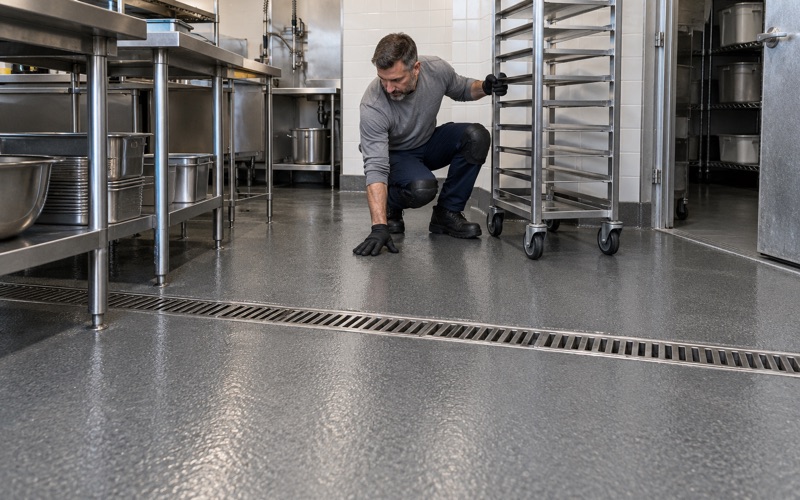
Apparatus get washed in the bay, and the water runs to trench or floor drains. The slope toward those drains matters more than the color of the finish. Where the slab ponds or a drain body has settled, we say so before quoting.
A coating is a film that follows the concrete under it. It will not correct a low spot, and it will not stop a moving crack from moving. We tell a client that at the start rather than letting a new floor take the blame for an old slab.
Slip resistance on a wet bay floor is a matter of texture, not of the resin alone. A smooth high-gloss finish that looks clean in a showroom turns slick under a film of soapy water. We set the broadcast and the topcoat so the floor keeps its grip when wet without becoming so rough that it traps grit and resists the squeegee.
Detailing at drains and edges
The weak point of a wet floor is usually where the coating ends. We cut terminations into the concrete, key the system in at drain bodies and trench edges, and treat joints so water cannot track under the film. Sump pit and floor drain detailing is written into the scope instead of being left to the last afternoon.
Moisture from below as well as from the hose
A bay slab can be wet from the ground as well as from the wash. We test with ASTM F2170 in-situ relative humidity probes or the ASTM F1869 calcium chloride method and compare the reading with the product’s published limit. Where it runs high, a moisture-mitigation primer goes into the build before the base coat.
Moisture is also the first exclusion we read out when we go through the warranty. A client should know before signing what the coverage does not include, and moisture from below is a common reason a coating lets go.
Turnout gear and drying areas
Wet turnout gear hangs to dry near the bays, and water drips onto the floor under the racks for hours. A textured, chemical-resistant topcoat suits those areas, along with a cove at the wall so water does not sit in the corner. The same build keeps cleaning simple in rooms where gear is stored and inspected.
Keeping a Station in Service While Its Floor Is Redone
A fire station never closes, so a floor project there has to be planned around apparatus that may need to leave at any minute. That shapes the sequence of the job more than any product decision. We plan the phasing first and choose the system to fit it.
Working one bay at a time
We coat one bay or one section at a time so the rest of the building stays usable. Vehicles relocate from the bay under work while it cures, and the zone is marked so crews are not walking through fresh material. Fast-curing polyaspartic topcoats can shorten the time a bay is out of service, though the base coat still needs its own cure.
Overnight and off-hour windows are part of how we work on any building that has to stay open. A station is the extreme case of that, and we build the schedule with the people who run it rather than handing them one.
Curing on the slab’s terms
We schedule curing by slab temperature and the dew point spread at the slab surface, not by the calendar. Bay doors open and close through the day, and a rush of cold, damp air over a fresh coat can cause amine blush or a slow cure. If conditions are wrong, we say so and move the date rather than coating into them.
Maintenance rooms and storage beyond the bays
A station usually has more floor than its bays: a workshop, a storage room, an equipment area. These rooms see less tire traffic but plenty of oil, tools and dropped gear. A thinner epoxy system with a vinyl flake or quartz broadcast often suits them, and a lithium silicate densifier is an option for a back room that only needs dust control.
Every product we install is chosen within the Illinois limit on VOC content for floor coatings, which applies to the installer as well as the manufacturer. In a building that stays occupied while we work, low-odor products and good ventilation planning matter more than they would in an empty warehouse.
What the finished proposal shows
For a working building, the paperwork has to answer practical questions before anyone moves a truck. Our proposal lists the surface preparation method, the moisture test and its target, each coat in the system build, the finished thickness and the cure time before a bay can take a vehicle again. It also names any slab repair we found during the walk-through and prices it separately.
That level of detail lets whoever approves the job compare one bid against another on the same terms. It also gives the department a record to check the floor against later, when the question is whether the coating that went down matches the one that was quoted.
- 20+ Years Coating Floors
- Moisture Tested Before Coating
- Written Contract on Every Home Job