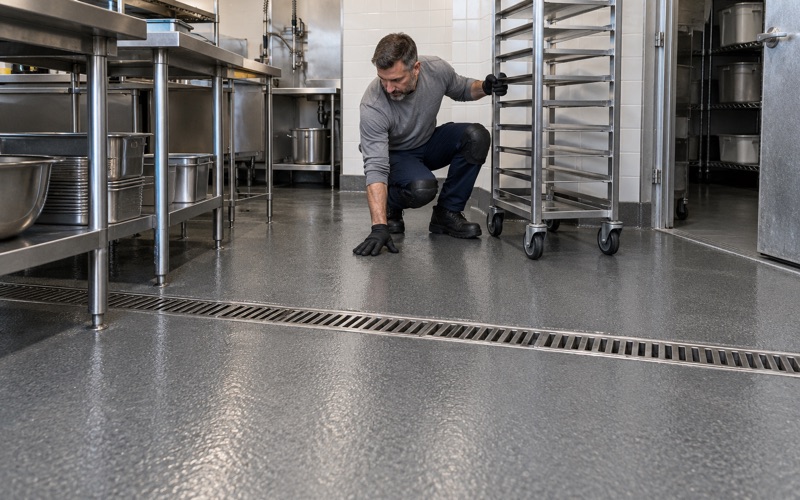
Schaumburg Epoxy Flooring brings more than 20 years of epoxy-flooring in Forest Park to basement and garage slabs, and the basement jobs here start with a question most coating quotes skip: where does the water come from? In this village the answer is often not the ground outside the wall but the drains inside the house. A floor plan that ignores that will look fine on the day it cures and fail the first time the system pushes water back up.
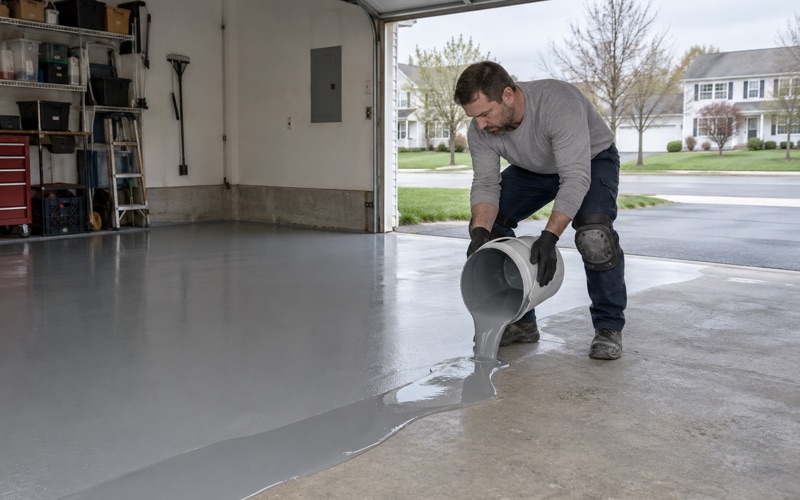
So we begin with the slab and the plumbing around it before we talk about colors or flake blends. We read the cracks, the old paint or sealer, the floor drain and the sump pit, and we tell you in plain words whether the concrete can take a coating as it is or needs repair first. Moisture testing is written into the scope as its own line, not added later after a floor has already blistered.
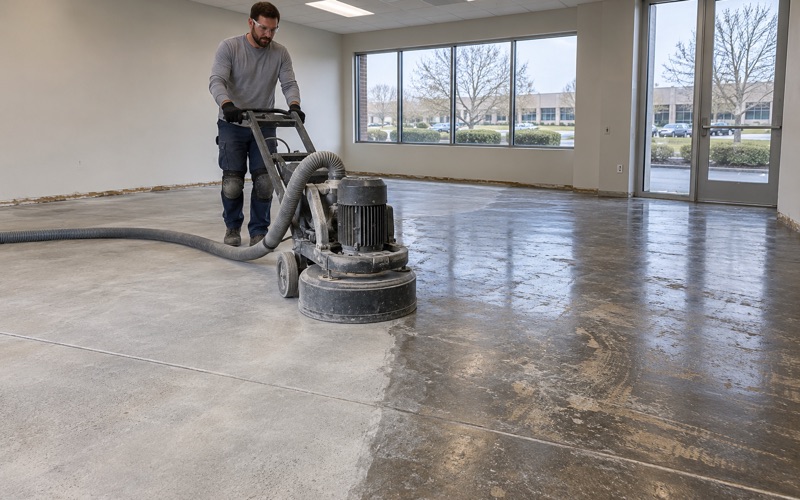
Our proposals name the product, the system build and the finished thickness, so you can hold the paperwork against the floor once the crew is gone. Every slab is opened with a diamond grinder or shot blaster, never acid, because a coating only holds as well as the profile under it.
One Pipe for Rain and Sewage: How a Basement Gets Wet Here
Forest Park drains through a combined sewer system, which means storm runoff and household sewage share the same pipes on the way out. In ordinary weather that works. In a heavy storm the rain fills the pipe, and the water has to go somewhere, and the lowest open point on many properties is a basement floor drain.
Why the river matters
The village sits next to the Des Plaines River, and its own hazard annex to the Cook County multi-jurisdictional hazard mitigation plan names the pairing directly. Proximity to the river together with the combined sewer system has flooded Madison and Roosevelt Roads, according to that annex. When the river runs high and the sewer is full, there is less room for storm water to leave the village quickly.
Madison and Roosevelt as a warning sign
Street water collecting on Madison and Roosevelt is the visible half of the problem. The half a homeowner does not see is the same surcharged sewer pressing back against service lines, which is how a basement can take water without a drop coming through a window well. When the streets are holding water, the pipes under them are usually full too.
What that means for a floor plan
A basement floor in a combined-sewer village is coated around a drain that can run in reverse. That changes where we pitch the coating, how we detail the edge of the floor drain and the sump pit, and which products we will put down. It also changes what we will promise, which we cover further down this page.
We also ask early whether the house has an overhead sewer, a backflow valve or a standpipe plug, because those decide how much water a basement can expect. We do not install plumbing, and we will not quote a floor as if it were a fix for a backup. What we can do is build a floor that is easy to clean and quick to return to service if water does reach it.
Looking for epoxy-flooring closer to Hinsdale? See Hinsdale Epoxy-Flooring.
July 24, 2010: The Night the Basements Filled
The village’s hazard annex records that on July 24, 2010, thousands of basements flooded across north central Cook County. The same record notes that I-290 was closed just east of Des Plaines Avenue in Forest Park. That count is regional, not a tally of Forest Park homes, and we do not stretch it into one.
What a storm like that leaves in a slab
Water that comes up through a floor drain is not clean rain. It carries sewage, silt and whatever was sitting in the line, and it soaks into bare or poorly sealed concrete. Long after the floor looks dry, a slab like that can keep releasing moisture, salts and odor from below the surface.
That is why we treat a basement with any history of backup as a moisture question first and a coating question second. Efflorescence, the white crust that forms when salts are carried to the surface, is one of the signs we look for. Old paint lifting in patches near the drain is another.
Why we do not read 2010 as a pattern
FEMA counts zero repetitive loss properties in the village, and we take that number at face value. A single large storm is not a forecast, and we will not tell a homeowner their basement is due to flood again. What 2010 does show is how the system behaves when it is overwhelmed, and a floor should be planned with that behavior in mind.
A Prewar Basement Floor After a Backup: What to Check First
The housing stock here is old. Of 7,649 housing units counted in the 2024 American Community Survey five-year estimates, 3,653 were built in 1939 or earlier, 47.8 percent of the total. Many of those houses have basement floors poured long before vapor retarders, modern drain detailing or anyone expected the floor to carry a finish.
Moisture testing on an old slab
A prewar basement floor usually sits directly on soil with nothing under it to stop vapor. We test before we coat, using ASTM F2170 in-situ relative humidity probes, ASTM F1869 calcium chloride emission testing, or the ASTM D4263 plastic sheet test, depending on the slab. The results are compared against the product maker’s limits and ASTM F710 thresholds, and they decide whether the floor needs a moisture-mitigation primer or is not a candidate for a film coating at all.
When the readings come back high, we say so before any money changes hands. Hydrostatic pressure under a basement slab can push a coating off the concrete from below, and no topcoat fixes that from above. Warranty exclusions get read out before the job is sold, and moisture is the first one we name.
Cracks, patches and old coatings
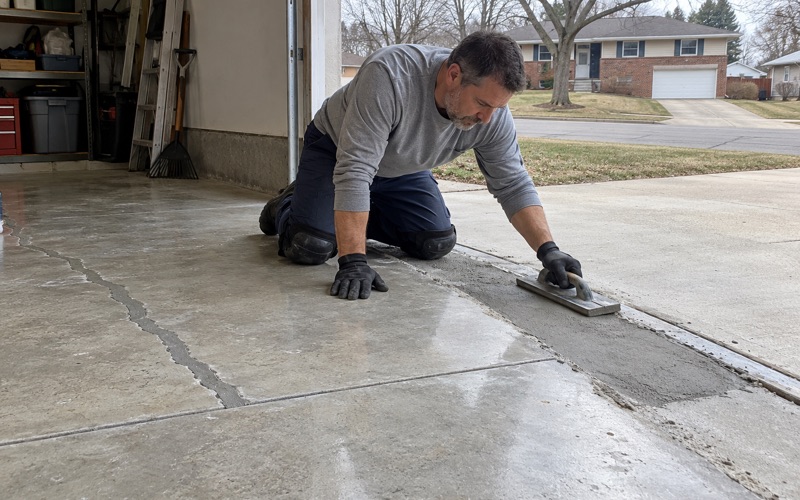
Old basements carry decades of patches, settlement cracks and layers of paint or sealer. We read each one, because some cracks are stable and can be filled, while others are still moving. A coating is a film that follows the slab under it, so an active crack will telegraph through no matter what product goes on top.
Old coatings come off before new ones go down. Grinding removes paint and sealer and opens the concrete to a measurable ICRI surface profile, typically in the CSP range the primer calls for. If the floor needs repair before it can be coated, that becomes a separate line in the proposal rather than a surprise on install day.
Drains, sump pits and edges
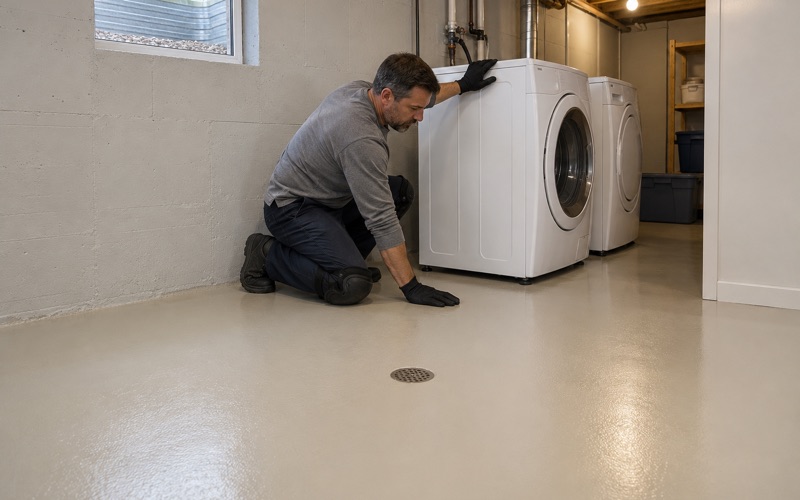
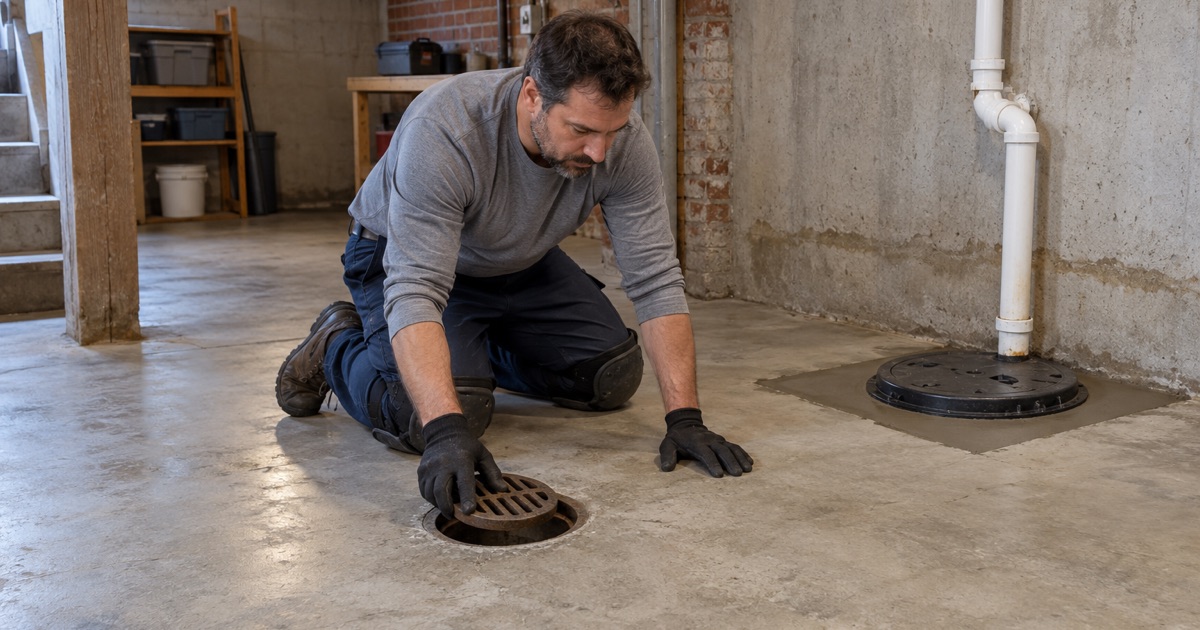
The floor drain is where a backup starts, so it is where a coating has to be detailed with the most care. We keep the drain body clear, slope the finish so water still runs to it, and stop the coating cleanly at the sump pit rim. A floor that sheds water toward the drain is easier to clean and dry if the sewer ever does push back.
What a Coating Does After a Backup, and Who Signs Off
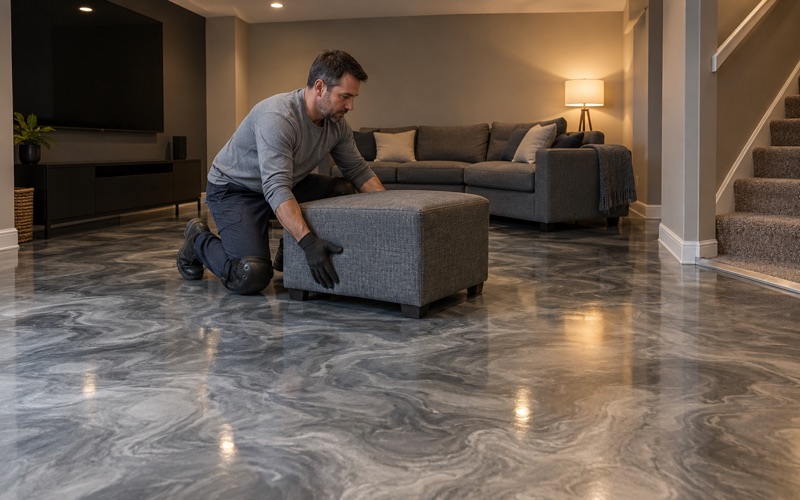
An epoxy or urethane cement floor does not stop a sewer backup and does not waterproof a basement. Water that comes up through a drain will still come up. What a good coating changes is what happens afterward: a sealed, seamless surface does not soak up sewage, and it can be scrubbed and disinfected instead of torn out.
Choosing a system for a basement that may see water
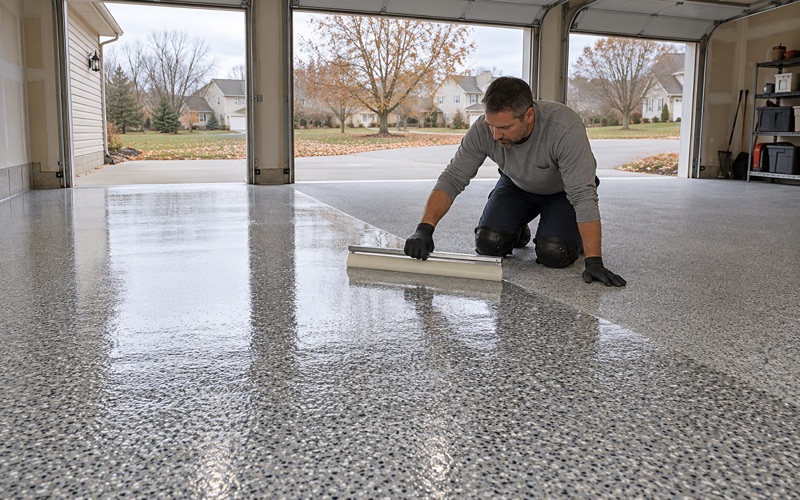
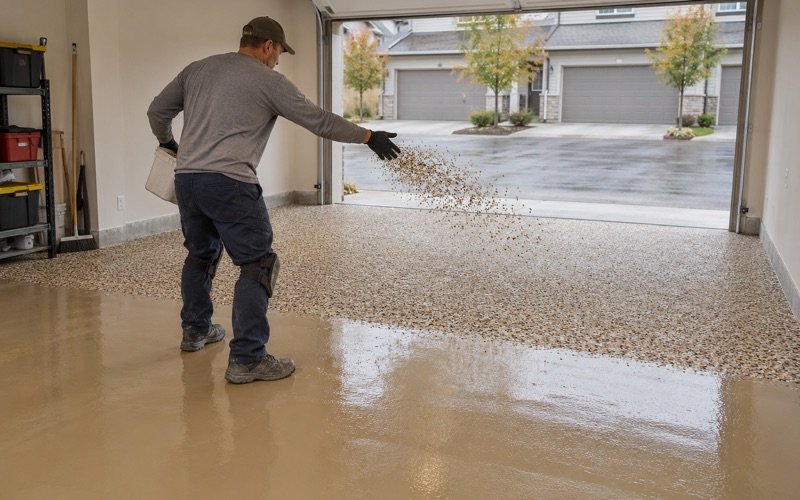
For a basement where moisture readings allow it, a 100% solids epoxy base with a vinyl flake or quartz aggregate broadcast gives a textured, cleanable floor. Where readings run higher or the slab is likely to stay damp, we look at urethane cement, which tolerates more vapor than a standard epoxy. Polyaspartic and polyurea topcoats add abrasion and stain resistance, and every product we choose falls within the Illinois limit on VOC content.
We schedule curing against the slab temperature and the dew point spread at the surface rather than the calendar. A cool basement with damp air can leave amine blush on fresh epoxy, which weakens the bond of the next coat. If conditions are not right, we wait, and we tell you why.
The village ordinance and the Building Department
Forest Park regulates development in flood hazard areas through its flood damage prevention ordinance, Title 11 Chapter 1 of the village code. The regulatory floodway along the river is the Des Plaines River floodway delineated by IDNR. The floodplain administrator is listed under the village Building Department, which also handles engineering.
We ask the permit desk before a job whether a basement or garage coating counts as decorating or needs a permit, rather than assuming either answer. Illinois issues no state license for flooring or coatings work, so we also confirm the village’s own contractor registration, bond and insurance rules before scheduling. If the work touches anything the Building Department regulates, the paperwork is settled first.
Paperwork on a home job
Every home job gets a written contract and the state’s Home Repair: Know Your Consumer Rights pamphlet before work starts, as the Illinois Home Repair and Remodeling Act requires. We do not sell a floor coating as radon reduction either; in Illinois that work takes a state radon mitigation license. What you get from us is a floor, scoped honestly around a sewer that can run backward and a slab that may be older than anything else in the house.
- 20+ Years Coating Floors
- Moisture Tested Before Coating
- Written Contract on Every Home Job