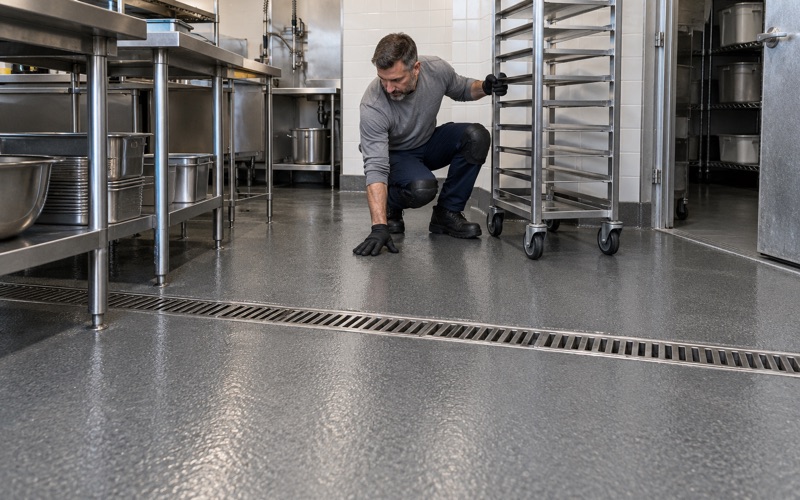
Schaumburg Epoxy Flooring has more than 20 years behind it, and our approach to epoxy-flooring in Deerfield starts with a question most estimates skip: what sits under the concrete? On an older slab the answer is usually missing from any paper record, so we measure the floor before we price a coating for it.
That changes the order of a visit. We read the cracks and any old coating first, take moisture readings as a priced line item in the scope, and only then write a proposal that names the product, the system build and the finished thickness. If the slab needs repair before it can hold a coating, the proposal says so in plain words rather than leaving it for the day the grinder starts.
The sections below explain why the age of a floor bears on the choice of system, what a moisture test can and cannot tell us, and how we build a floor when nobody can say what was poured beneath it.
Half the Village Predates the 1997 Vapor Retarder Standard
Deerfield is a village in Lake and Cook counties on Chicago’s North Shore, about 28 miles north of downtown, with 19,196 residents at the 2020 census. The age of its housing stock, more than anything else, shapes how we approach a floor here.
What the census counts
The Census Bureau’s 2024 five-year American Community Survey counts 7,800 housing units in Deerfield, and 3,933 of them were built before 1970. The 1960s are the largest single decade at 1,767 units, followed by the 1950s at 1,597, with 322 more from the 1940s and 247 older still.
Those slabs are now roughly 55 to 75 years old. A floor of that age could have been poured over a plastic sheet, over bare gravel or over something else entirely. In most cases no drawing or builder’s specification survives to say which.
What ASTM E1745 changed
ASTM E1745 is the standard specification for plastic water vapor retarders placed in contact with soil or granular fill under concrete slabs. It was published in 1997, and it gave designers a defined class of material to call for instead of whatever sheet happened to be on the truck.
That matters to a coating because a vapor retarder is the main thing slowing moisture on its way up from the ground into the concrete. A slab poured over a specified, intact retarder behaves differently under an impermeable film than one poured straight on fill.
What it did not change
A standard does not reach back in time. It did nothing for a slab poured in 1958 or 1964, and it never obliged anyone to install a retarder in the first place. It also says nothing about whether a sheet placed decades ago survived the pour intact.
So the honest position on a Deerfield floor of that era is that what lies under it is unknown, not absent. Some of these slabs may sit on a sheet that still works, and some may not. We do not assume either answer, and we do not quote a system until a reading gives us one.
Looking for epoxy-flooring closer to Warrenville? See Warrenville Epoxy-Flooring.
The Garage Slab Was Never Required to Have One
Age is only half of the story. A garage floor poured last decade can share the same uncertainty as one poured in 1960, for a reason written into the code itself.
The code exemption
The International Residential Code requires a vapor retarder under most slabs on ground, but section R506.2.3 lists exceptions, and garages are among them. A garage slab built exactly to code may therefore have nothing under it at all.
That is why we test a newer garage floor as carefully as an older one. Roughly a fifth of Deerfield’s housing was built in 2000 or later, sitting street by street beside the postwar stock. A recent build date tells us how old the concrete is, not whether it is dry.
Why moisture decides the outcome
A 100% solids epoxy cures into a dense film with very little ability to pass vapor. When moisture keeps rising through a slab beneath that film, it has nowhere to go, and pressure builds at the bond line until the coating blisters or lets go. Efflorescence, the white mineral bloom that shows up on bare concrete, is often a visible sign of the same movement.
It is also why moisture is the first exclusion we read out when we go over warranty terms, before the job is sold. A warranty cannot cover a condition the slab brings with it, and a customer should hear that from us at the kitchen table rather than discover it later.
What a garage floor still has to handle
Once the moisture question is settled, a garage coating here still has a hard job. Tires carry calcium chloride brine and rock salt in through the winter, and that residue sits on the floor for weeks at a time.
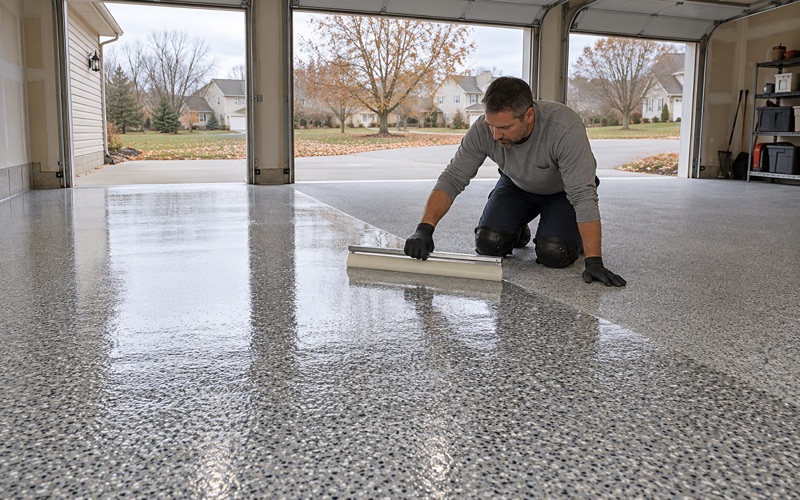
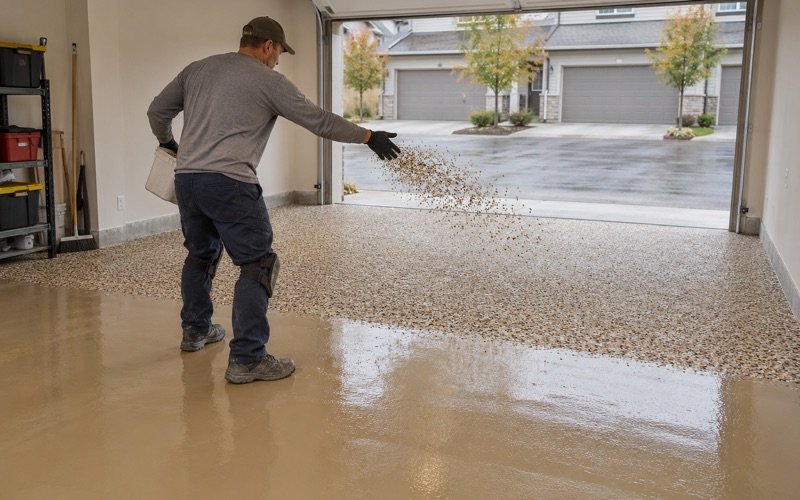
We build garage systems with that in mind: a broadcast layer for texture and a topcoat chosen to resist salt and hot tire pickup. We also say up front that a coating is a film that follows the slab beneath it, so an active crack will telegraph through no matter which product goes down.
A Moisture Reading Stands In for the Missing Record
Where no construction record exists, a measurement has to serve as one. We scope testing as its own line item on a basement slab and a garage slab alike, because selling it after a floor has blistered helps no one.
A quick look first
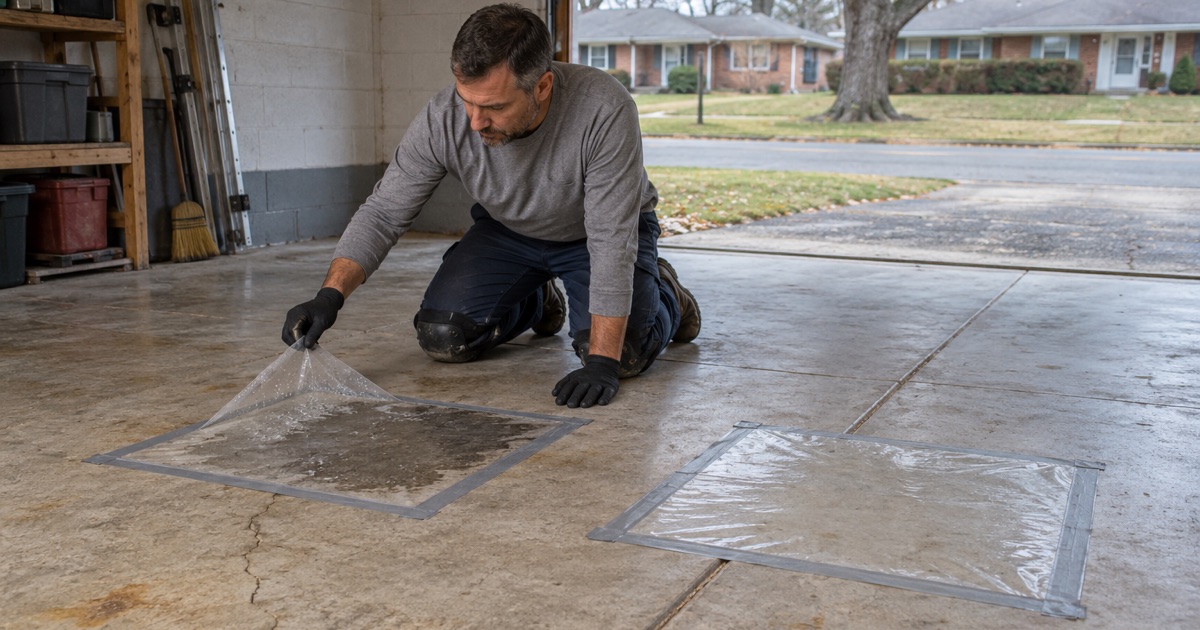
The ASTM D4263 plastic sheet test is the simplest method. A square of clear plastic is taped to the slab and checked later for condensation underneath or darkening of the concrete.
It is useful as a first look, and it can rule a floor out quickly. It is not a number, though, and we never base a system choice on it alone.
Numbers a manufacturer will accept
For a figure, we use one or both of two methods. ASTM F1869 measures the moisture vapor emission rate with a sealed dish of calcium chloride left on the surface, and ASTM F2170 places relative humidity probes in holes drilled into the slab itself.
The probe method reads conditions inside the concrete rather than at its surface, which suits an older slab whose top may have dried while the depth has not. Coating manufacturers publish their own moisture limits, often built around the thresholds referenced in ASTM F710, and we compare each reading to the limit for the exact product named in the proposal.
Both methods need time on the slab before they report, so we build that wait into the schedule rather than treating it as a delay. The probe holes are small, and they are filled once the readings are recorded.
Reading the result honestly
A good reading on an older Deerfield slab is good news, but it is a snapshot of one floor on one day, not proof of what lies underneath. A high reading does not prove there is no retarder either; it only tells us what the coating will face.
Either way, the result goes into the written scope so the customer can see why we chose the system we did. If the numbers say the slab should not be coated with a standard system, we say so.
Choosing a System When the Base Is Unknown
With readings in hand, the system choice becomes a practical decision rather than a guess. Three things shape it: how the slab is opened, what the moisture allows and what the local paperwork requires.
Opening the slab
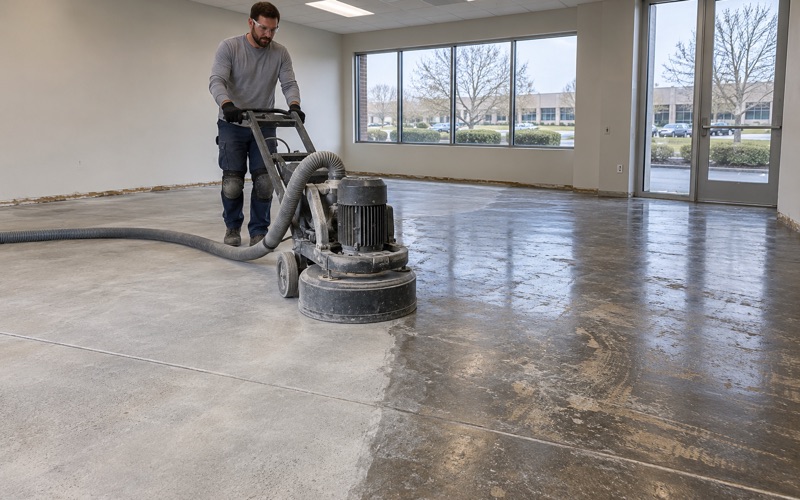
Every floor is opened mechanically, by diamond grinding or shot blasting, to a surface profile on the ICRI CSP scale that suits the product. We do not acid etch, because etching leaves residue and an uneven profile on concrete this old.
Grinding also shows us what the slab is made of. Old adhesive, paint, patches and hairline cracks surface once the top layer comes off, and we address repairs before any coating goes down.
Matching the system to the reading
When readings sit within the product’s limits, a typical garage or basement build is a 100% solids epoxy base, a vinyl flake or quartz aggregate broadcast, and a polyaspartic or polyurea topcoat. When readings run high, the options narrow to a moisture-mitigation primer under the system or a urethane cement, both of which tolerate more vapor than a standard epoxy base.
Each build is listed in the proposal with the product and finished thickness, so what was quoted can be checked against what went down. Curing is scheduled against slab temperature and the dew point spread at the surface rather than the calendar, and an unheated garage sometimes has to wait for spring.
When the answer is not yet
Sometimes the right recommendation is no coating at all, at least for now. A slab with high readings and active cracking may be better served by repair and a second test, or by a lithium silicate densifier that hardens the surface without sealing it under a film.
We would rather lose a coating job than install a floor the slab is going to push off. Saying that before the contract is signed costs us far less than a failed floor costs the owner.
Permits, registration and the contract
The Bernard Forrest Deerfield Village Hall at 850 Waukegan Road sits in West Deerfield Township, Lake County, the county that holds about 91.7 percent of the village, and the Village of Deerfield handles building permits. We ask the permit desk before a job whether a floor coating is treated as decorating or needs a permit, rather than assuming either way.
Illinois issues no state license for flooring or coatings work, so we confirm the village’s own contractor registration, bond and insurance requirements before scheduling. Of the 7,515 occupied homes in the village, 6,203 are owner-occupied, about 82.5 percent, so most of our Deerfield customers are the people who will live on the floor. Every home job gets a written contract and the Home Repair: Know Your Consumer Rights pamphlet before work begins, as the Illinois Home Repair and Remodeling Act requires.
- 20+ Years Coating Floors
- Moisture Tested Before Coating
- Written Contract on Every Home Job