
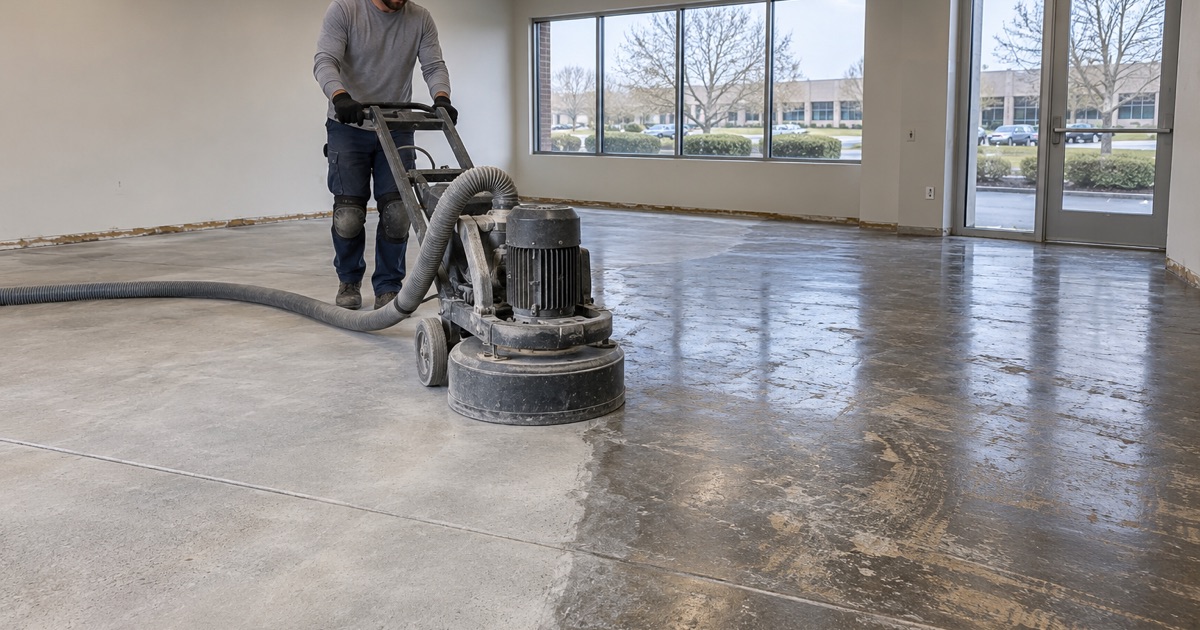
Schaumburg Epoxy Flooring provides concrete grinding in Schaumburg, IL, serving surrounding cities including Wood Dale, Bensenville, Barrington, Prospect Heights and Winfield. Grinding is the first step of every coating we install, and over more than 20 years it has become its own service: opening slabs, removing old coatings and adhesives, and flattening concrete for whatever floor goes on next.
No coating bonds properly to concrete that is sealed, painted, glazed by a steel trowel or contaminated with oil and adhesive. Diamond grinding and shot blasting remove that top layer and leave a clean, porous surface with a measurable texture. That texture, called the concrete surface profile, is what a coating or adhesive mechanically locks into.
We grind for our own coating and polishing jobs, for homeowners preparing a floor for another product, and for general contractors and flooring installers who need a slab ready for tile, vinyl, wood or carpet.
Surface Profiles and Why They Matter
ICRI Concrete Surface Profiles
The International Concrete Repair Institute publishes a scale of concrete surface profiles, numbered from CSP 1, nearly smooth, to CSP 10, very rough. Each coating and flooring product specifies the profile it needs. A thin sealer wants a light profile, while a thick resin mortar or self-leveling overlay needs a much more aggressive one.
Matching the profile matters in both directions. Too smooth and the product has nothing to grip; too rough and a thin coating shows every scratch pattern or uses far more material than planned. We choose tooling and passes to hit the profile the product’s data sheet calls for, and we compare the finished surface against ICRI reference chips.
Profile is also where a moisture test belongs. Once the slab is open, an in-situ relative humidity probe or a calcium chloride test gives a reading the next product’s warranty will care about, and it is far cheaper to learn the slab is wet before a floor goes down than after.
Grinding Compared With Acid Etching
Acid etching is cheap and common in DIY kits, but it cannot remove sealers, paints or oil, and it leaves an uneven profile and residue that must be rinsed and dried. We do not etch. Mechanical preparation gives a consistent result, removes contamination rather than wetting it, and shows us the condition of the slab under the surface.
Shot Blasting Large Floors
Shot blasters throw steel shot at the concrete and recover it with a vacuum, opening the surface quickly and evenly. On large open floors in warehouses, retail spaces and parking structures, shot blasting is often faster than grinding. Edges, corners and tight rooms are then finished with grinders, so the whole floor reaches the same profile.
Removing Old Coatings and Adhesives
Paints, Epoxies and Failed Kits
Peeling garage paint, failed DIY epoxy kits and worn industrial coatings have to come off completely before a new system goes down. We grind them off with diamond tooling suited to the coating’s thickness and hardness. Thick or rubbery coatings may need scraping or special tooling first, and we price removal separately so it is visible in the proposal.
Removal also shows why the old floor failed. Bubbles and blisters point to moisture, peeling in tire paths to a thin coating over etched concrete, and clean sheets lifting off to sealer underneath. Knowing the cause tells us what the next system needs.
Mastic, Thinset and Carpet Glue
Basements and commercial spaces often hide old black mastic, thinset mortar or carpet adhesive. We grind these residues down to clean concrete rather than using chemical strippers, which can soak into the slab and interfere with the next product’s bond. Older black mastics can contain asbestos, so where a floor’s age and adhesive suggest it, we recommend testing before any grinding begins.
Sealers and Curing Compounds
New slabs are often treated with curing compounds or penetrating sealers that block coatings and adhesives. They are usually invisible, so we test with a water drop and, where needed, a small trial patch. Grinding through them is the reliable way to restore a bondable surface.
Flattening and Leveling a Slab
High Spots, Lippage and Trowel Ridges
Grinding removes high spots, lippage where two slab sections meet at different heights, and trowel ridges left during finishing. Large-format tile and long vinyl planks are especially sensitive to these, since they bridge high points and rock or crack over them. We grind to the flatness the flooring manufacturer specifies.
Filling Low Areas
Grinding cannot raise a low spot. Where a slab has dips, we pair grinding with a patching compound or a self-leveling underlayment. The grind first opens the surface so the leveler bonds, and the leveler then brings the floor to plane.
Cracks and Joints Found During Grinding
Grinding exposes cracks, hollow-sounding areas and spalled joints that a covering had hidden. We mark each one as it appears and discuss it before going further, because some are simple fills and others are signs of a slab that is still moving. A crack that keeps moving will show through any floor laid over it, whether that is a coating, a tile or a plank.
Dust Control and Working in Occupied Spaces
Capturing Dust at the Tool
Concrete dust contains fine crystalline silica. We run every grinder and shot blaster through industrial vacuums with filtration designed for concrete dust, edge with shrouded hand grinders, and mask doorways and HVAC returns. The goal is that dust is captured where it is made rather than swept up afterward.
Noise, Hours and Building Rules
Grinding is loud, and many villages limit construction noise to daytime hours unless an exception is granted. In occupied offices, stores and townhome garages, we plan the noisiest work for agreed hours, confirm any association or landlord rules, and sequence the job so the rest of the building can keep working.
- 20+ Years Coating Floors
- Moisture Tested Before Coating
- Written Contract on Every Home Job