
Schaumburg Epoxy Flooring handles concrete floor repair in Schaumburg, IL, serving surrounding cities including Wood Dale, Bensenville, Barrington, Prospect Heights and Winfield. After more than 20 years of preparing slabs for coatings, we repair the cracks, spalls, scaled surfaces and failed coatings that stand between a damaged floor and a finished one.
Our repairs are surface repairs on interior floors: garages, basements, shops, stores and commercial spaces. We do not lift sunken slabs or work on foundations, and when a floor needs that kind of help we say so before quoting. What we do is read the damage, repair what can be repaired, and tell you plainly what a coating can and cannot hide afterward.
Cracks and Control Joints
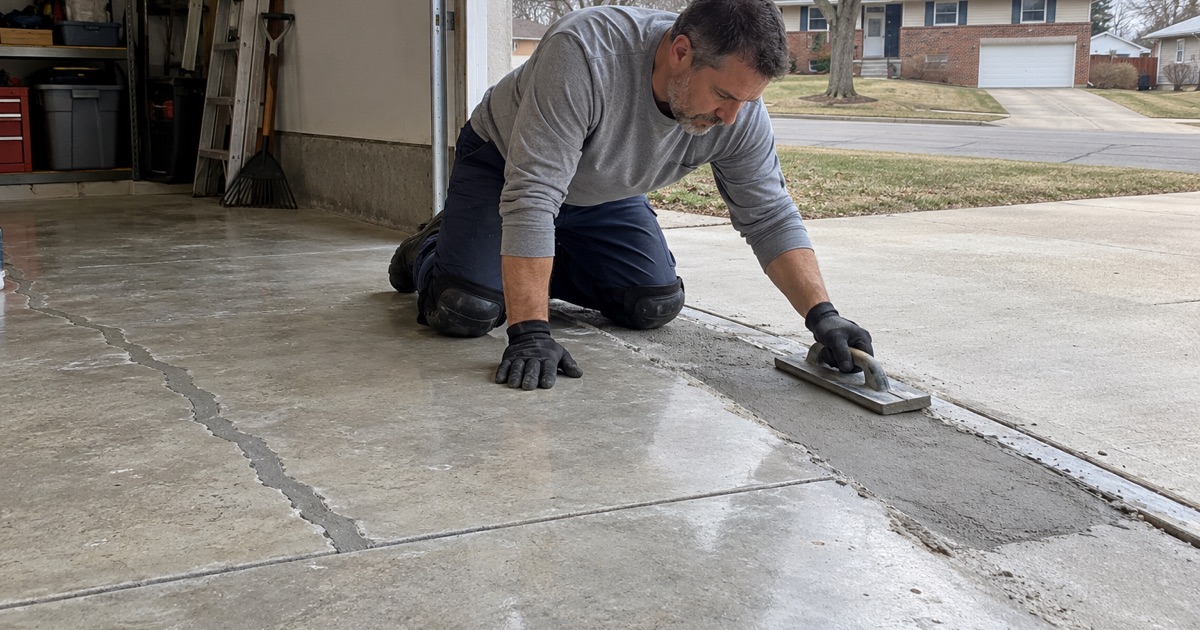
Reading a Crack Before Filling It
Not every crack is the same problem. Hairline shrinkage cracks are common and usually stable, control joints are cuts placed on purpose, and a crack that opens and closes with the seasons is a moving joint the slab chose for itself. We look at width, edges, offset and history before deciding how to treat each one.
The distinction matters because any coating is a film that follows the slab under it. A rigid repair over a moving crack will reopen, and the coating will open with it. We fill stable cracks rigidly and tell you which ones are likely to show again, rather than promising a floor that will never crack.
Crack Filling and Grinding Flush
Stable cracks are chased open, cleaned and filled with an epoxy or polyurea crack filler, then ground flush with the surrounding floor. On a floor being coated, the repair disappears under the system. On a polished floor it stays visible as a fine line, which many owners accept as part of the look.
The filler is chosen for the job. Rigid epoxy fillers suit stable cracks under a coating, semi-rigid polyurea fillers suit joints that see some movement, and fast-setting products keep a one-day garage schedule on track. We name the repair materials in the proposal along with the coating, so the repair work is something you can check rather than a hidden line folded into a single price.
Control Joints and Saw Cuts
Control joints are often left open in a coated garage floor, filled with a flexible joint filler, or filled and coated over, depending on use. Open joints collect dirt and salt; filled joints are cleaner but may show a hairline over time. We walk through the trade-off with you, joint by joint.
Spalls, Pitting and Salt Scaling
Garage Floor Scaling From Deicers
Calcium chloride and rock salt carried in on tires soak into bare concrete and break up the surface through repeated freeze-thaw cycles. The result is scaling: a flaky, pitted top layer, often worst where the cars park and near the apron. We grind back to sound concrete and rebuild the low areas with a resin mortar or polymer-modified patch.
This is one of the most common repairs we make on older garage slabs. Once rebuilt, the floor needs a coating, because the same brine that caused the damage will start on the patch the next winter.
Depth matters with scaling. Light surface scaling grinds away in the normal preparation pass, while deeper pitting needs a full skim of repair mortar before the base coat. We measure how far the damage goes during the first grind and price the repair from what we find, so a heavily scaled floor is not quoted as if it were a clean slab.
Spalled Edges and Impact Damage
Spalls are chunks broken from joint edges, door thresholds and areas hit by dropped tools or loads. We saw-cut or grind out loose material, rebuild the edge with a fast-setting repair mortar, and shape it to match the floor. In commercial spaces, rebuilt joint edges keep forklift and cart wheels from hammering the slab apart.
Pop-Outs and Surface Voids
Small cone-shaped pop-outs and surface voids appear where aggregate near the surface has fractured or air pockets opened during finishing. They are filled during grinding so the coating goes onto an even surface rather than bridging holes that show as dimples later.
Failed Coatings and Old Floor Coverings
Peeling Paint and Lifting Kits
A failed garage paint or DIY epoxy kit has to come off completely before a new system goes down. We grind it off with diamond tooling, look at the concrete underneath for the reason it failed, and test the moisture. A coating that lifted because of moisture will lift again unless the moisture is addressed.
The pattern of a failure tells us a lot. Peeling in the tire paths points to hot tire pickup on a thin coating, bubbles and blisters across the floor point to vapor, and sheets lifting cleanly off a smooth surface point to an etched or unprepared slab. Each one changes what the repair and the new system need, which is why we look before we grind.
Adhesive, Mastic and Tile Residue
Basements and commercial spaces often carry black mastic, carpet glue or thinset from old floor coverings. We remove it mechanically, rather than with chemical strippers that soak into the slab and interfere with the bond of the next coating.
Moisture Problems Behind the Damage
When the Damage Is Coming From Below
Efflorescence, coating blisters and a damp, dark slab all point to moisture moving through the concrete. Repairing the surface without measuring that moisture is repairing the symptom. We test with an in-situ relative humidity probe or a calcium chloride kit, and if the readings are high, the repair plan includes a moisture-mitigation primer or a conversation about drainage before any coating is chosen.
In this area, poorly drained clay soils and a spring water table make that conversation common in basements. A floor that has seen sewer backup or seepage should have its plumbing and drainage sorted before repair, because patching and coating a slab that will flood again simply adds cost to the next cleanup.
- 20+ Years Coating Floors
- Moisture Tested Before Coating
- Written Contract on Every Home Job