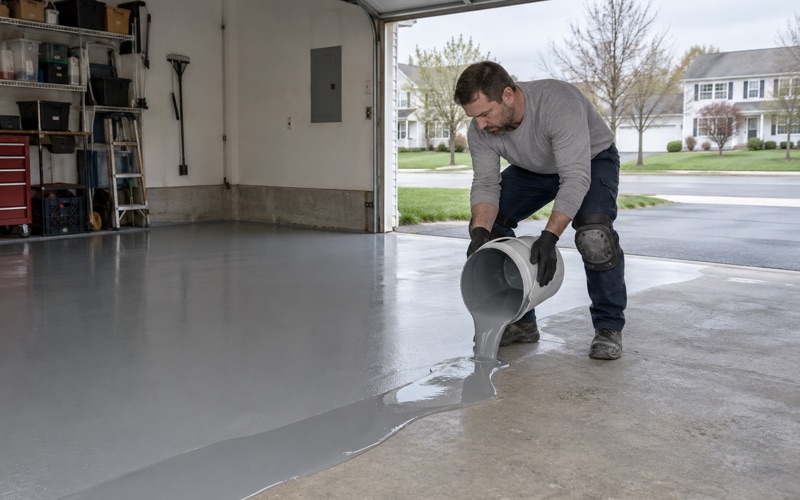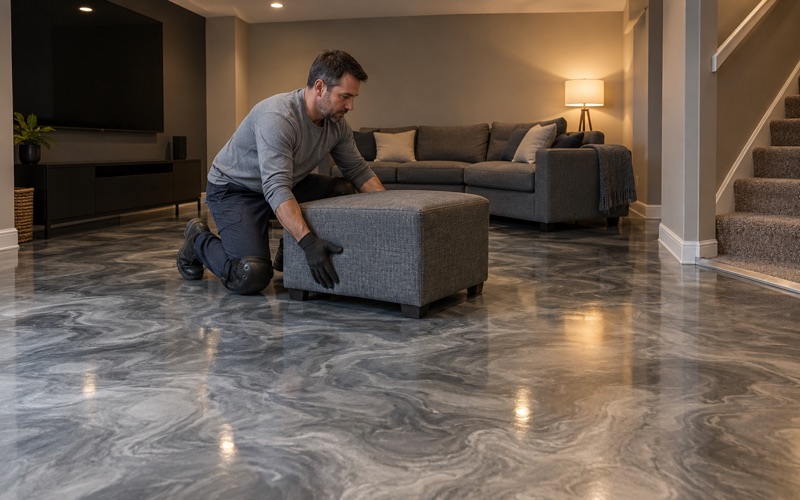
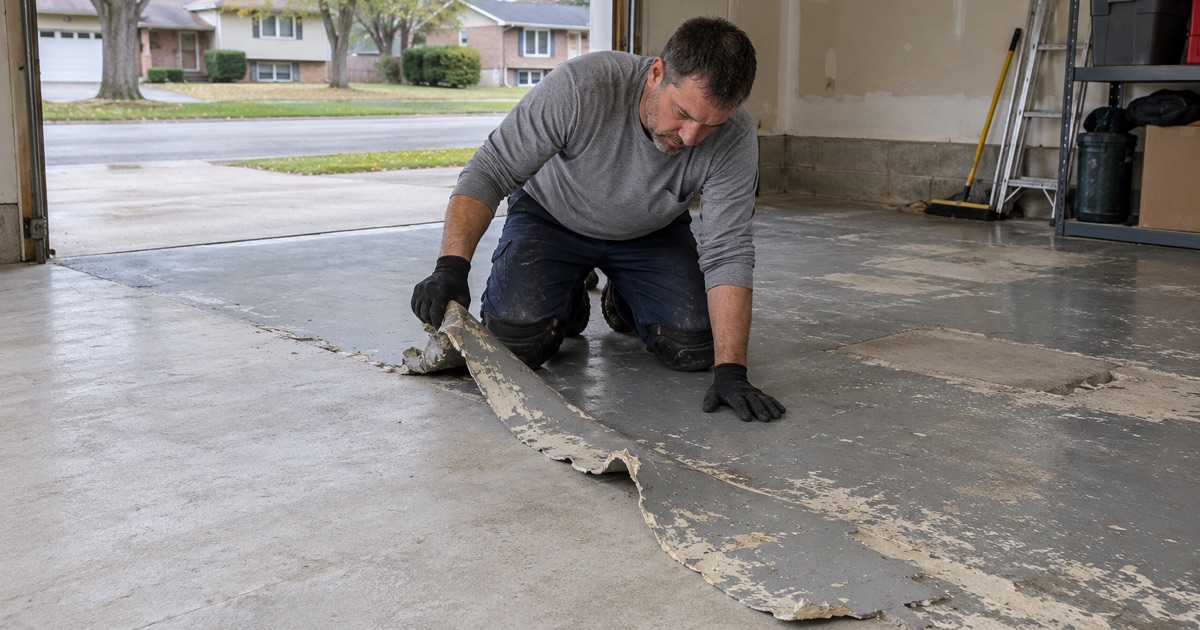
Schaumburg Epoxy Flooring has done more than 20 years of epoxy-flooring in Cary, IL, and the garage and basement slabs we see here share one trait before anything else: somebody has already lived on them. Oil has soaked in under the car, a previous owner may have rolled on paint or a hardware-store kit, and patches have gone in where a crack opened. None of that is a reason to skip a floor, but all of it decides how the floor has to be prepared.
That is why our quotes in Cary start with the slab rather than with a color chart. We look at what is on the surface, what is under it and how the concrete has moved over the years, and then we tell you whether it can take a coating as it stands or needs repair first. If it needs repair, the proposal says so in plain words.
The proposal also names the product, the system build and the finished thickness. When the crew leaves, you can hold the paperwork against the floor and check that what was quoted is what went down.
A Village That Has Stopped Adding Houses
The American Community Survey’s 2024 five-year estimates for Cary village record no housing units built in 2020 or later. The 2010s added 239, far fewer than any of the four decades before it. Those numbers are a sample estimate rather than a permit count, so zero recorded does not prove nothing was built, but the direction is clear: the housing here is overwhelmingly finished, occupied and decades into its working life.
Where the Houses Came From
The bulk of Cary went up between 1970 and 2009. The survey counts 1,263 units from the 1970s, 1,456 from the 1980s, 1,356 from the 1990s and 1,033 from the 2000s, which together make 5,108 homes, about 76.5 percent of the village’s 6,677 housing units. The 1980s were the single largest decade, so a slab around forty years old is as common a starting point as any.
What That Means for a Coating
A slab poured in the 1980s has been through decades of tires, drips, deicer and cleaning products. Even a house from the 2010s, the newest stock the survey records, has carried cars and storage for years. We do not get to start with fresh, clean concrete in a village like this, so every job here is planned as a coating over a used surface.
Newer Does Not Mean Ready
It is tempting to assume that one of the 239 houses from the 2010s has a cleaner, drier slab than a house from the 1970s. Sometimes it does, but a younger slab can still lack a vapor retarder, can still hold curing compound or a builder’s sealer on its surface, and can still have been parked on through several winters. We test and grind the newest floor in Cary exactly as we would the oldest, because the age of a house tells us less than the concrete does.
Cary’s Newest Slab Has Already Been Lived On
Because the newest recorded homes are already years old, the question we ask on every Cary job is the same: what has this floor absorbed, and what has been put on top of it? The answer changes the preparation, and occasionally it changes whether a coating makes sense at all.
Oil, Salt and Old Finishes
Motor oil and transmission fluid wick into bare concrete and can keep bleeding back out under a new film. Calcium chloride brine and rock salt from northern Illinois winters leave residue in the pores and along the door line. Paint, sealer or a thin kit coating sitting on the surface has to come off completely, because a new system bonded to a loose old one inherits every weakness of it.
Opening the Surface Mechanically
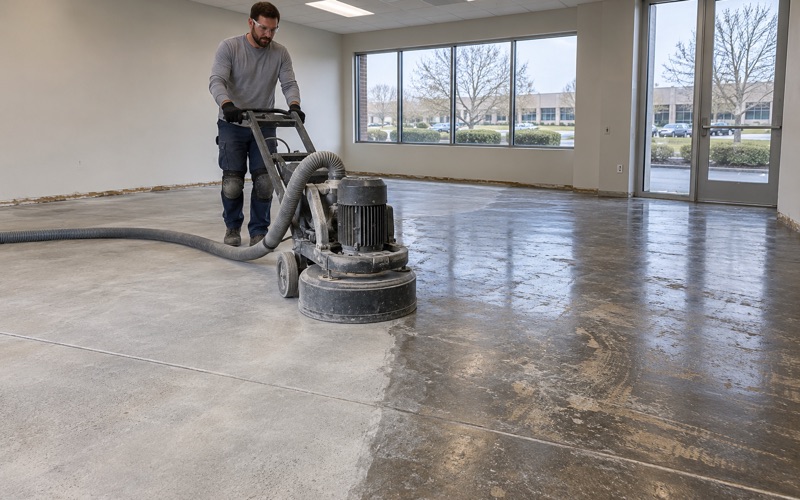
We open every slab with a diamond grinder or a shot blaster, and we do not acid etch. Grinding removes old film, contaminated cream and weak patches and leaves a profile we can measure against the ICRI CSP scale. Acid etching does none of that reliably on a floor that has been sealed or soaked with oil, and it leaves its own residue in the concrete.
Moisture Comes Before the Color
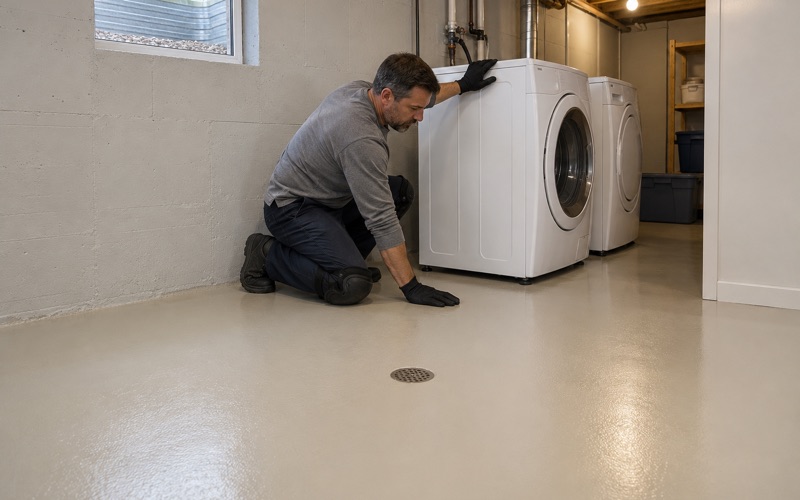
A garage built to the residential code may have no vapor retarder under it, because IRC R506.2.3 exempts garages from that requirement. Basements bring their own vapor drive. Moisture testing is therefore a line item in our scope for both, using the ASTM F1869 calcium chloride method, ASTM F2170 in-situ relative humidity probes or an ASTM D4263 plastic sheet check as the slab calls for. When readings run high, a moisture-mitigation primer goes into the system instead of a hopeful assumption.
Looking for epoxy-flooring closer to Deerfield? See Epoxy-Flooring Services in Deerfield.
4,616 Owner-Occupied Detached Houses
Owner occupancy in Cary is high. Of 6,468 occupied units, 5,483 are owner-occupied, or 84.8 percent, and 4,616 of those owners live in a one-unit detached house. The survey records no mobile homes and no two-unit buildings in the village, and only 391 detached houses are rented.
The Person Paying Lives Over the Garage
In practice that means the person signing for a garage floor here is usually the person who will park on it every morning. That buyer tends to care less about a showroom finish than about whether the floor will hold up to the next decade of winters, and that is the conversation we prefer to have. We would rather explain cure times and maintenance honestly than sell a floor on a sample board alone.
What Every Home Job Gets in Writing
Every residential job in Cary gets a written contract and the Home Repair: Know Your Consumer Rights pamphlet before work starts, as the Illinois Home Repair and Remodeling Act requires. Warranty exclusions are read out before the job is sold, and moisture is the first one we name. A coating is a film that follows the slab beneath it, so we say up front that it will not stop a crack from moving.
Paperwork Before the First Pass
Illinois issues no state license for flooring or coatings work, so we confirm the Village of Cary’s own contractor registration, bond and insurance requirements before a job goes on the calendar. We also ask the village whether a floor coating counts as decorating or needs a permit, rather than assuming either answer. The products we specify stay within the Illinois architectural coating VOC limits in Part 223 of Title 35 of the Illinois Administrative Code, which bind the installer as well as the manufacturer.
Reading What Is Already on the Floor
Before we price anything in Cary, we read the floor. That step takes longer than measuring square footage, but it is where a coating failure can usually be seen coming.
Cracks and Patches
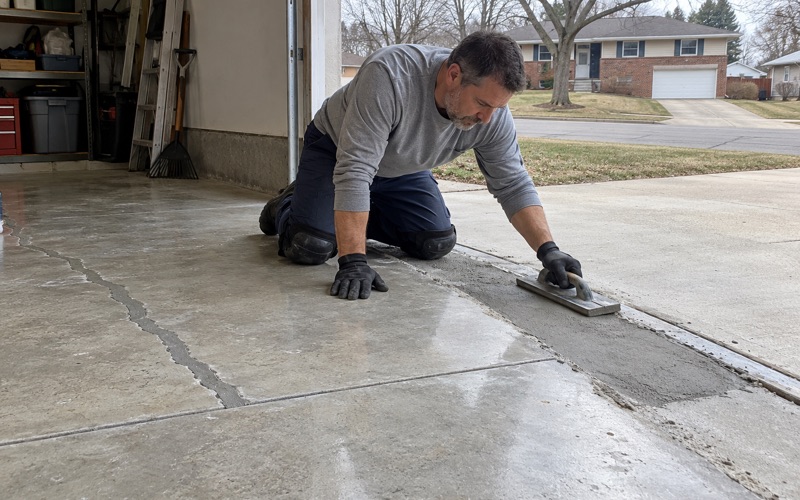
We map the cracks, note which ones are wide or offset and look at any previous patch to see whether it is still bonded. Some cracks can be routed and filled as part of the coating. Others, such as a slab that has settled or heaved at a joint, need repair before any coating goes down, and we say so plainly instead of hiding the problem under a broadcast of flake.
Old Coatings and Sealers
A peeling kit coating, a glossy sealer or a painted floor each comes off differently, and some leave residue that has to be ground through. We test how firmly an existing finish is holding before deciding how much of the slab has to be taken down. We do not survey what Cary owners have put on their floors, so we treat each one as unknown until it has been checked.
Choosing the System Once the Slab Is Known
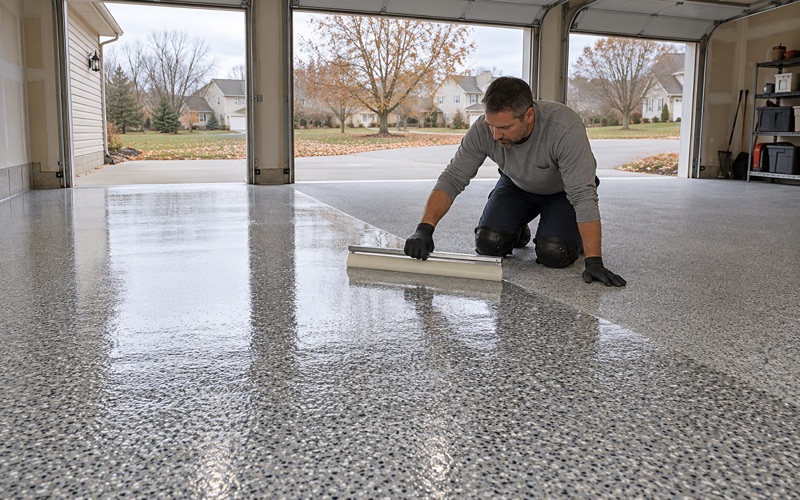
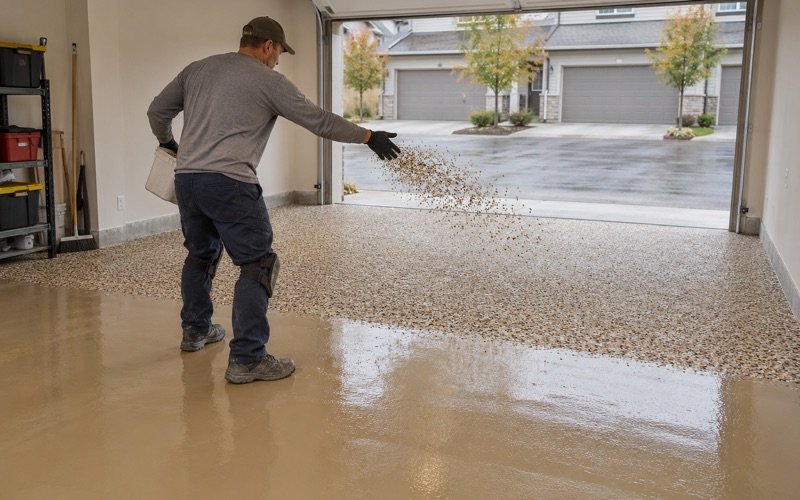
With the surface read and the moisture numbers in hand, the system choice is straightforward. A 100% solids epoxy base with a vinyl flake broadcast and a polyaspartic topcoat suits most attached garages, because it resists hot tire pickup and the salt brine that winter tracks in. A quartz aggregate broadcast adds grip where a floor stays wet, and a basement over a damp slab may call for a mitigation primer first.
When a Full System Is More Than the Floor Needs
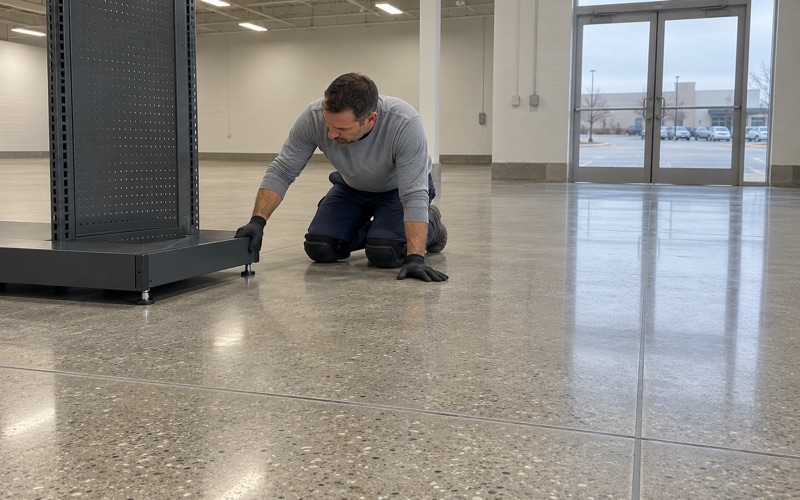
Not every lived-on slab needs a broadcast floor. A sound basement slab that only needs to shed dust and resist light staining may be better served by grinding and a lithium silicate densifier, which hardens the surface without adding a film that could later peel. Where an owner wants a clear, easy-to-clean floor and nothing more, we will price that option alongside the coated one so the comparison is on paper.
Curing, Scheduling and Local Authorities
The last decisions on a Cary job are about timing and the agencies that sit around the work. Getting them right is what keeps a well-prepared slab from failing in its first season.
Temperature and Dew Point, Not the Calendar
We schedule curing against slab temperature and the dew point spread at the slab surface rather than a date on the calendar. A coating laid on concrete that is too cold, or too close to the dew point, can cure soft or develop amine blush on the surface. When an unheated garage is simply too cold, we say it has to wait for spring rather than gamble with the floor.
Living Around the Work
Because most Cary floors belong to the people who live above them, a garage job also means a few days without the garage. We set the schedule with you before the first grinder arrives, including when the cars have to come out, when foot traffic is safe and when the floor can take a vehicle again. A coating driven on too early is one of the easiest failures to avoid.
Village, County and Fire District
Cary was incorporated in 1893 and covers 6.60 square miles on the Fox River. The village lies in Algonquin Township, McHenry County, with a portion in Cuba Township in Lake County, so the county offices that apply depend on which side of that line a house sits. Building questions go to the Village of Cary, while fire protection comes from the Cary Fire Protection District at 400 Cary-Algonquin Road, a separate district rather than a village department.
What a Floor Coating Will Not Do
We do not sell a floor coating as radon reduction. In Illinois, radon mitigation is licensed work through IEMA, and a sealed basement floor is not a substitute for a proper system. If a basement concern goes beyond the surface, we tell you what kind of contractor to call instead.
- 20+ Years Coating Floors
- Moisture Tested Before Coating
- Written Contract on Every Home Job