Schaumburg Epoxy Flooring has spent more than 20 years on epoxy-flooring in Campton Hills and across our wider service area, and the first question we settle here is rarely about color or flake. It is about paperwork: which office decides whether a garage or basement coating needs a permit, and what that office’s rules actually say. In Campton Hills that office belongs to the village, and we treat it that way.
A floor coating looks like a simple job from the driveway. Underneath it sit a slab that has to be ground open, tested for moisture and read for cracks, plus a local permit question that a contractor should ask rather than guess at. We handle both before a homeowner signs anything.
What follows covers how permits work in the village today, what the current building-permit ordinance and the 2024 residential code mean for a floor job, the slabs we tend to find in local garages and basements, and the one phone call we make before any resin is mixed.
A Village That Took Its Permits Back From Kane County
Campton Hills is young as Illinois villages go. It was established on May 14, 2007, after a referendum that spring incorporated 20.3 square miles of Campton and Plato townships, including the community of Wasco, and the village today also reaches into Blackberry Township. For its first four years it relied on Kane County personnel to handle permit reviews.
The 2011 handover
That arrangement ended on August 19, 2011, when the village ended its partnership with the county and took permit reviews over itself. The Kane County Chronicle reported the change a few days before it took effect. Since then, the question of whether a project needs a permit has belonged to Campton Hills rather than the county.
Who reviews and inspects now
The village did not build a full plan-review staff from scratch. It contracted B&F Technical Code Services, later known as B&F Construction Code Services of Elgin, to carry out permit reviews and inspections on its behalf. The Campton Hills Building and Zoning Department, at Village Hall on LaFox Road, remains the front door for every application.
That arrangement shapes how we work. The code service is the village’s contractor, not ours, and nothing in our scope depends on a relationship with it. When we need an answer, we take the question straight to Building and Zoning.
Why the old county habit does not settle anything
Owners who bought before 2011, or who moved in from unincorporated parts of Kane County, sometimes assume the county’s rules still decide the matter. They no longer do. The permit list a floor job is measured against is now a Campton Hills document, written and administered by the village.
The village has kept rewriting its own rules since then. Its Zoning Ordinance of 2024, approved in December 2024 after 19 public meetings, is the third it has adopted, following versions from 2007 and January 2023. A village that revisits its codes that often is one where last decade’s answer to a permit question is worth checking again.
Looking for epoxy-flooring closer to Lincolnwood? See Epoxy-Flooring Services in Lincolnwood.
Ordinance 25-29 and the 2024 Residential Code
The village board has adopted a revised building-permit ordinance, Ordinance 25-29, aligned with the 2024 residential code and carrying local amendments on top of it. That is a common pattern for a village writing its own permit rules over a national model code. We have read it through a summary of the board’s action rather than as final codified text, so we do not quote its sections to customers.
What the exemption list names
Part of the revision is a list of work that does not require a building permit. As summarized, it includes small accessory structures under 200 square feet, certain driveway overlays and residential nonstructural interior remodels. That last category is the one owners ask us about most, because coating a slab inside an existing house moves no wall, beam or footing.
Where a floor coating lands is the village’s decision
It would be easy to read that list and conclude that an epoxy floor sits inside it. We do not make that call on the village’s behalf. Whether a particular garage or basement coating counts as a nonstructural interior remodel, needs a permit, or falls outside both depends on the scope and on how Building and Zoning reads its own list.
Some jobs sharpen the question. A basement coating that is one part of a larger remodel, a garage floor going in alongside new drains or electrical work, or a repair that saws and patches concrete is a different scope from a clean coating over sound concrete. We describe the real scope to the village and let the people who administer the ordinance answer.
What the code itself says about garage slabs
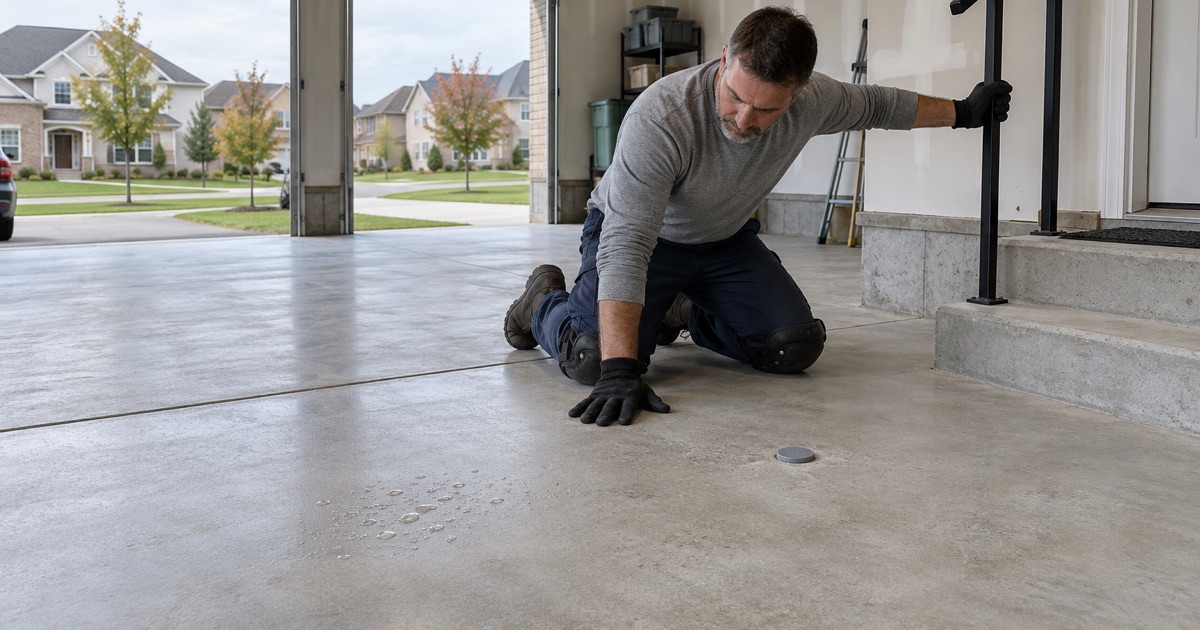
The residential code also explains something we find on garage floors. It exempts garage slabs from the vapor retarder it requires beneath living space, so a garage poured fully to code can have nothing between the concrete and the soil. That is the reason we test a garage slab rather than assume a newer one is a dry one.
The Garages and Basements We Coat Here
Owners booking the floor they live on
Campton Hills is above all a village of owner-occupied detached houses, 3,595 of them, against 48 renter households across the whole village. The person who calls us is nearly always the person who will park on that floor or cross it every morning. So we quote plainly, with the tradeoffs on paper, because the owner lives with every one of them.
Slabs from the 1970s through the 2000s
Most of the housing here went up between the 1970s and the 1990s, with a further 767 homes built in the 2000s. That puts many garage and basement slabs at roughly 25 to 55 years old. Concrete of that age has often been sealed, painted or coated at least once, and an earlier film has to come off before a new system can bond.
An old garage coating tells its own story once we look closely. Tire marks lifted out of the finish point to hot tire pickup on a thin product, and a cloudy, greasy surface on a past epoxy job can be amine blush that was never washed off before the next coat. Neither is fixed by rolling a fresh layer over the top.
Opening the slab and reading it first
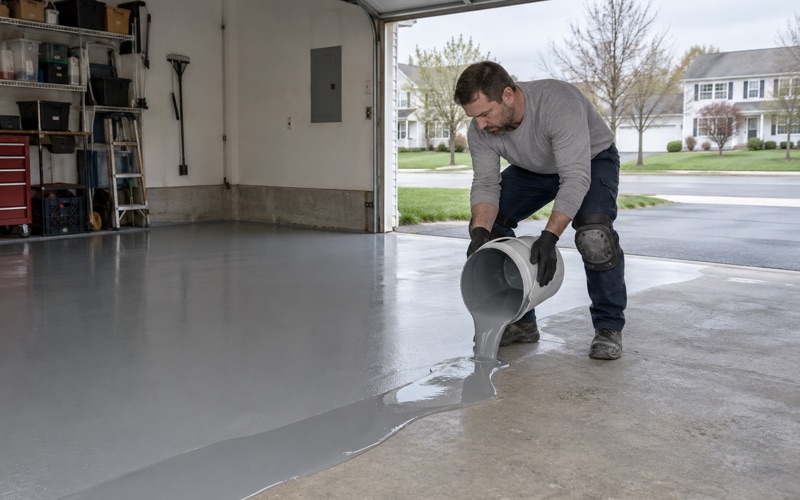
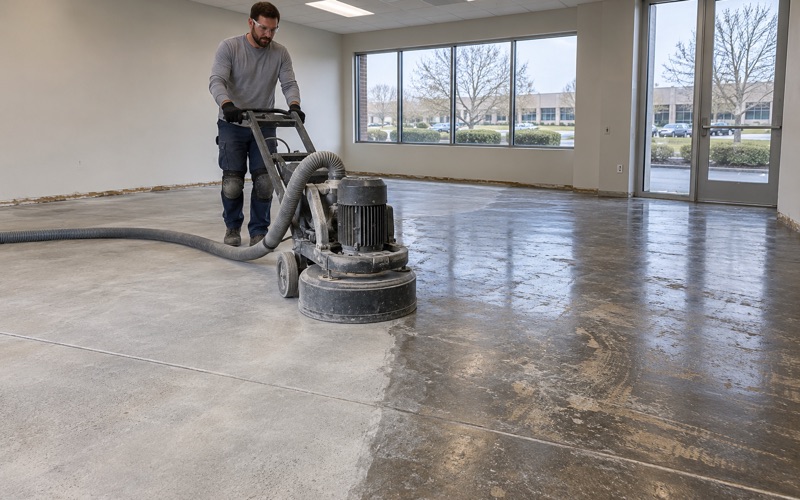
We open every slab with a diamond grinder or a shot blaster to a measured ICRI concrete surface profile, and we never acid etch. Grinding also shows what the floor has been hiding: a sealer that has let go, a hairline crack that has widened, a patch that never bonded. If a slab needs repair before it can take a coating, the quote says so instead of burying the problem under fresh resin.
We are just as direct about what a coating can and cannot do. A floor coating is a film that follows the slab beneath it, so a crack that keeps moving will eventually show through. We would rather tell an owner that before the job than promise a floor that holds still when the concrete under it does not.
Moisture testing as part of the scope
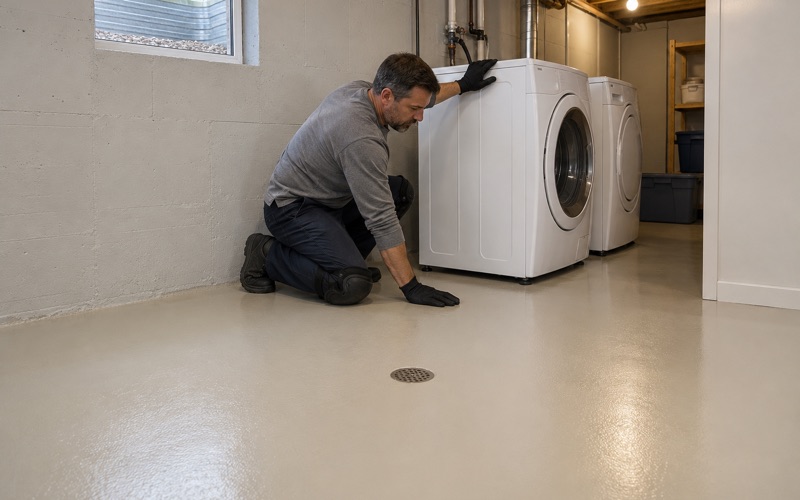
Moisture testing is priced into our scope on garage slabs and basement slabs alike. Depending on the floor, that can mean an ASTM F1869 calcium chloride test, ASTM F2170 relative humidity probes set into the concrete, or an ASTM D4263 plastic sheet check as a first read. Where the readings call for it, we specify a moisture-mitigation primer under the 100% solids epoxy rather than hoping the slab stays dry.
One Call to Building and Zoning Before the First Coat
What we ask the village
Before a Campton Hills job goes on our calendar, we contact the Building and Zoning Department at (630) 524-6254 and describe the work in plain terms. We ask whether that scope needs a permit under the current ordinance or falls within its exemptions. If a permit is required, it is applied for and approved before materials arrive.
Illinois issues no state license for flooring or coatings work, so the same conversation covers what the village expects of contractors working inside its limits. We confirm registration, bond and insurance requirements there rather than assuming one village’s rules carry over to the next.
What goes on paper before work starts
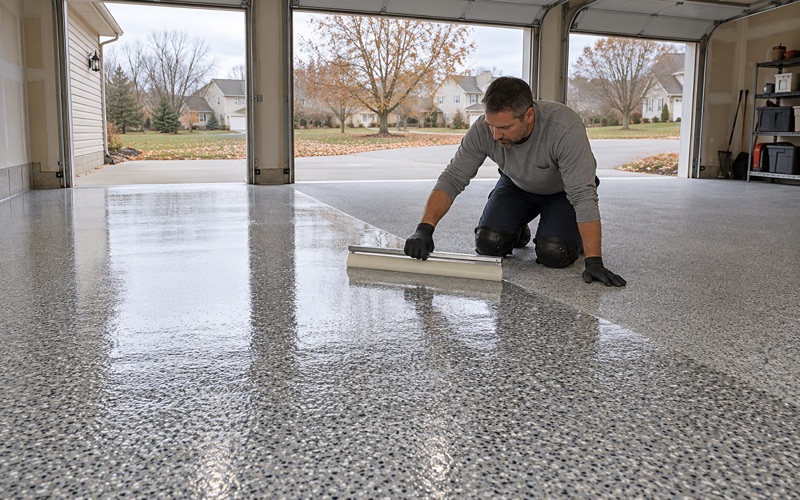
Our proposal names the product, the system build and the finished thickness, so an owner can hold the installed floor up against the quote. A typical garage build might be a 100% solids epoxy base with a vinyl flake broadcast and a polyaspartic topcoat, but the proposal lists the actual layers for that particular floor. Every home job also gets a written contract and the Home Repair: Know Your Consumer Rights pamphlet before we begin, as the Illinois Home Repair and Remodeling Act requires.
The coatings we choose stay within the Illinois limits on VOC content for architectural coatings. Those limits bind the contractor applying a product as well as the company that made it, so we check compliance when we pick the product, not after it is on the floor.
What we say before the sale
Warranty exclusions are read aloud before a job is sold, and moisture is the first one named. We also explain that curing is scheduled against slab temperature and dew point rather than a date picked in advance, and that an unheated garage sometimes has to wait. We do not present a floor coating as radon reduction either, since in Illinois that work requires a state radon mitigation license.
For a Campton Hills owner, all of this adds up to a short set of answers in writing: what the village said about the permit, what the slab tested at, what is going down and how thick, and what the warranty leaves out. We gather those answers before the first coat, not after it.
- 20+ Years Coating Floors
- Moisture Tested Before Coating
- Written Contract on Every Home Job