Schaumburg Epoxy Flooring has spent more than 20 years on concrete, and our approach to epoxy-flooring in Burr Ridge starts with how hard the floor will be worked. A production line, a machine shop and a loading dock each ask something different of a coating. Picking the system before knowing which of those a floor faces is how a coating fails early.
So the first thing we do on a commercial slab is watch it in use, or ask the people who run it. We note where carts turn, where coolant or wash water collects, where forklifts brake and where pallets get dragged. Then we read the existing cracks and any old coating, and we tell the owner directly if the slab needs repair before anything can be applied to it.
What comes back is a written proposal naming the product, the layers in the system and the finished thickness. A plant manager or a landlord can hold the installed floor against that page and check it. The sections below follow the kinds of floors the village actually holds.
More than offices along I-55
What the employer list shows
Burr Ridge is often pictured as corporate offices and quiet streets, and both are real. The village’s Economic Development Plan, in its 2018 update, tells a wider story. Among its major employers it lists Mars Chocolate North America as a snack-food manufacturer with 200 workers, Bronson & Bratton making tungsten and ceramic dies and tools with 130, Personalization Mall in warehousing and distribution with 140, and SAIA Motor Freight with 100.
That list is eight years old, and we have not checked who still operates where. We name it because of what it says about the floors here, not because any of those companies are our customers. Food production, precision machining, racked storage and a truck terminal all sit inside one village of about 7 square miles.
A highway through the middle
Interstate 55 cuts Burr Ridge roughly in half, and the village counts 149,000 cars a day passing businesses on four frontage roads. The same plan says the village is home to more than 500 businesses. Industrial and distribution floors cluster near highway access for an obvious reason, since trucks have to get in and out.
For us, that means a Burr Ridge job is as likely to be a production bay or a dock as a garage. Each of those floors has its own failure modes, and the coating has to be chosen against them rather than against a brochure.
The village also spans two counties and two townships, Lyons Township on the Cook side and Downers Grove Township on the DuPage side. We note which side a building sits on when we plan a job, since a food tenant in particular answers to the health department of its own county.
Looking for epoxy-flooring closer to Wood Dale? See Epoxy-Flooring in Wood Dale.
Food production floors that get washed down
Water, heat and cleaning chemicals
A snack-food floor is wet on purpose. Sanitation crews hose it down, scrub it with cleaners and sometimes hit it with hot water, often on a schedule that leaves little drying time. A thin roll-on epoxy that does well in a showroom can soften, blister or lose grip under that routine.
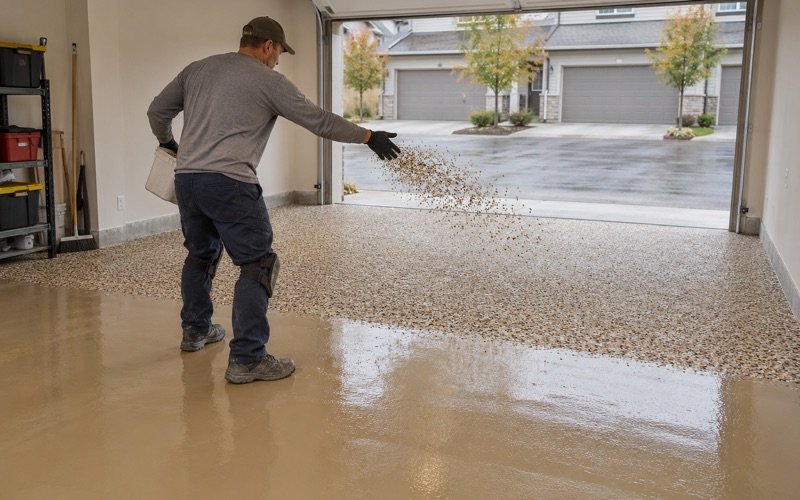
For wash-down rooms we look first at urethane cement, which tolerates thermal shock and constant moisture better than a standard epoxy film. Where a lighter-duty room stays mostly dry, a 100% solids epoxy with a quartz aggregate broadcast can be the right build. The choice depends on water temperature, the cleaning chemicals on site and how often the floor is flooded.
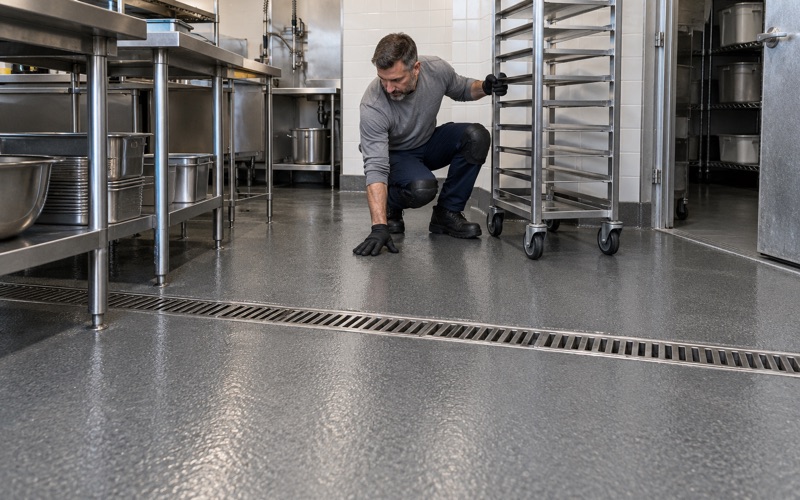
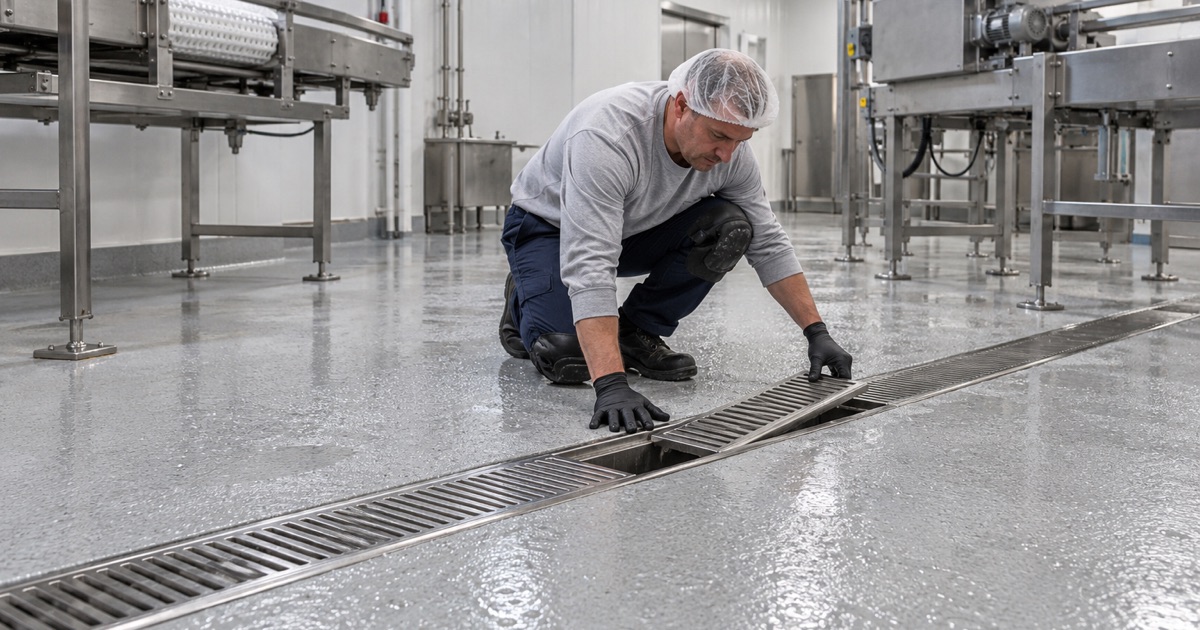
Drains decide whether a wash-down floor works at all. Water that pools in a low spot sits on the coating for hours and finds any weak edge. We check the slope toward each floor drain, detail the coating into the drain body so water cannot creep under it, and flag spots where the concrete itself needs reshaping before it is coated.
What the food code asks of a floor
The Illinois Food Code adopts the 2022 FDA Food Code, and that code cares about how a floor can be cleaned. Section 6-201.13 addresses coved junctures where the floor meets the wall, so dirt and water have no square corner to hide in. We can carry the coating up the wall in a cove base to meet that detail, and behind heavy kitchen or processing equipment a cement board wainscot may be the better backing.
Section 6-201.11 carries an exception for antislip floors in some areas, which matters because grip and cleanability pull against each other. A rougher broadcast holds a boot better but takes more scrubbing. We talk through that trade with the people who clean the floor, not only the people who sign for it.
What we will not promise
No health agency has approved our work or any product we install, and we never say otherwise. Our job is to build a floor that a sanitation program can keep clean, and the operator’s inspector decides whether it does.
Tool rooms, racking aisles and truck docks
Under the machines
A die and tool shop puts concentrated weight on small footprints and drips cutting fluid and oil around them. Steel chips get tracked and ground into the surface by every cart wheel. A floor there needs real thickness and chemical resistance more than it needs decorative color.
We often build those floors with a thicker 100% solids epoxy base and a chemical-resistant topcoat, sometimes with aggregate in the walk paths. If a tenant runs electronics or testing benches, a static-dissipative system rated to a stated resistance range may be worth pricing. We only quote it where the work inside the building calls for it.
Racking and forklift lanes
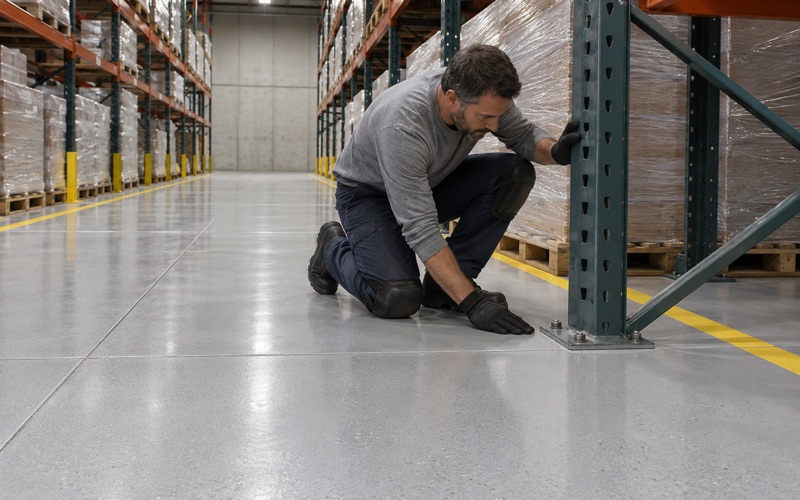
Distribution floors fail in predictable places. Forklift tires scuff the turning points at aisle ends, rack base plates concentrate load, and pallet jacks chip the edges of any coating that has not bonded well. A densified slab finished with lithium silicate is sometimes a better answer for a busy warehouse than a film coating that will need regular repair.
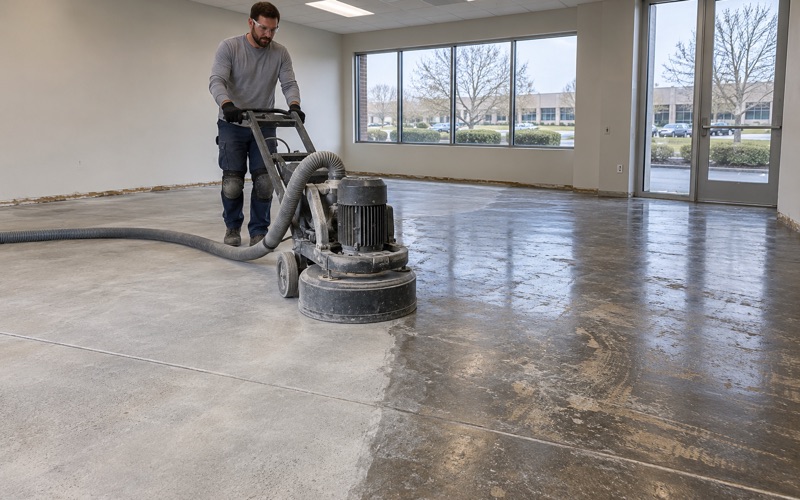
Where a coating is wanted, for striping, dust control or a cleaner floor for packing work, the bond is everything. We open every slab mechanically with a diamond grinder or shot blaster to a measured ICRI surface profile, and we do not acid etch. That profile is what lets the coating hold up at the aisle ends.
Dock edges and terminal floors
A motor-freight terminal or a loading dock takes impact from dock plates, steel wheels and dropped freight. Trailers bring water and grit straight onto the slab whenever a door is open. Dock edges and the first few feet inside a door usually wear fastest, and they can be detailed with a heavier build than the open floor.
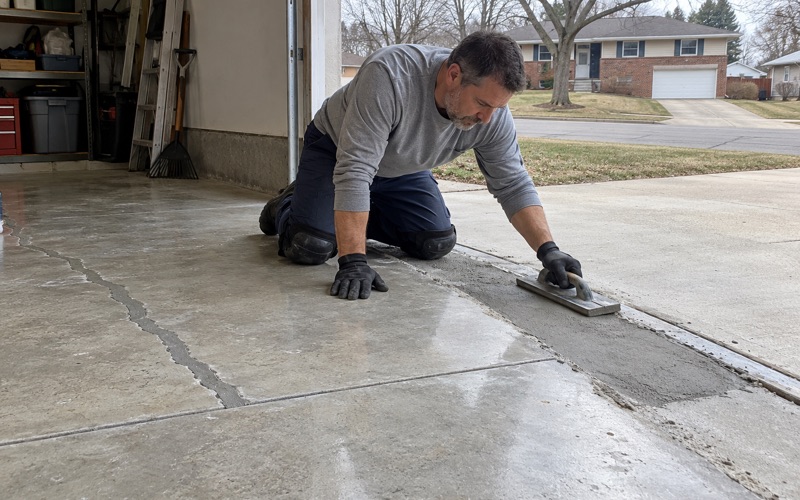
Moving joints and cracks matter even more there. A coating is a film that follows the concrete under it, and it will not stop a slab from shifting. We say that before the work is sold, and we plan joint treatment so the floor flexes where the concrete does.
A new tenant, a new floor
The certificate of occupancy comes first
The village requires a certificate of occupancy for each new business, though it generally imposes no separate business license. That makes a change of tenant a natural moment to redo a floor. A new food producer, a shop moving in or a distributor taking over a bay will often want the slab coated before equipment arrives and the occupancy is signed off.
A bay that changes hands often carries the last tenant’s floor. It might be a worn epoxy, a painted aisle line, a sealer or patches from equipment that was bolted down and pulled out. We grind test areas to see what is bonded and what is loose, and the proposal says whether the old system comes off entirely or can serve as a sound base.
We ask Burr Ridge Community Development before the job whether the coating work needs its own permit or counts as finish work, rather than guessing either way. Building permits there run under the 2021 IBC and IRC with the village’s local amendments in Building Ordinance 1225, effective January 1, 2025. Illinois issues no state license for flooring or coatings contractors, so we confirm the village’s own contractor requirements before any job is scheduled.
Between-lease windows and night shifts
An empty bay between tenants is the easiest floor to coat, because nothing has to be moved and nobody is working on it. When the building is occupied, we schedule around the hours it has to keep running, including overnight work and weekend shutdowns. A plant that cannot stop production can sometimes be done in sections, one area cured and back in use before the next begins.
Cure timing follows slab temperature and the dew point spread at the surface, not the calendar. A cold dock floor with an open door can sweat, and coating it then invites amine blush and a poor bond between layers. We take the readings on the day and adjust the schedule if the floor is not ready.
Moisture testing on every scope
A commercial slab can carry moisture whether or not it was poured over a vapor retarder, and the records rarely say which. Our proposals list moisture testing as its own line, using ASTM F1869 calcium chloride kits or ASTM F2170 in-situ relative humidity probes as the floor requires. A high reading means a moisture-mitigation primer goes under the system.
At the proposal meeting the warranty exclusions get read out loud, with moisture at the top of that list. Every coating we specify also falls under the Illinois cap on VOC content, a limit that holds the installer to account and not only the manufacturer. Plant managers usually want that settled before a crew walks in, and so do we.
- 20+ Years Coating Floors
- Moisture Tested Before Coating
- Written Contract on Every Home Job