Schaumburg Epoxy Flooring brings more than 20 years of concrete coating work to epoxy-flooring in Brookfield, and a large share of the floors we are asked to look at here sit under houses that are now seventy or eighty years old. A slab that age has lived a long life before we arrive. It has carried cars, paint cans, patches and at least one earlier owner’s idea of a finished floor.
That history shapes the job more than any product choice does. Before we price anything, we walk the floor, study the cracks and test whatever coating is already stuck to it, then tell you plainly whether the concrete can take a new system or needs repair first. The written proposal spells out the product, the layers in the build and the finished thickness, so you can hold the floor that went down against the paper you signed.
The sections below follow the houses we meet most often in this village: the postwar garages and basements, the 1970s homes that came after them, the way detached ownership changes who makes the decisions, and what we check with the village before a crew shows up.
The Postwar Decades Built More of Brookfield Than Any Other Era
Census figures make the point quickly. Of Brookfield’s 7,927 housing units, 853 went up in the 1940s and 2,086 in the 1950s, so 2,939 homes, or 37.1 percent of the stock, date from the war years and the decade that followed. The 1950s alone account for more houses than any other single decade in the count.
Those houses did not start a new town. The village began in 1889 as Grossdale, laid out by Samuel Eberly Gross as a place where working families could buy affordable homes with train access to the city, and it took the Brookfield name in 1905. The postwar builders mostly filled lots on that older grid, which is why a midcentury house here often shares a block with something from before 1940.
The rail line that drew those first buyers still runs through town, with the BNSF route stopping at three Brookfield stations. For our purposes the takeaway is simpler: the village grew in layers on a grid first planned for working households, and a garage floor from the 1950s has often seen seventy years of hard everyday use.
A 1940s or 1950s Garage Slab
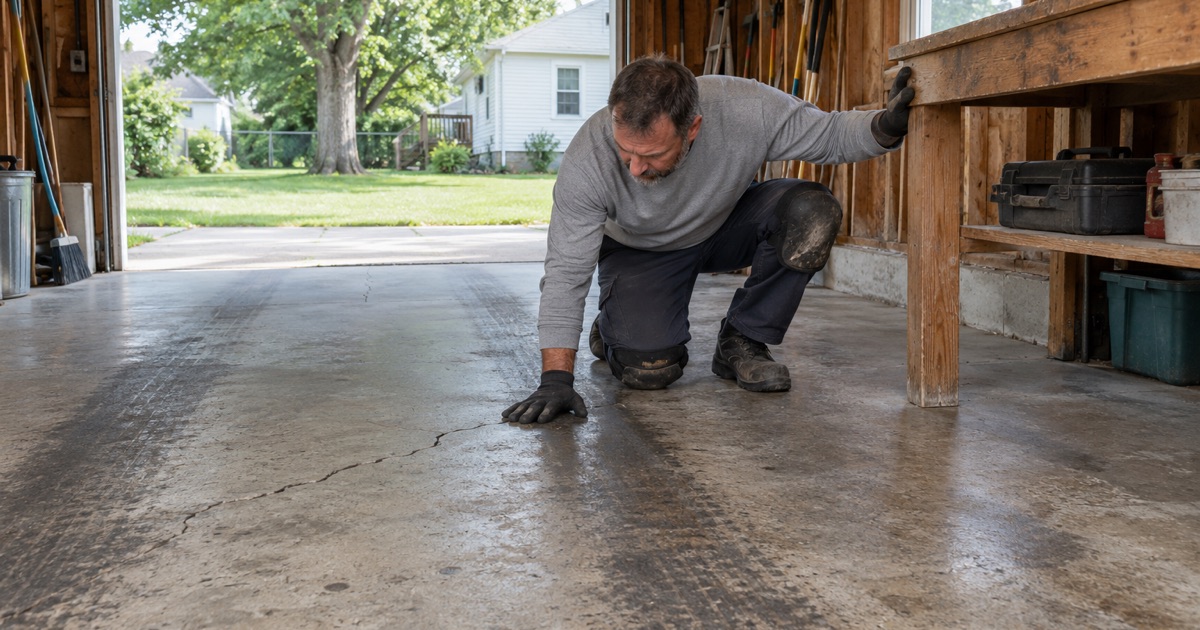
Garage floors from this period vary widely, and we never assume we know what one holds until we have looked. Some are thinner than a modern pour, some show no sign of reinforcement, and plenty have been painted once or several times over the decades. Each of those conditions changes how the floor has to be prepared.
Old paint is the most common surprise. A coating applied over a painted slab bonds only as well as that paint holds the concrete, so we take the floor back to sound material with a diamond grinder or shot blaster until it reaches a profile in the ICRI CSP range the system calls for. We do not acid etch; a chemical wash leaves residue and an uneven profile on concrete this old.
Grinding also shows us things a visual walk-through cannot. Oil that soaked in decades ago, a skim patch that never bonded, or a soft top layer all come to light once the paint is off. If the opened slab turns up something that changes the scope, we stop and show you before going further.
Cracks, Patches and What a Coating Can Promise
A slab poured seventy years ago has usually settled and cracked somewhere. We read those cracks before quoting: a hairline shrinkage crack is routine, while an edge that has heaved or dropped tells us the concrete underneath is still moving. When repair has to come first, the proposal says so and prices it on its own line.
We are also direct about what a coating cannot do. Epoxy, polyaspartic and polyurea finishes are films that ride on the concrete beneath them, and if the slab shifts, the film follows. A new floor will not hold a moving crack together, and we explain that before anyone signs.
Looking for epoxy-flooring closer to La Grange? See Epoxy-Flooring Services in La Grange.
Basements on a Prewar Grid, and the 1970s Houses Next Door
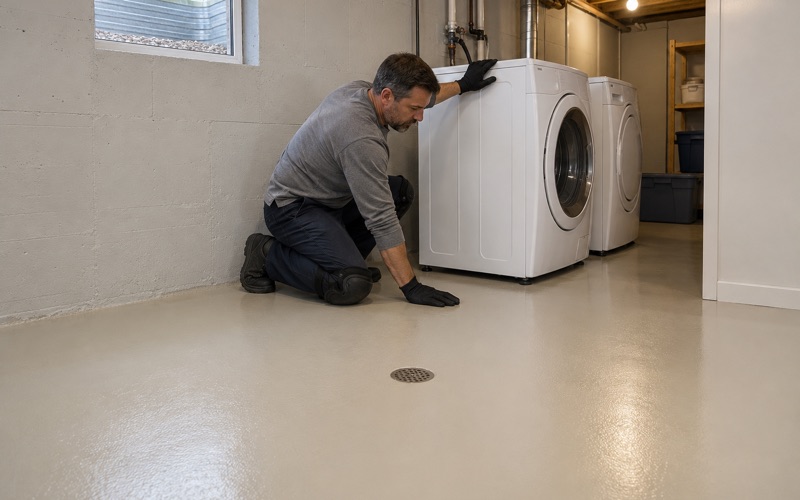
Where a postwar house here has a basement, that floor behaves differently from a garage. A basement slab is in contact with soil on its underside and often against foundation walls on several sides, so moisture vapor moving up through the concrete is the first question we answer. Hydrostatic pressure under a slab can push a coating off from below no matter how carefully the top was prepared.
Testing Before We Quote a Basement
Moisture testing appears as its own item in our scope for basements and garages alike. Depending on the slab, that means a plastic sheet test under ASTM D4263 as a first read, calcium chloride emission testing under ASTM F1869, or in-situ relative humidity probes under ASTM F2170, measured against the thresholds in ASTM F710 and the limits the coating manufacturer publishes. We would rather find a problem on a test kit than on a blistered floor a year later.
When the readings come back high, we discuss a moisture-mitigation primer under the system, or a urethane cement build that tolerates more vapor than a standard epoxy. Signs like efflorescence on the slab surface, a sump pit or a floor drain also shape the detailing. Our warranty exclusions are read aloud before the job is sold, and moisture is the first one we name.
The 1970s Layer That Followed
After the postwar boom, the village kept building at a slower pace: 792 homes in the 1960s and 1,080 in the 1970s, then far fewer in each decade since. Those 1970s houses are younger than their neighbors, but a newer slab is not automatically a dry one. The model residential code exempts garage floors from the vapor retarder requirement under IRC R506.2.3, so a garage poured to code may have nothing under it at all.
That is why our testing step does not change with the age of the house. A 1975 garage and a 1950 garage get the same moisture readings before we commit to a system, and the results, not the year of construction, decide the primer.
Most Owner-Occupied Homes Here Are Detached Houses
Of the 7,683 occupied units in Brookfield, 6,284 are owner-occupied, and 5,726 of those owners live in detached houses. That is 91.1 percent of the owner-occupied stock. For a floor job, it means the person we meet at the garage door is usually the person who decides the scope, with no association board or building manager in the loop.
What That Owner Receives in Writing
A home floor job here gets a written contract and a copy of the Home Repair: Know Your Consumer Rights pamphlet before any grinding starts, as the Illinois Home Repair and Remodeling Act, 815 ILCS 513, requires. The contract carries the same product names, build and thickness as the proposal. For the smaller group of owners in attached homes, we plan the work around the association’s rules and the neighbors’ need to reach their own garages.
Building a Garage Floor for Winter
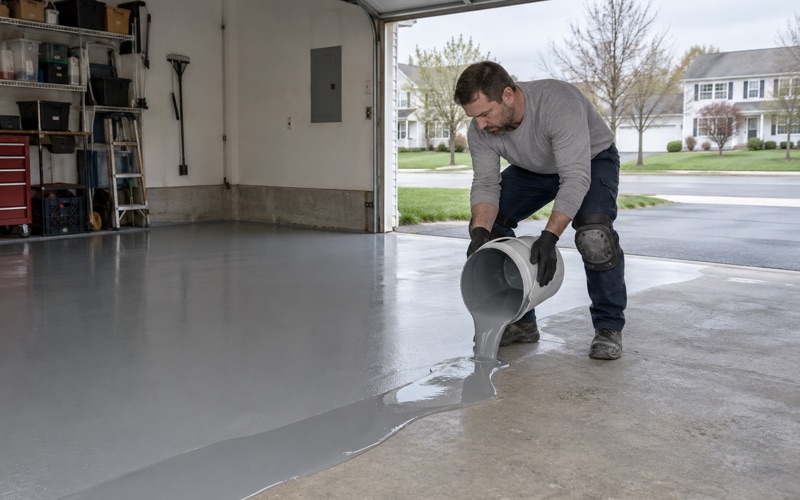
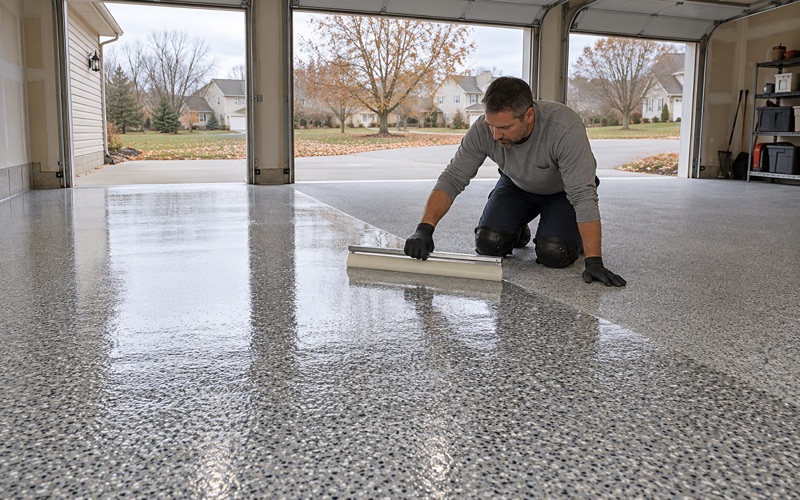
Northern Illinois winters send calcium chloride brine and rock salt into the garage on every set of tires, and a residential floor here has to stand up to that. Our usual garage build pairs a 100% solids epoxy base with a vinyl flake or quartz aggregate broadcast and a polyaspartic or polyurea topcoat chosen to resist hot tire pickup and salt staining. Some owners want a plainer finish, and for a basement workshop or storage floor a ground concrete surface sealed with a lithium silicate densifier can be the better fit. Every coating we install falls within the Illinois VOC content limits for architectural coatings, a rule that applies to the installer as well as the manufacturer.
Scheduling Around the Weather Inside the Garage
Cure time follows slab temperature and the dew point spread at the slab surface, not a date on the calendar. When the concrete is too cold or too close to dew point, a coating can develop amine blush or fail to cure fully, so we say plainly when an unheated garage should wait for spring. We also do not sell a floor coating as a radon fix; in Illinois that work requires a state radon mitigation license.
Chapter 12, Building and Planning, and When We Ask First
Construction rules in Brookfield are administered by the village’s Building and Planning divisions, which sit under the Administration and Finance department. Chapter 12 of the municipal code holds the building rules and was most recently updated on April 10, 2023, adopting the 2021 International Building Code family and the 2023 National Electrical Code.
Asking the Permit Desk Before the Job
Whether a floor coating counts as decorating or as work needing a permit is a question we put to the village before the job, rather than guessing either way. The answer can depend on what else is happening, such as concrete replacement or drain work alongside the coating. We would rather make one phone call than leave an owner with a stop-work notice.
If a permit is needed, we tell you what the village asked for and build that time into the schedule. If it is not, we note who we spoke with and when, so the answer is on file rather than in someone’s memory.
Registration, Bonds and Insurance
Illinois issues no state license for flooring or coatings contractors, so each village sets its own expectations. Before a Brookfield job goes on the calendar, we confirm the village’s contractor registration, bond and insurance requirements and meet them. Owners are welcome to ask for that paperwork at the first visit, and we would rather hand it over early than be asked for it on the morning the grinder arrives.
Townships and the Village
The village crosses township lines: Village Hall at 8820 Brookfield Avenue falls in Proviso Township, while other parts of Brookfield fall in Riverside Township. For a garage or basement floor, those lines rarely matter, because the building questions run through the village itself.
- 20+ Years Coating Floors
- Moisture Tested Before Coating
- Written Contract on Every Home Job