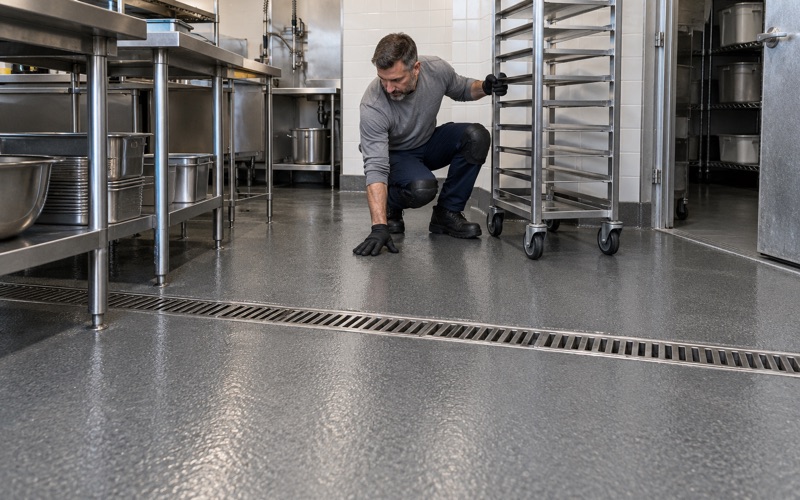
Schaumburg Epoxy Flooring brings more than 20 years in the trade to epoxy flooring in Bensenville, where a good share of the floors we price are not floors the person calling us lives on. The request comes from an owner or a property manager, and the people who walk that floor every day are tenants who will still be living there while we work.
That changes the job more than the product does. The slab still has to be ground open, tested for moisture and coated to a thickness we name in writing, but the schedule, the notice and the order in which rooms come out of service all have to be planned around residents who never asked for the project.
This page covers how we handle that kind of work: shared floors in larger rental buildings, the staging that keeps a building usable, the odor and cure questions tenants actually ask, and the rented single-family houses where a landlord wants the garage done between occupants.
1,168 Apartments in Buildings of 50 or More
Census figures give Bensenville a housing mix that shapes who hires a floor contractor. The American Community Survey’s 2024 five-year estimates count 1,168 units in buildings of 50 or more, and 989 of those are occupied by renters. Across the village, renters hold 3,462 of 7,015 occupied units, close to half.
The practical reading is simple. In a rental building of that size, nobody who sleeps there owns the corridor outside their door, or a storage or mechanical room where the building has one. Those floors belong to an owner, and in day-to-day terms they belong to whoever manages the building.
Who Orders the Floor When Nobody Who Lives There Owns It
Our first conversation on a job like this is usually with a property manager rather than a resident. The manager knows which areas are in scope, what the owner has approved to spend, which entrances and routes have to stay open, and how far ahead tenants need to hear about common-area work.
That is the person our proposal is written for, so it names the product, the system build and the finished thickness in terms a manager can hand to an owner and check against the floor afterward. If the existing slab has cracks or an old coating that will not hold, we say so in the quote, including when repair has to come before any coating.
Warranty exclusions get the same treatment. We read them to the manager before the job is sold, moisture first, so the owner’s file holds the terms the floor was bought under.
Approval, Phasing and the Permit Question
Where the owner signs off separately from the manager, we price the scope by area so it can be approved in phases. Before the job, we also ask the village permit desk whether the coating counts as decorating or needs a permit, rather than assuming either answer, and we put that answer in writing for the manager’s file.
Insurance and registration are checked the same way. Illinois issues no state license for flooring or coatings work, so we confirm Bensenville’s own contractor registration and insurance rules rather than carrying over what another village asked of us.
Looking for epoxy-flooring closer to Barrington? See Barrington Epoxy-Flooring.
Corridors, Storage and Service Rooms, Done in Sections
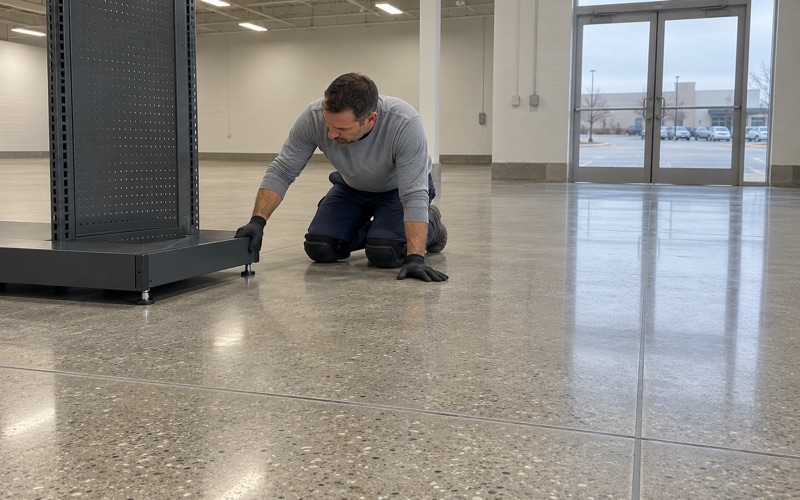
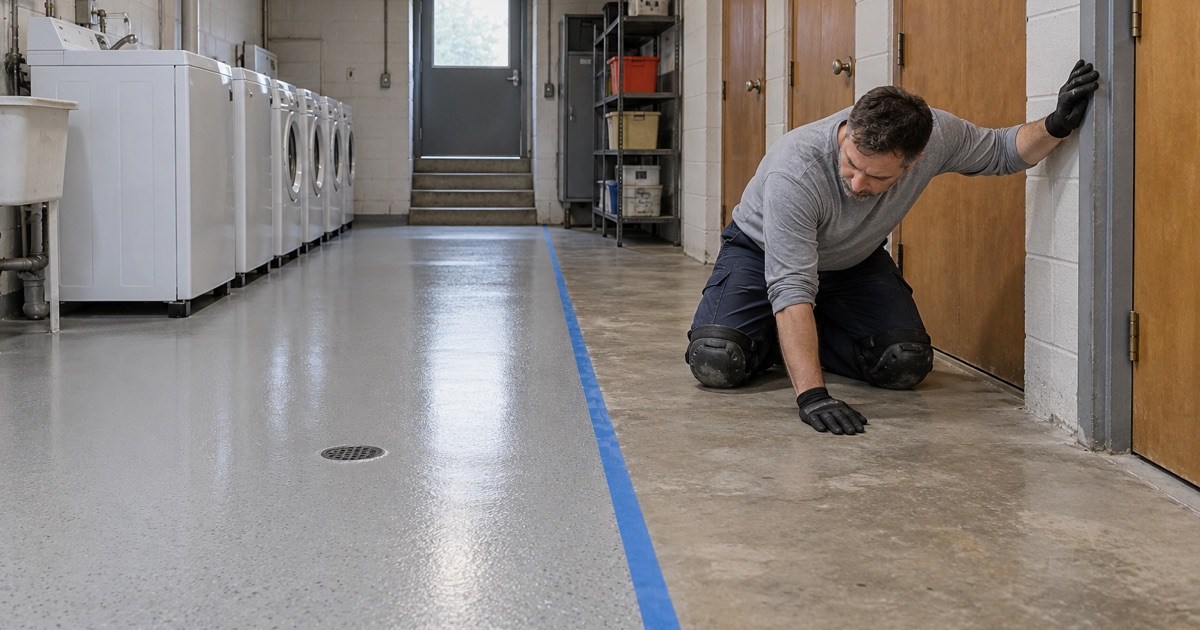
Common-area floors in an occupied building cannot all come out of service at once. We break the scope into sections a building can live without for the length of a cure, and we agree that sequence with the manager before the first grinder is unloaded.
Keeping a Route Open
A corridor is usually done in halves or in runs between doors, so residents always have a way past the work. Storage rooms and service rooms are easier to close, but the manager has to tell us who needs access to them and when, because a locked-out tenant or a maintenance call that cannot reach a shutoff becomes the building’s problem the same day.
Section seams are planned, not accidental. We end each section at a doorway or a straight saw-cut line where the next section can tie in cleanly, rather than stopping wherever the day ran out.
Preparing Older Slabs
Bensenville’s housing stock is mostly older: 73.8 percent of its units predate 1980. An older common-area floor may carry a past coating, paint or adhesive, and every one of those has to come off. We open the slab mechanically with diamond grinding or shot blasting to an ICRI CSP profile that suits the system, and we do not acid etch, which matters indoors where rinse water has nowhere to go.
Grinding indoors means dust control. We run grinders tied to vacuum extraction and keep the work zone screened off from the open corridor, so the section being prepared is the only one that sees the dust.
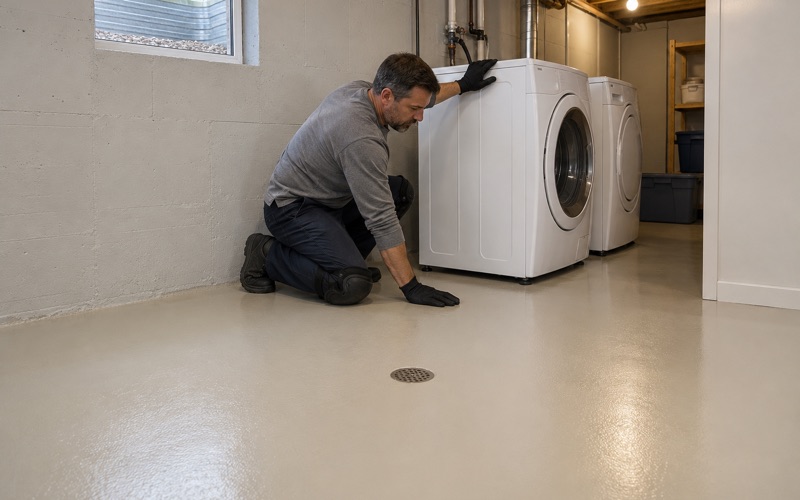
Moisture testing is part of the scope on these floors too. We use ASTM F2170 relative humidity probes or ASTM F1869 calcium chloride tests depending on the slab and the product, and a reading over the system’s limit means a moisture-mitigation primer is priced before the floor goes down, not after it blisters.
Choosing the Finish for a Shared Floor
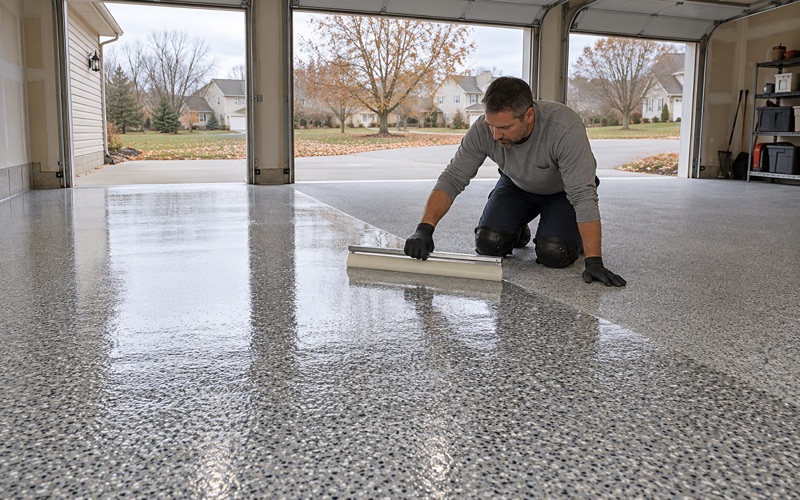
Corridors take foot traffic, carts and the occasional move-in dolly, so we usually build them as a broadcast system rather than a thin roll-on coat. A vinyl flake broadcast hides scuffs and gives the surface some texture underfoot, and a quartz aggregate broadcast goes further where a service room sees wet mopping or heavier carts.
Where a storage room only needs dust control and a cleanable surface, a lithium silicate densifier on a ground slab can be the better spend, and we will say so. Either way the build is written down, so the manager can compare like with like across bids.
Odor, Cure Time and Notice to Tenants
The questions tenants bring to a property manager are usually about smell, noise and when they can walk down the hall again, not about mil thickness. We plan the system choice around those answers as much as around traffic.
Choosing a Low-Odor System
For an occupied building we favor 100% solids epoxy, which carries no solvent to flash off, and we choose every coating within the Illinois limit on VOC content, a limit that binds the installer as well as the manufacturer. Polyaspartic topcoats return a floor to foot traffic faster than a standard epoxy topcoat, which can shorten how long a corridor section stays closed. They also set fast, so they suit sections small enough to finish cleanly in one pass.
Some odor comes with any application, so we ask the manager to tell residents near each section which days it is being coated. Where a section sits near apartment doors, we schedule the coating for the hours that suit the building rather than the hours that suit us.
Cure Time Set by the Slab, Not the Calendar
A coating’s cure depends on the temperature of the slab and the dew point at its surface, and a cool corridor or service room can run slower than a warm one. We measure both before we coat and give the manager a walk-on time and a full-service time for each section, so the notice tenants receive is based on the actual floor.
Coating too close to the dew point invites amine blush, a greasy film that weakens the bond of the next coat. Watching the dew point spread at the slab is how we avoid sending a crew back into an occupied hallway to redo a section.
What the Notice Should Say
We write the schedule out section by section, with closure dates, the route residents should use instead, and the time each area reopens. The manager sends it in whatever form the building already uses, and we keep to it, because a notice the crew ignores costs the manager more goodwill than the floor earns.
454 Rented Houses: The Landlord’s Garage
Not every Bensenville rental is in a large building. The same census tables count 454 detached houses occupied by renters, and when one of those has a garage floor to coat, the person hiring us is the landlord rather than the household parking in it.
Owner-occupied detached houses still far outnumber them, so rented garages are the smaller pool in the village. They differ enough from an owner’s garage that we plan them on their own terms.
Working Between Tenants or Around Them
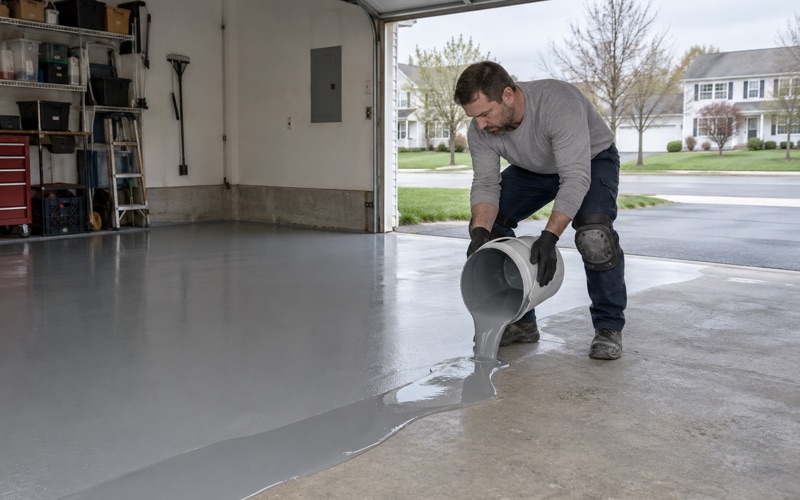
The cleanest window is the gap between leases, when the garage is empty and the cure can run without anyone needing to pull a car in. When the tenants stay, we agree with the landlord on the days the garage is out of use, and the landlord passes that on, since the household loses its parking while the floor cures.
Driving on a floor before it has cured is a common cause of hot tire pickup, where warm tires lift the coating off in patches. We give the landlord a firm vehicle-return time to pass along, worked out from slab temperature, and in an unheated garage we will say plainly when the job has to wait for spring.
Testing Before Coating, Even on a Newer Slab
A garage slab poured to code may have no vapor retarder under it, because IRC R506.2.3 exempts garages from that requirement. We run a moisture test before we coat any garage, older or newer, rather than assume a dry slab, and the result goes into the landlord’s quote along with any crack repair the slab needs first.
A coating is a film that follows the slab beneath it. If a garage floor has a moving crack, we tell the landlord before the job that the coating will not hold that crack still, so nobody expects a new floor to fix a structural problem.
Paperwork for a Rented House
A landlord’s garage is still a residential job to us. It gets a written contract and the Home Repair: Know Your Consumer Rights pamphlet before work starts, the same as any home job we take.
- 20+ Years Coating Floors
- Moisture Tested Before Coating
- Written Contract on Every Home Job