Schaumburg Epoxy Flooring brings more than 20 years of epoxy flooring work to Bellwood, and the first thing we want to know on any job here is not the color or the flake blend. It is how much water vapor is moving up through the concrete when nothing looks wet at all. That single reading decides which primer goes down, which system we build on top of it, and whether the job should start this week or wait.
Most coating failures we are called to look at did not start with a bad product. They started with a slab that was coated without anyone measuring it, and a film that was asked to hold back pressure it was never designed to resist. A coating bonds to concrete and follows it; it does not seal moisture out of a floor.
So our proposals in Bellwood read a little differently from a price sheet. The moisture test is a line item, the product and finished thickness are named in writing, and the warranty exclusions are read aloud before anything is signed, with moisture at the top of that list.
Seven Bellwood Homes in Ten Were Built Before 1960
What the housing count shows
The Census Bureau’s American Community Survey, in its 2024 five-year release, counts 6,340 housing units in Bellwood. Of those, 4,433 were built before 1960, which is 69.9 percent of the village’s homes. Within that older group, 1,089 date to 1939 or earlier, and construction after 1970 makes up less than a fifth of the stock.
In practical terms, a floor job in this village is almost always a job on an old slab. A basement or garage floor here has usually been in place for well over sixty years, often under several owners, sometimes under an earlier paint or sealer nobody remembers applying.
Built before plastic went under the slab
The housing record’s own service note points out that this build era predates the ASTM E1745 standard for under-slab vapor retarders by decades. Modern practice puts a sheet of polyethylene or a similar membrane beneath a new basement floor to slow vapor rising from the soil. The pre-1960 houses counted above went up long before that step became routine.
We want to be precise about what that does and does not mean. Nobody has tested Bellwood’s slabs as a group, and we cannot tell from the street whether a given floor has a retarder under it or not. The build era raises the question; only a test on the slab in front of us answers it.
Why that matters to a coating
A slab without a barrier beneath it can pass moisture vapor upward continuously, even in a room that feels dry and shows no stains. Bare concrete lets that vapor escape into the air. A dense coating such as 100% solids epoxy closes the surface, so the vapor collects at the bond line instead.
When enough pressure builds there, the result is blisters, soft spots, white efflorescence pushing through, or a coating that peels in sheets a year or two later. That is why we treat vapor on these older floors as the first engineering question, ahead of looks.
The oldest floors add a second variable. A slab poured in 1939 or before may carry decades of paint, mastic from old tile, or oil soaked into the surface, and each of those changes how a test reads and how a primer bonds. We note them on the first visit so the test results are read in context.
Looking for epoxy-flooring closer to Cary? See Epoxy-Flooring in Cary.
Testing Moisture on a Dry Day, Not After a Storm
The ordinary day is the honest reading
People often expect us to test right after heavy rain, when a basement feels damp. We would rather test on an ordinary dry day with the room at normal living conditions, because that reading shows the baseline vapor coming through the slab every day of the year. It is that everyday load the coating has to live with.
Before the test we close up the room, run it at the temperature and humidity it normally sees, and note any dehumidifier or heater that is usually running. The goal is a number that describes the floor as it will actually be used.
Three tests, chosen for the job
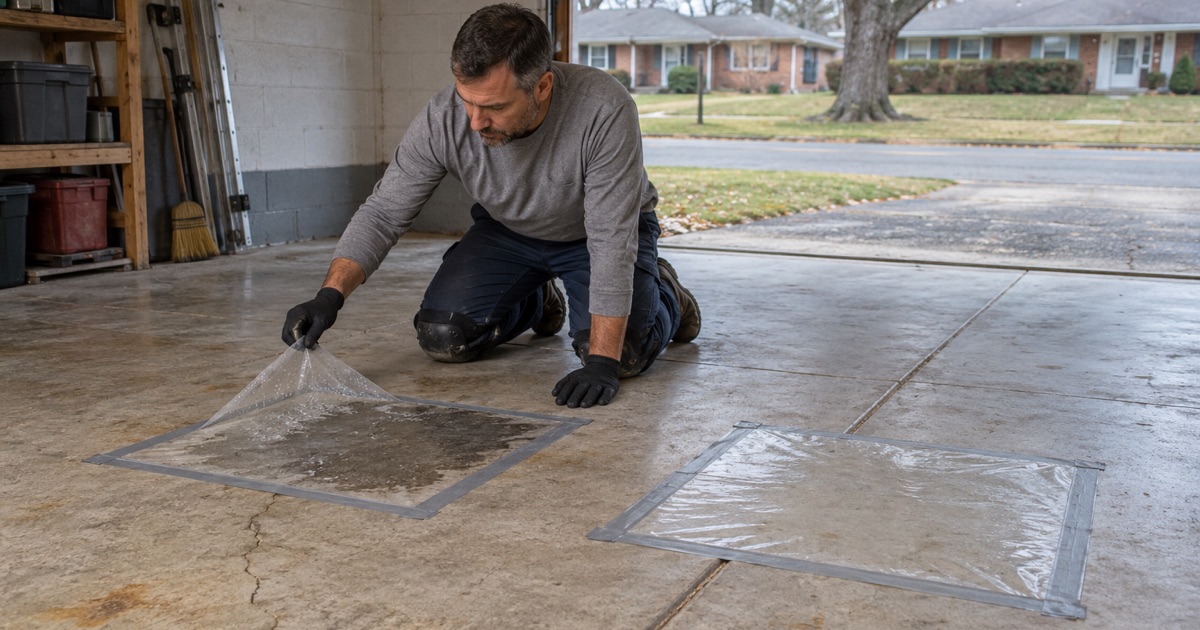
The quickest screen is the ASTM D4263 plastic sheet test: a square of clear plastic taped to the slab and checked for condensation or darkening. It is a useful first look but it is a pass or fail screen, and a pass does not prove a slab is dry enough to coat.
For a measured answer we use ASTM F1869, the calcium chloride moisture vapor emission rate test, which reports how many pounds of water leave a set area of slab over a day. Where the job calls for it, we add ASTM F2170 in-situ relative humidity probes, drilled into the slab to read conditions at depth rather than at the surface. We compare results against the thresholds the chosen product’s manufacturer publishes and the ASTM F710 moisture framework.
Placement matters as much as the method. We spread test sites across the floor rather than clustering them in one convenient corner, and we include the spots that tell the most: along the foundation walls, near a floor drain or sump pit, and anywhere the old surface is darker or chalky. A single reading from the middle of a dry room can miss the area that will fail first.
Priced into the scope from the start
On a Bellwood basement or garage, the moisture test is part of the quote rather than an extra sold after a floor has already blistered. We test garage slabs too. The residential model code exempts garages from the under-slab vapor retarder requirement, so a garage floor can be the wettest slab on the property even when the house above it is far newer.
Primers and Systems for a Slab That Breathes
Opening the surface mechanically
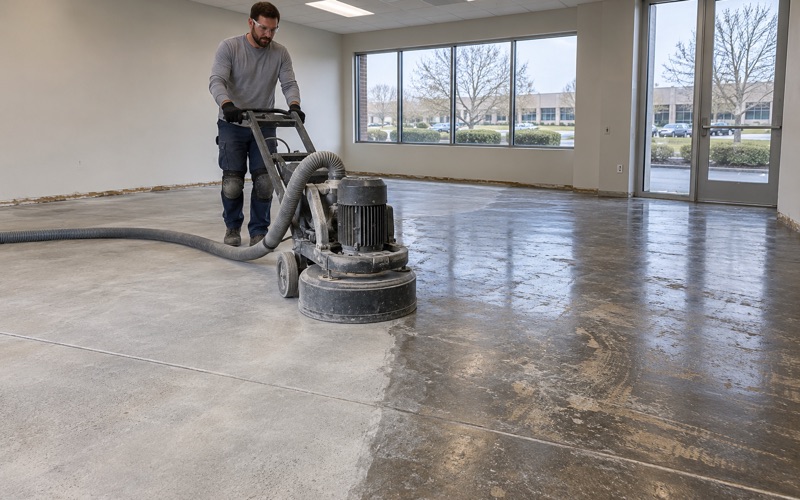
Every system starts with diamond grinding or shot blasting, never acid etching. Mechanical prep removes old sealer, paint and the weak top layer of the slab and leaves a measured profile, usually in the ICRI CSP 2 to 3 range for a thin coating and rougher for a heavier build. On an older floor, grinding also shows us what the concrete looks like a few millimeters down.
We read the cracks and any old coating before quoting. If a slab needs crack repair, patching or leveling before it can be coated, we say so plainly in the proposal rather than covering it over.
When the numbers are moderate or high
If the test comes back within the coating maker’s limits, a standard primer under a 100% solids epoxy body coat with a vinyl flake or quartz aggregate broadcast is often the right build. A polyaspartic or polyurea topcoat adds abrasion and stain resistance and resists hot tire pickup in a garage. In a garage we also build for the calcium chloride brine and rock salt that ride in on tires through the winter, with a topcoat chosen to shrug off those chemicals.
If emissions run higher, we specify a moisture-mitigation primer rated for the measured reading, installed at the thickness the manufacturer requires, before the decorative layers go on. On slabs that read higher still, urethane cement is a heavier, more vapor-tolerant option for a basement that needs a hard, cleanable surface.
Sometimes the answer is not a film at all
For some old floors the most sensible finish is a lithium silicate densifier and a ground or polished surface, which hardens the concrete while still letting vapor pass. It will not give the color and gloss of a flake floor, but it will not blister either. Whatever we recommend, the proposal names the product, the system build and the finished thickness so you can check what was quoted against what went down.
When the Test Says Wait
Dry the room, then retest
A high reading is not a dead end. Often the right step is to find the source and lower it: run a dehumidifier, correct a gutter or downspout that empties against the foundation, or fix a plumbing leak, then let the slab settle for a few weeks. We then test again before deciding on a system.
We schedule the cure itself around slab temperature and the dew point spread at the slab surface rather than the calendar. Coating a cold slab with a narrow dew point spread invites amine blush and a weak bond, so we will move the date rather than force it.
What a coating can and cannot promise
A coating is a film that follows the slab beneath it. It will not stop a crack from moving, and it will not stop moisture or water from entering a basement. Our warranty exclusions say exactly that, and we read them to you before the job is sold, beginning with moisture.
We also do not sell a floor coating as radon reduction. In Illinois that work requires a radon mitigation license issued through IEMA, and it is a separate trade from ours.
Paperwork for a Bellwood job
Illinois issues no state license for flooring or coating contractors, so we confirm whatever contractor registration, bond and insurance rules the Village of Bellwood sets before a job goes on the calendar. We also ask the Building Department whether a given floor coating needs a permit, rather than guessing. The village reports the 2006 International Building Code as its adopted code, which is worth knowing when a specification is borrowed from a town on a newer edition.
With 78.4 percent of Bellwood’s occupied homes owner-occupied, the person approving a floor is usually the person who will live on it. Every home job gets a written contract and the Home Repair: Know Your Consumer Rights pamphlet before work starts, as the Illinois Home Repair and Remodeling Act requires, and every coating we install sits within the Illinois limits on VOC content.
- 20+ Years Coating Floors
- Moisture Tested Before Coating
- Written Contract on Every Home Job