Schaumburg Epoxy Flooring has spent more than 20 years on epoxy flooring in Barrington and across the northwest suburbs, and a good share of that work starts with a phone call from someone who does not live in the building. A property manager, an owner’s representative or a maintenance lead needs a floor redone in a room that tenants walk past every day, and the questions they ask are different from a homeowner’s: when the room can be closed, how long before people can walk on it, and what it will smell like in the hallway.
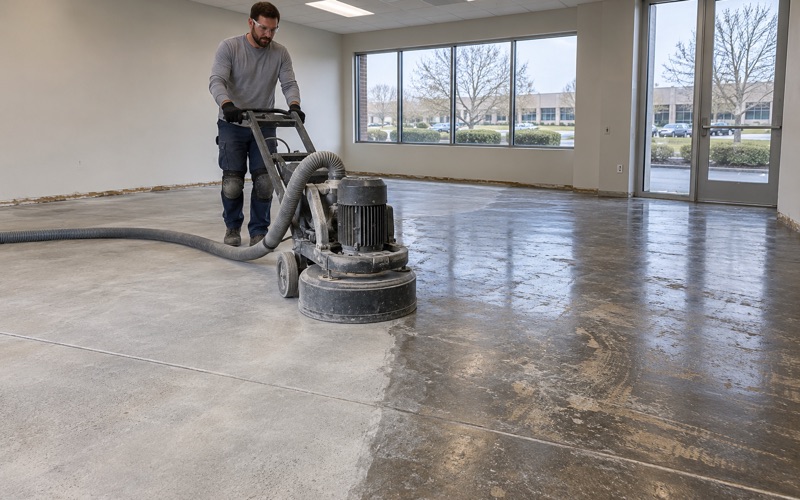
We answer those questions in writing before anyone signs. Every proposal names the product, the system build and the finished thickness, so the person approving the invoice can check what was quoted against what went down. Moisture testing is a line item, not an upsell after the fact, and the slab is opened with a diamond grinder or a shot blaster rather than an acid etch.
That approach matters most in the buildings where the decision maker and the people living on the other side of the wall are two different parties. This page is about those buildings, the floors inside them and the way a coating job gets scheduled there.
Barrington’s Larger Rental Buildings and Who Books the Work
Barrington is mostly a village of owner-occupied houses, but it is not only that. Census figures for the village count 3,368 owner-occupied homes and 929 renter households out of 4,297 occupied units, so a little more than one household in five rents. The rentals that matter for floor work are concentrated in a handful of larger structures rather than spread evenly through the streets.
404 units in buildings of 50 or more
The same Census tables count 404 housing units in structures of 50 or more units, and only 17 of those are owner-occupied. In practical terms, the units in Barrington’s biggest buildings are overwhelmingly rentals. Nobody living there is going to call us about the corridor, the storage room or the trash room, because none of those spaces belong to them.
The 20-to-49-unit middle
Another 217 units sit in buildings of 20 to 49 units, and smaller multifamily stock adds 166 units in 5-to-9-unit buildings and 119 in 10-to-19-unit buildings. These mid-sized properties are often run by a smaller management firm or by an owner who handles maintenance directly. The scale is different, but the pattern holds: the floor is a building decision, made by whoever manages the property.
What that changes about a quote
When the client is a manager, the quote has to survive a second reader. An owner, a board or an asset manager may approve the spend, so we write the scope so it stands on its own: substrate condition, preparation method, the coating system by name, the finished thickness, the cure time before foot traffic and the warranty exclusions, with moisture listed first. Nothing in that document should require a phone call to interpret.
The owner-occupied 78.4 percent
The rest of the village looks very different. There are 2,863 owner-occupied detached houses and 271 owner-occupied attached homes, and only 103 detached houses are rented. Those owners call us directly about a garage or a basement, and that work is scoped one household at a time. The rental buildings are where a single decision covers dozens of homes at once, and where the quote answers to someone other than the people who will walk on the floor.
Looking for epoxy-flooring closer to Prospect Heights? See Epoxy-Flooring in Prospect Heights.
Common-Area, Storage and Service Floors With Tenants in Residence
The floors we see in rental buildings are rarely showpieces. They are the rooms that take carts, bins, dollies and wet boots, and they are usually bare concrete or an old coating that has started to lift. Each one has its own demands.
Storage and service rooms
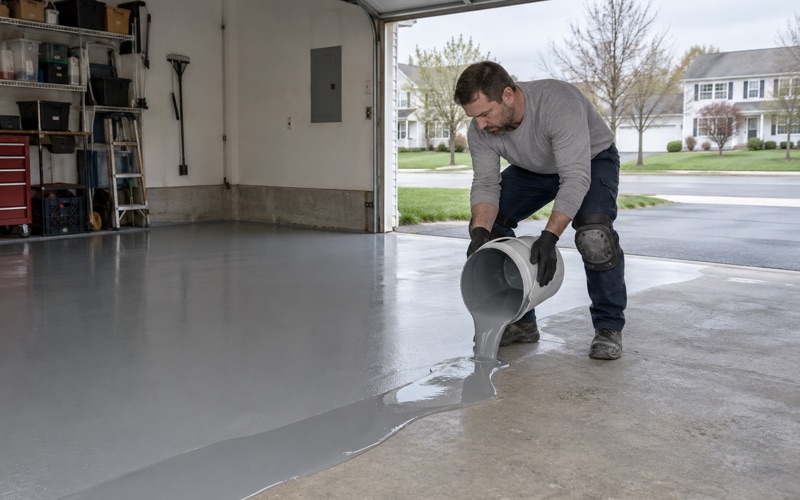
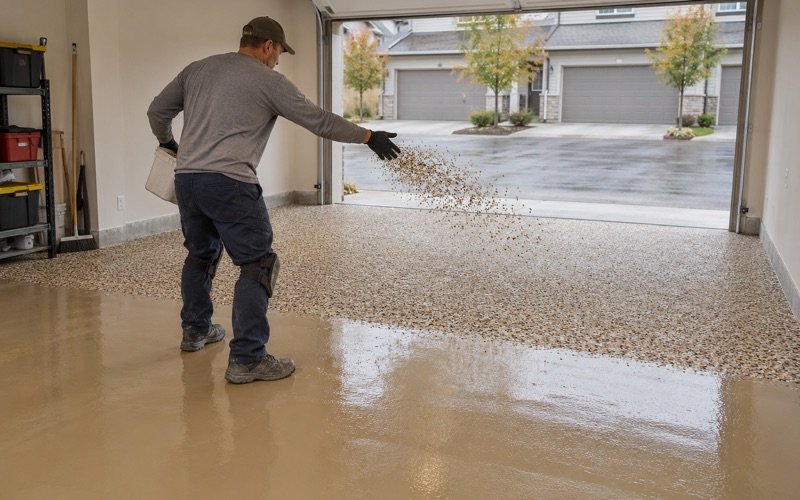
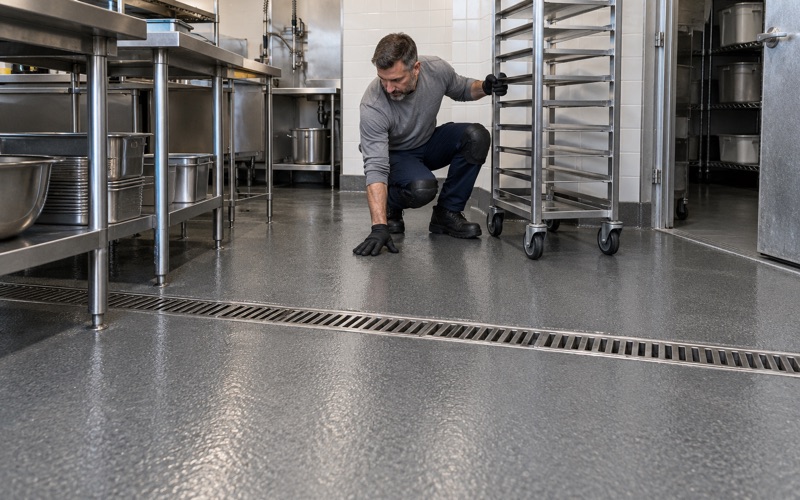
A storage locker room or a building maintenance shop needs a floor that sweeps clean and shrugs off dragged furniture and dropped tools. A 100% solids epoxy base with a quartz aggregate broadcast gives texture underfoot and a surface that wears slowly. Where a room carries trash bins or recycling, we look at the floor drain, if there is one, and detail the coating so water sheds toward it rather than pooling at the edge.
Corridors and entry floors that never get a day off
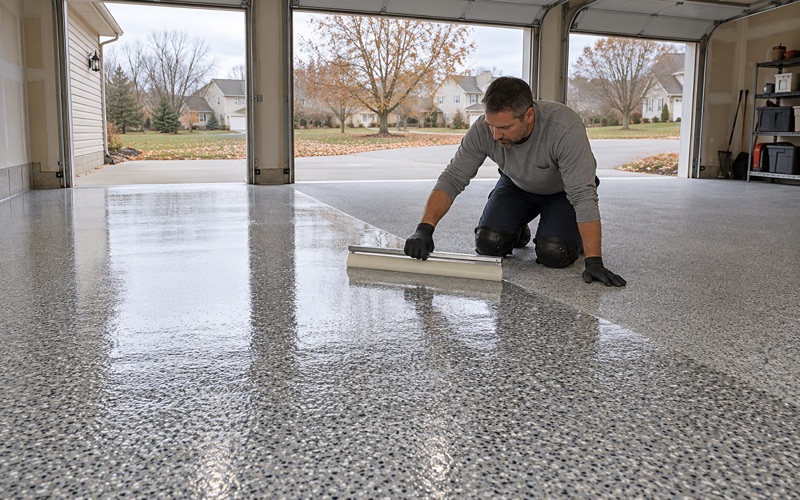
Where a building’s corridors or entry areas are bare or coated concrete rather than tile or carpet, the traffic is constant. A vinyl flake broadcast under a polyaspartic or polyurea topcoat hides scuffs and grit between cleanings, and the flake load can be set for more or less texture depending on how often the floor sees wet shoes. We also look closely at thresholds and door stops, where a badly feathered edge chips first, and name each of those details in the scope so the manager knows what was done at every edge.
Reading the slab before anything is promised
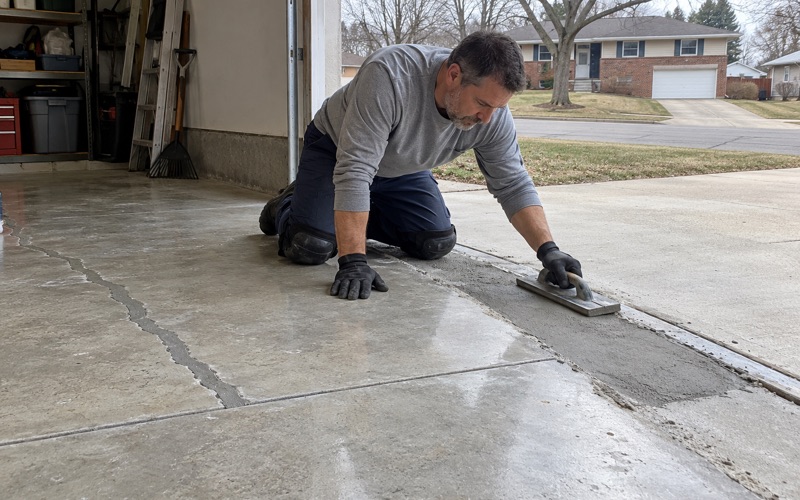
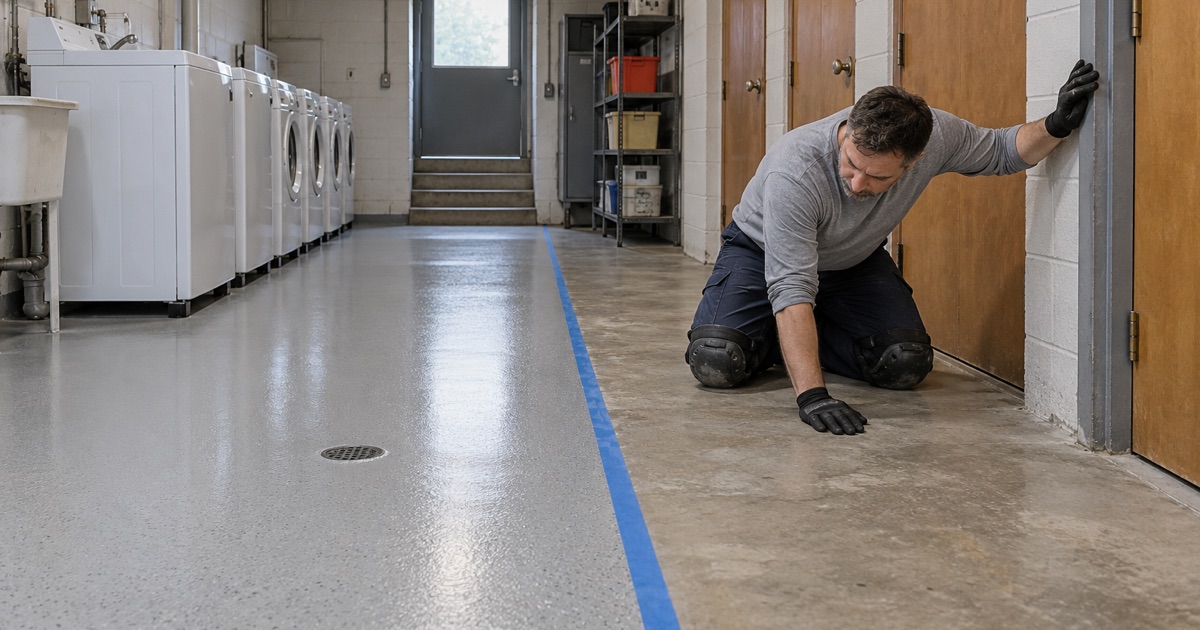
An older service room slab often has cracks, patches and two or three generations of paint. We read the cracks and the old coating before quoting and say plainly if the slab needs repair first. A coating is a film that follows the concrete under it; it will not stop a slab from moving, and we tell a manager that before the job, not after a crack telegraphs through. Grinding to an ICRI CSP profile removes the failed material and gives the new system something to bond to.
Moisture comes first
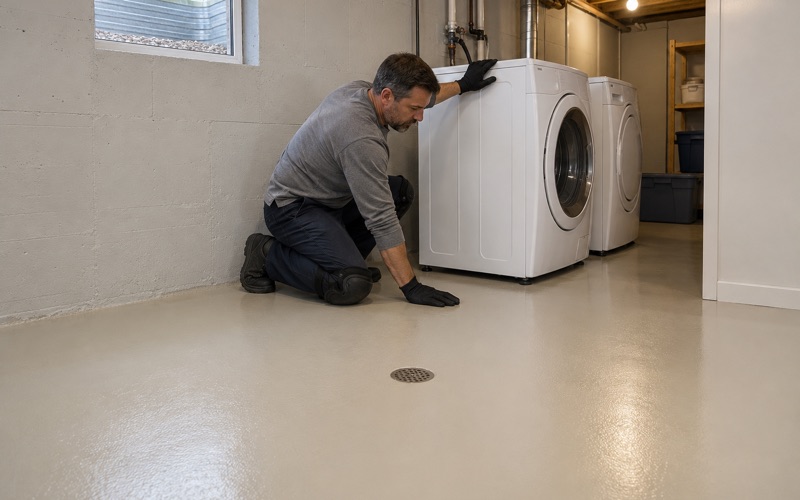
A basement or ground-level service room can carry more moisture than its dry-looking surface suggests. We test with ASTM F2170 in-situ relative humidity probes or ASTM F1869 calcium chloride kits, depending on the slab, and compare the readings to the coating manufacturer’s limits. If the numbers are high, the scope calls for a moisture-mitigation primer, and the price reflects it from the start instead of showing up as a blistered floor six months later.
Scheduling Around Move-Ins, Deliveries and Quiet Hours
Coating a floor in an occupied building is mostly a scheduling problem. The chemistry is well understood; the hard part is closing a room that people use without disrupting their lives more than the job requires.
Working the building’s calendar
We ask the manager for the move-in and move-out schedule, the delivery days and any posted quiet hours before we set a start date. A storage room may need to be emptied and the residents notified, a service corridor may be the only route to a loading door, and a trash room cannot simply close for three days. Where a building has to stay in use, we can split a room into sections or work overnight and in between-lease windows so the space is out of service for as short a time as possible.
Odor, ventilation and coating choice
Residents notice smell before they notice anything else. Every coating we use falls within the Illinois limits on VOC content for architectural coatings, and those limits bind the installer as well as the manufacturer. In a building with shared air, a low-odor 100% solids epoxy or a polyaspartic topcoat is often the better call, and we plan airflow with the maintenance staff before work starts.
Cure time against conditions, not the clock
A polyaspartic topcoat can return a room to light foot traffic far sooner than a conventional epoxy, which is why it suits buildings that cannot stay closed. Even so, we schedule cure against slab temperature and the dew point spread at the slab surface rather than a fixed number of hours. A cold, damp basement room can stretch a cure, and we would rather move a reopening by a day than leave tenants walking on a soft film or an amine blush.
Notice, signage and the final walk-through
Tenants accept a closed room far more easily when they hear about it ahead of time. We give the manager the dates, the hours the space will be closed and the time it reopens to foot traffic, in plain language that can go straight into a notice. On site, the work area is roped off and signed. When the cure is complete, we walk the floor with the manager or maintenance lead, check the edges and drains, and leave written care instructions for the cleaning staff, including which cleaners the coating tolerates.
Village Rules Before the Crew Arrives
Barrington is a home-rule village, chartered by the Illinois legislature on February 16, 1865, and it runs under a council-manager government with a village president and six trustees. It also spans both Cook and Lake counties and parts of four townships, Barrington, Palatine, Cuba and Ela, which is one more reason not to assume how a given address is handled.
Asking Barrington Development Services first
Village of Barrington Development Services is the building authority for the village. Whether coating a common-area or service floor in a multifamily building needs a permit is not something we assume either way. We ask the village permit desk before the job is scheduled whether the work counts as decorating or needs a permit, and we pass the answer to the manager in writing so it sits in the building’s file.
Contractor registration, bond and insurance
Illinois issues no state license for flooring or coating work, so the rules that apply are the village’s own. Before a Barrington job goes on the calendar, we confirm the village’s contractor registration, bond and insurance requirements and supply the certificates a management company usually asks for. If the work is in an individual condominium unit or a home rather than a rental common area, the job also gets a written contract and the state’s Home Repair: Know Your Consumer Rights pamphlet, as the Illinois Home Repair and Remodeling Act requires.
What we will not sell
A floor coating is not radon reduction, and we do not present it as one; in Illinois that work takes an IEMA radon mitigation license. We also do not promise that a coating will hold back water coming up through a slab. What we do promise is a floor built to the scope on paper, on a slab that was tested and prepared before the first coat went down, in a building whose schedule was respected from the first call to the final walk-through.
- 20+ Years Coating Floors
- Moisture Tested Before Coating
- Written Contract on Every Home Job